
Self Introduction in English: How to Introduce Yourself Naturally With Examples and Practice
To introduce yourself in English, say hello, give your name, add one or two details relevant to the listener, and invite a reply. You can begin with: “Hi, I’m Ayesha. I’m from Lahore. Nice to meet you.” This lesson gives short, 10-line, one-minute and two-minute examples; a reusable template; formal and casual phrases with Urdu meanings; and introductions for work, presentations and different English levels. You’ll learn to continue conversations, correct common Urdu-to-English mistakes, speak clearly, handle nervousness or unexpected questions, practise without memorising, and check your progress. Student and job-interview introductions have separate lessons.
Self Introduction in English Examples You Can Use Right Away
You do not need advanced vocabulary to introduce yourself. Start with a clear greeting, your name, and information that matters in the situation.
The following examples show different self introduction lengths and contexts. Replace the sample details with your own information, understand what each sentence means, and practise saying it aloud.
A Short and Easy Self Introduction in 5 Sentences
Use this example when someone asks you to introduce yourself briefly.
- Hello, my name is Ayesha.
- I’m from Lahore, Pakistan.
- I currently live in Islamabad.
- I enjoy reading and learning English.
- It’s nice to meet you.
This self introduction tells the listener who you are without giving unnecessary information.
You can replace the fourth sentence according to your situation:
“I’m here for the English conversation group.”
For an ordinary first meeting, even two or three sentences may be sufficient.
Try it: Say the five sentences using your own name, hometown and interests. Then give a shorter self introduction using only the information your listener needs.
Self Introduction in English in 10 Lines
A ten-line self introduction is useful for a prepared group-speaking activity.
- Good morning, everyone.
- My name is Ahmed.
- I’m from Karachi, Pakistan.
- I currently live in Hyderabad.
- I work in a clothing shop.
- I enjoy meeting new people.
- In my free time, I like playing cricket.
- I’m learning English to communicate more comfortably.
- I’m happy to be here with you today.
- Thank you for listening.
Notice that the self introduction moves from identity to background, personal interests and a polite closing.
You would not normally recite all ten lines when meeting someone casually.
Practise the self introduction once with the text. Then cover it and speak from these prompts: name, city, activity, interests and purpose.
A Self Introduction Paragraph in Simple English
Sometimes, you may need to write about yourself before speaking.
Example paragraph:
“Hello, my name is Sara. I’m from Multan, and I currently live in Lahore. I work in a small business and enjoy learning new skills. In my free time, I like cooking and spending time with my family. I’m learning English because I want to communicate more easily with different people. It’s a pleasure to meet you.”
This paragraph is suitable as a simple written self introduction or a speaking model.
When writing, check your spelling, punctuation and capital letters. Names of people and places, such as Sara and Lahore, begin with capital letters.
When speaking, use natural pauses rather than reading every sentence in the same tone.
Writing a self introduction and speaking it independently are different tasks. Practise both if you need both skills.
One-Minute and Two-Minute Self Introduction Examples
A longer self introduction may be appropriate when a group leader gives you time to speak or when you are completing a presentation exercise.
These examples are approximate timed models. Your actual duration depends on your speaking pace and pauses.
One-minute self introduction — approximately 112 words
“Good morning, everyone. My name is Hina, and I’m from Rawalpindi. I live in Islamabad now and work in a small local business, where I help customers and organise daily tasks. I enjoy the work because I meet different people and learn from their experiences.
Outside work, I like reading, cooking and walking with my family.
I joined this conversation group because I want to speak English more clearly, especially when I meet someone new. I sometimes need a moment to find the right words, so I’m practising short conversations and follow-up questions.
I’m happy to be here, and I’m looking forward to hearing about your interests. Thank you for welcoming me.”
This script takes approximately one minute at a measured pace of around 110–115 words per minute.
Two-minute self introduction — approximately 243 words
“Good afternoon, everyone. My name is Hina, and I’m from Rawalpindi. I grew up there with my family and moved to Islamabad a few years ago. Although I miss some things about my hometown, I enjoy living here because I have opportunities to meet people from different places.
At the moment, I work in a small local business. My main responsibilities include helping customers, answering questions, and organising everyday tasks. I especially enjoy the moments when I can solve a problem for someone. This experience has also taught me to listen carefully and to explain my ideas in a way other people can understand.
When I’m not working, I like reading, cooking, and spending time with my family. On weekends, we sometimes try a new recipe or visit a park. One thing I’m interested in learning is photography, because I enjoy noticing small details in the places around me.
I joined this conversation group to practise using English in ordinary situations. I can follow familiar conversations, but when someone asks me an unexpected question, I sometimes need extra time to reply. I want to become more comfortable asking questions, sharing opinions, and explaining what I mean without reading from notes.
I’m pleased to be here, and I’m interested in learning about the different people in this group. If we have something in common, I’d love to talk about it after the session. Thank you for listening, and I look forward to meeting you.”
At around 120 words per minute, the longer script takes approximately two minutes.
How to use these examples
Read the script aloud with a timer. If you take longer than expected, do not immediately start rushing. First check whether you have included details that the audience does not need.
If the self introduction is too short, add a relevant explanation or personal example.
A good self introduction should fit both the available time and the listener’s interests.
A Complete Informal Self Introduction for Meeting Someone New
Informal self introductions are useful when meeting someone at a community event, in a neighbourhood or at a social gathering.
Example:
“Hey, I’m Hamza. I live nearby, and I’ve just joined this group. I enjoy playing football and meeting new people. What about you?”
The last question makes it easy for the other person to respond.
A shorter version is:
“Hi, I’m Hamza. Nice to meet you.”
At a relaxed gathering, you may also hear greetings such as “What’s up?” or “How’s it going?”
There is no single Gen Z way to introduce yourself. Slang varies by community, relationship and situation. Using expressions you understand is better than forcing unfamiliar slang into your speech.
When approaching a group that is already talking, wait for an appropriate moment.
You could say:
“Hi, I’m Hamza. Mind if I join you?”
If people appear busy or are having a private conversation, respect that and choose another opportunity.
A Complete Formal Self Introduction for a Workplace Meeting
A formal self introduction should communicate your identity and role clearly.
Example:
“Good morning, everyone. My name is Sana, and I’ve recently joined the customer support team. My previous experience includes assisting customers and handling enquiries. I’m looking forward to working with you and learning more about the team. Thank you.”
This self introduction is professional without being unnecessarily complicated.
A less formal version might be:
“Hi, I’m Sana. I’ve just joined customer support. It’s great to meet everyone.”
Both are appropriate in different workplaces.
When a meeting leader asks each person to introduce themselves, keep your self introduction relevant to the meeting.
For example:
“Hello, I’m Sana from customer support. I’ll be helping the operations team with customer enquiries. I’m glad to meet everyone.”
You do not need to explain your complete employment history unless the situation calls for it.
A Full Self Introduction Example With English and Urdu Meanings
Here is a complete beginner-friendly self introduction with natural Urdu meanings.
| English Sentence | Urdu Meaning |
|---|---|
| Hello, my name is Ayesha. | ہیلو، میرا نام عائشہ ہے۔ |
| I’m from Lahore. | میرا تعلق لاہور سے ہے۔ |
| I currently live in Islamabad. | میں اس وقت اسلام آباد میں رہتی ہوں۔ |
| I’m learning English. | میں انگریزی سیکھ رہی ہوں۔ |
| I enjoy reading books. | مجھے کتابیں پڑھنا پسند ہے۔ |
| I’m happy to meet you. | آپ سے مل کر مجھے خوشی ہوئی۔ |
The Urdu meanings are natural equivalents, not compulsory word-for-word translations.
For example:
“I’m from Lahore” describes your place of origin.
“I live in Islamabad” describes your current residence.
Practice: Read the English sentences aloud. Then cover the English column and try speaking from the Urdu meanings. Finally, introduce yourself using your actual information without looking at the table.
A Complete Two-Person Self-Introduction Dialogue From Greeting to Goodbye
A self introduction often becomes a conversation. Both people need an opportunity to speak.
Situation: Two people meet at an English conversation group.
Ali: Hi, I’m Ali. What’s your name?
Sara: Hello, I’m Sara. Nice to meet you.
Ali: Nice to meet you too. Is this your first time here?
Sara: Yes, it is. I joined because I want to practise speaking English. What about you?
Ali: I’ve been coming here for a few weeks. Where are you from?
Sara: I’m from Multan, but I live in Islamabad now. How about you?
Ali: I’m from Rawalpindi. What do you like doing in your free time?
Sara: I enjoy reading and watching movies. Do you have any hobbies?
Ali: Yes, I like cricket and photography.
Sara: That’s interesting. What do you like taking pictures of?
Ali: Mostly nature and places around the city.
Sara: That sounds lovely. I’d like to learn photography someday.
Ali: You should try it. It’s a lot of fun.
Sara: It was nice talking to you, Ali.
Ali: Nice talking to you too. See you next time!
Sara: See you!
The dialogue follows a natural sequence: greeting, names, shared context, background, common interests, follow-up questions and goodbye.
Notice how Sara asks about photography after Ali mentions it. Her question comes from listening, not from following a fixed list.
You can also introduce someone else during a conversation.
For example:
“Ali, this is my friend Hamza. Hamza, this is Ali.”
The two people can respond with:
“Nice to meet you.”
This is different from introducing yourself, but it is useful when meeting people in groups.
Practise the full conversation with a partner. Then change one detail and ask a different follow-up question.
How to Introduce Yourself in English Step by Step
A simple five-step structure can help you prepare a self introduction without memorising a long speech.
Use the steps that fit the occasion. Not every self introduction needs all five.
Step 1: Choose a Suitable Greeting and Say Your Name
Begin with an appropriate greeting.
Informal: “Hi, I’m Zain.”
Formal: “Good morning. My name is Zain.”
If you prefer a shorter version of your name:
“My name is Muhammad Zain, but you can call me Zain.”
When speaking to a group, begin after the meeting leader invites you or when you have a natural opportunity.
You do not need an elaborate opening before giving your name.
Step 2: Share Where You Are From or What You Do
Choose information that helps the listener understand your situation.
- “I’m from Peshawar.”
- “I work as a shop assistant.”
- “I’m currently learning English.”
At a social gathering, your hometown may be a useful conversation starter.
At work, your role may matter more.
Select one or two details rather than giving every possible fact about your life.
Step 3: Add Relevant Background Information or Personal Interests
Include a relevant detail if you have time.
For example:
- “I moved here last year.”
- “I enjoy playing badminton.”
- “I’m interested in photography.”
Personal interests may help you discover something in common with another person.
However, do not add information merely to make the self introduction sound impressive.
Step 4: Explain Why You Are There When Appropriate
The reason you are attending may be more useful than your personal history.
- “I’m here for the English conversation session.”
- “I’ve recently joined this team.”
- “I’m attending the workshop because I want to learn photography.”
In a professional setting, you may explain your current responsibility or contribution.
For example:
“I’m joining today’s meeting to discuss the customer support process.”
If the purpose is already obvious, you can leave this step out.
Step 5: Finish Politely and Invite the Other Person to Respond
In a one-to-one conversation, a suitable question can help the interaction continue.
- “Nice to meet you. What about you?”
- “What brings you here?”
- “Is this your first time at this event?”
When speaking to a group, a short closing may be more appropriate:
“I’m glad to be here. Thank you.”
If other people are waiting to introduce themselves, allow the next person to speak.
What Is a Self Introduction and What Should You Include?
A self introduction is a brief explanation of who you are. It helps someone understand your identity and your connection to a situation.
Your self introduction might include your name, hometown, work, studies, interests or reason for being there.
You do not need to share everything about yourself.
Understand the Purpose of a Self Introduction
The purpose is to begin communication and help people understand who you are.
A social self introduction may focus on where you are from or why you are attending an event.
A workplace self introduction may focus on your current role.
A good first impression comes from clear, relevant and considerate communication—not simply from using impressive vocabulary.
There is no single best self introduction for every situation.
Choose Essential Information and Optional Personal Details
Your name is usually the most useful first detail.
Depending on the context, you may add your current activity, location or reason for being present.
For example:
“Hi, I’m Noor. I’ve just moved into the neighbourhood.”
This is a complete self introduction.
If the other person asks a question, Noor can share more information.
Your self introduction should give the listener enough information to respond.
Decide When to Mention Your Hometown, Family, Hobbies or Goals
Your hometown can create a connection with someone from the same region.
Your hobbies can help people discover shared interests.
Your goals may be relevant in an English-learning group.
Family information is optional and can be more personal.
You do not need to mention your age, marital status or family circumstances in an ordinary self introduction.
Before adding information, ask whether it is relevant and whether you feel comfortable sharing it.
Adjust the Length and Details for the Person Listening
The length of your self introduction should match the situation.
Short social self introduction:
“Hi, I’m Hassan. I live nearby. Nice to meet you.”
Group self introduction:
“Good morning, everyone. I’m Hassan, and I’ve recently joined the photography club. I enjoy taking pictures of nature, and I’m looking forward to learning from the group.”
In a professional meeting, you may add your role or responsibility.
Start with essential information, then explain more if the listener asks questions or shows interest.
Do not treat a fixed duration as compulsory for every self introduction.
Know Which Personal Information You Do Not Need to Share
A self introduction does not require sensitive personal information.
Avoid sharing your full home address, identity numbers, financial information, private family circumstances or contact details with people you have only just met.
For example:
“I live in Lahore.”
is usually sufficient when discussing your current city.
This is particularly important in public and online self introductions.
You decide which optional personal details you are comfortable sharing.
Useful English Sentences and Phrases for Self Introduction
You can create many natural self introductions from a small number of familiar sentence patterns.
Learn what each phrase means and when to use it.
Formal, Neutral and Informal Greetings
| Situation | Useful Greeting |
|---|---|
| Neutral | Hello. |
| Friendly | Hi! |
| Informal | Hey! |
| Formal morning greeting | Good morning. |
| Formal afternoon greeting | Good afternoon. |
| Formal evening greeting | Good evening. |
“Hello” works in many situations.
“Hey” is generally more casual.
“What’s up?” can be natural among friends, but it may not suit a formal first meeting.
“Good night” is normally used when leaving or going to bed, not when beginning a self introduction.
In some formal settings, people use titles such as “Mr.”, “Ms.” or “Dr.” followed by a surname.
For example:
“Good morning, Dr. Ahmed.”
Use a person’s preferred title when you know it. If you are unsure, a neutral greeting is often sufficient.
Saying Your Name and What You Prefer to Be Called
Useful expressions include:
- “My name is Amina.”
- “I’m Amina.”
- “You can call me Mina.”
- “My name is Amina, but I usually go by Mina.”
To ask another person’s name:
- “What’s your name?”
- “May I ask your name?”
If someone does not hear your name clearly, repeat it.
For example:
“I’m Nadia. That’s N-A-D-I-A.”
You can also ask:
“Could you spell your name for me, please?”
Spelling is particularly useful during phone calls or when someone is recording your name.
Talking About Where You Are From and Where You Live
These expressions communicate different details.
- Origin: “I’m from Sialkot.”
- Current residence: “I live in Islamabad.”
- Birthplace: “I was born in Multan.”
- Childhood location: “I grew up in Faisalabad.”
- Previous residence: “I used to live in Lahore.”
You can combine them:
“I’m originally from Karachi, but I live in Lahore now.”
Use only the information that is relevant to the conversation.
Describing Your Work, Studies or Everyday Activities
These patterns help you explain what you currently do.
- “I work as a teacher.”
- “I work in sales.”
- “I work for a local company.”
- “I’m studying computer science.”
- “I’m currently looking for work.”
- “I’m retired.”
The expressions have different meanings:
- Work as describes your position.
- Work in describes your field or department.
- Work for identifies an employer.
For example:
“I’m an English teacher at a local learning centre.”
When meeting a new group, a teacher might say:
“Hello, I’m Ms Ali. I’ll be teaching English this term, and I’m looking forward to getting to know everyone.”
Detailed teaching-job interview answers belong in the separate interview lesson.
Talking About Your Hobbies and Interests
Useful expressions include:
- “I like reading.”
- “I enjoy cooking.”
- “I love playing cricket.”
- “I’m interested in photography.”
- “In my free time, I like gardening.”
Remember that “interested” is followed by “in.”
Correct:
“I’m interested in learning English.”
Incorrect:
“I’m interested on learning English.”
A natural follow-up question is:
“What do you like doing in your free time?”
An interest is not just something to list. It can help you find common ground with another person.
Saying Nice to Meet You and Responding Naturally
When meeting someone, you can say:
- “Nice to meet you.”
- “It’s nice to meet you.”
- “Pleased to meet you.”
- “It’s a pleasure to meet you.”
If someone says “Nice to meet you,” you can reply:
- “Nice to meet you too.”
- “You too.”
- “Likewise.”
For beginners, “Nice to meet you too” is a clear and reliable response.
Useful Self Introduction Phrases With Simple Urdu Meanings
| English Phrase | Urdu Meaning |
|---|---|
| Let me introduce myself. | مجھے اپنا تعارف کروانے دیجیے۔ |
| My name is Ahmed. | میرا نام احمد ہے۔ |
| I’m from Pakistan. | میرا تعلق پاکستان سے ہے۔ |
| I live in Lahore. | میں لاہور میں رہتا/رہتی ہوں۔ |
| I work as a teacher. | میں استاد کے طور پر کام کرتا/کرتی ہوں۔ |
| I’m learning English. | میں انگریزی سیکھ رہا/رہی ہوں۔ |
| I enjoy reading. | مجھے پڑھنا پسند ہے۔ |
| Nice to meet you. | آپ سے مل کر خوشی ہوئی۔ |
| What about you? | اور آپ؟ |
| What brings you here? | آپ یہاں کس مقصد سے آئے ہیں؟ |
| Could you repeat that, please? | کیا آپ براہِ کرم دوبارہ کہہ سکتے ہیں؟ |
The Urdu sentences provide natural meanings rather than literal translations.
For speaking practice, learn the complete English phrase and use it in a realistic situation.
How to Adapt Your Self Introduction to Different Situations and English Levels
A beginner and an intermediate speaker may introduce themselves using similar personal information.
The difference lies in how much detail they can communicate and how independently they can respond.
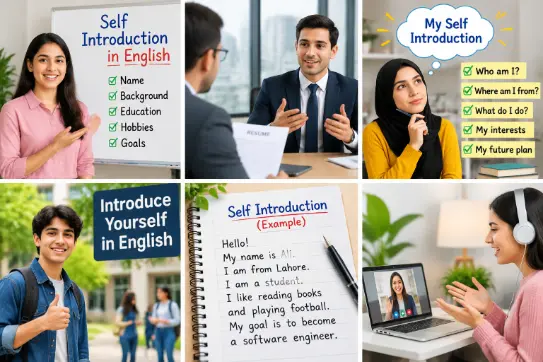
The Common European Framework of Reference for Languages describes a progression from basic personal exchanges to more detailed and independent communication.
Use Simple, Familiar Sentences at Beginner Level (A1)
At A1, focus on basic information.
Example:
“Hello. I’m Ali. I’m from Pakistan. I live in Lahore. I like cricket. Nice to meet you.”
Practise answering:
- “What’s your name?”
- “Where are you from?”
- “Where do you live?”
The CEFR identifies basic self introductions and simple personal questions as part of A1 communication when the listener provides appropriate support.
You do not need complicated sentences to begin speaking.
Add Connected Details and Simple Questions at Elementary Level (A2)
At A2, practise connecting familiar ideas.
Example:
“Hi, I’m Ali, and I’m from Lahore. I work in a shop near my home. I enjoy meeting people and playing cricket in my free time. What do you like doing?”
Useful connecting words include “and,” “but” and “because.”
For example:
“I’m learning English because I want to speak with more people.”
You should also practise short questions and answers about familiar subjects.
Share More Detailed Information and Respond Spontaneously at Intermediate Level (B1 and Above)
At B1, try giving connected information and explaining your reasons.
Example:
“I’m Ali, and I’ve lived in Lahore for most of my life. I work in retail, where I help customers choose products. I enjoy meeting new people, and one reason I’ve joined this group is to practise speaking more naturally in English.”
You can then answer questions such as:
- “What do you enjoy about your work?”
- “How long have you worked there?”
At B2 and above, you may be able to explain your experience in more detail, discuss familiar professional topics and respond more independently to unexpected questions.
However, advanced English does not mean using difficult words when simple expressions communicate better.
A proficient speaker may still say:
“Hi, I’m Ali. Nice to meet you.”
Adjust Your Self Introduction for Casual and Formal Situations
Compare these examples.
Casual:
“Hey, I’m Danish. I just moved here. How’s it going?”
Formal:
“Good morning. My name is Danish, and I’ve recently joined the team. I’m pleased to meet you.”
Both can be appropriate.
Choose your language according to the person, relationship and purpose.
You can also adjust your tone during the conversation. If people speak in a relaxed way, you may use a less formal style without becoming overly familiar.
Introduce Yourself at Work, in Team Meetings or Online Meetings
In a workplace self introduction, explain your name, current role and connection to the group.
Team meeting example:
“Hello, everyone. I’m Farah, and I work in the operations department. I’ll be helping the team with customer enquiries. I’m looking forward to working with you.”
If you have more time and the audience needs context, you can organise your information around your current role, relevant previous experience and what you hope to contribute next.
Example:
“I’m Farah, and I currently coordinate customer support enquiries. Before joining this team, I worked directly with customers at a local business. I’m now looking forward to helping improve how we respond to customer questions.”
This approach is consistent with the present–past–future framework discussed in Harvard Business Review’s guide to introducing yourself. It is useful when a professional audience needs more than your name.
At a networking event, you might say:
“Hi, I’m Farah. I work in customer operations and help teams improve how they respond to enquiries. I’m interested in meeting people who work on similar challenges. What kind of work do you do?”
This resembles a brief elevator pitch, but it should still sound conversational.
At a conference, you may mention your organisation, department or area of work if it helps others understand why you are attending.
In an online meeting, you can begin by checking:
“Can everyone hear me clearly?”
On a phone call, a natural opening is:
“Hello, this is Sana speaking.”
Avoid unexplained abbreviations when the listener may not know them.
Introduce Yourself Before a Speech or Presentation
Before a presentation, briefly introduce yourself and the topic.
Example:
“Good morning, everyone. My name is Mariam, and today I’ll be talking about clear communication in everyday life. I’ll share a few practical examples and explain how we can avoid common misunderstandings.”
This tells the audience who is speaking and what to expect.
In a group discussion, you may also need to introduce yourself before expressing a point of view.
For example:
“Hello, I’m Mariam. I work in customer support, and I’d like to share an example from my experience.”
Keep your self introduction short enough to leave time for the main discussion.
Introduce Yourself When You Are Not Working or Studying
You can give a meaningful self introduction without a job title or qualification.
Example:
“Hi, I’m Nida. I live in Hyderabad with my family. I enjoy cooking and gardening, and I’ve recently started learning English. It’s nice to meet you.”
If you are looking for work:
“Hello, I’m Usman. I’m currently looking for work and improving my communication skills.”
If you are retired:
“Hi, I’m Salim. I’m retired, and I enjoy reading and spending time with my grandchildren.”
Choose details that describe your current life accurately.
How to Continue a Conversation After Introducing Yourself
A successful self introduction often leads to a short conversation.
That means you need to listen, respond, ask questions and recognise when it is appropriate to finish.
The British Council’s A1 lesson on meeting new people uses a conversation model to practise common introductory expressions.
Ask the Other Person’s Name and Respond Politely
After giving your name, ask:
“What’s your name?”
Or:
“May I ask your name?”
Example:
You: “Hi, I’m Hammad. What’s your name?”
Other person: “I’m Zoya.”
You: “Nice to meet you, Zoya.”
Other person: “Nice to meet you too.”
If someone introduces another person to you:
“This is my colleague Sara.”
You can respond:
“Nice to meet you, Sara.”
Introducing yourself and responding to self introductions are related communication skills.
Answer Common Self Introduction Questions With Simple Responses
Practise these questions and answers.
What’s your name?
“My name is Ayesha.”
Where are you from?
“I’m from Lahore.”
What do you do?
“I work in a shop.”
What do you like doing?
“I enjoy reading.”
What brings you here?
“I’m here to practise English.”
Can you tell me a little about yourself?
“Of course. I’m Ayesha, and I work in a local business. I enjoy learning new skills and meeting people.”
Answer the question the person asks. You do not need to repeat your full self introduction every time.
Ask Follow-Up Questions Based on What the Other Person Says
A follow-up question connects to the previous answer.
Example:
Person A: “I enjoy photography.”
Person B: “That’s interesting. What do you like taking pictures of?”
Useful questions include:
- “How long have you been doing that?”
- “What do you enjoy about it?”
- “Where do you usually do that?”
Before asking another question, you can acknowledge the person’s answer.
- “That sounds interesting.”
- “I enjoy that too.”
- “Oh, I see.”
These short expressions help establish rapport—a comfortable connection between speakers.
Listen carefully instead of preparing your next question while the other person is still talking.
Use Small Talk and Shared Interests to Keep the Conversation Going
Small talk is a short conversation about familiar subjects.
At a community event, you might ask:
“Is this your first time here?”
At a workshop:
“How are you finding the workshop so far?”
At a social gathering:
“How do you know the host?”
At a conference:
“What kind of work do you do?”
You can also comment on your shared situation.
For example:
“This has been an interesting session. What did you think?”
A genuine, situation-appropriate compliment may help continue a conversation.
For example:
“I liked the example you shared during the discussion.”
You could follow it with:
“How did you come up with that idea?”
Compliments about someone’s ideas, contributions or work may be more appropriate than personal remarks about their appearance, particularly in professional settings.
When someone mentions an interest you share, acknowledge the connection.
“I like cricket too. Do you play or mostly watch?”
You do not need to force a conversation if the other person is busy or appears uncomfortable.
Ask for Repetition or Clarification When You Do Not Understand
You do not need to pretend that you understood everything.
Useful expressions include:
- “Sorry, could you repeat that?”
- “Could you speak a little more slowly, please?”
- “What does that word mean?”
- “Do you mean you live in Karachi now?”
Example:
Person A: “I moved here last September.”
Person B: “Sorry, did you say September?”
Person A: “Yes, last September.”
Person B: “Oh, I see. Do you like living here?”
Asking for clarification allows the conversation to continue.
End the Conversation Naturally and Politely
You can finish with:
- “It was nice talking to you.”
- “I’m glad we met.”
- “I hope to see you again.”
- “I should get going. See you later.”
Example:
“It was lovely meeting you, Sara. I need to leave now, but I hope to see you at the next session.”
If both people want to continue talking in the future, you might say:
“I enjoyed our conversation. Would you like to stay in touch?”
At a professional event:
“Would you like to continue this discussion after the session?”
You may exchange contact information when it is appropriate and mutually agreed upon. Do not pressure someone to share personal details.
Common Self Introduction Mistakes and Urdu-to-English Translation Errors
Some mistakes occur when learners translate Urdu directly into English.
Others happen because a phrase is grammatically incorrect or does not suit the situation.
Focus on learning natural expressions rather than memorising long speeches without understanding them.
Saying “Myself…” Instead of “I’m…” or “My Name Is…”
You may hear:
“Myself Ali.”
This usage occurs in some South Asian English contexts, but it is not the usual form for stating your name in widely used international English.
Prefer:
- “I’m Ali.”
- “My name is Ali.”
The word “myself” has other correct uses.
For example:
“I introduced myself to the group.”
“I made this myself.”
The word is not inherently incorrect. Its function in the sentence matters.
Avoiding Word-for-Word Urdu Translation in English Sentences
Urdu and English often use different sentence patterns.
Less natural:
“I am belonging to Lahore.”
Natural:
“I’m from Lahore.”
Less natural:
“I am doing job.”
Natural:
“I have a job.”
Or:
“I work as a teacher.”
Learn the English expression as a meaningful sentence instead of translating each Urdu word separately.
Confusing “I’m From,” “I Live In” and “I Was Born In”
These expressions describe different information.
“I’m from Lahore” describes your origin.
“I live in Karachi” describes your present residence.
“I was born in Multan” identifies your birthplace.
You can combine them:
“I was born in Multan, grew up in Lahore, and now live in Karachi.”
Choose the expression that matches your circumstances.
Using Incorrect Sentence Patterns for Work, Studies and Interests
Small grammatical differences can affect how natural your self introduction sounds.
Incorrect:
“I am working as teacher.”
Correct:
“I work as a teacher.”
Incorrect:
“I’m interested on photography.”
Correct:
“I’m interested in photography.”
Less natural:
“I passed my graduation last year.”
More natural:
“I graduated last year.”
You can also say:
“I completed my degree last year.”
Practise these expressions using your real information.
Asking Someone’s Name Using Unnatural English Expressions
Avoid translating a question directly from Urdu when English uses a different pattern.
Unnatural:
“How are you called?”
Natural:
“What’s your name?”
More formal:
“May I ask your name?”
You may also hear “What is your good name?” in South Asian English. It is understood in some communities, but “What’s your name?” is more widely natural in everyday international communication.
Use a polite tone and an appropriate expression.
Mixing Past and Present Tenses When Describing Your Background
Choose a verb form that matches the time.
- Current: “I live in Lahore.”
- Past: “I lived in Lahore when I was younger.”
- Recent change: “I’ve recently moved to Islamabad.”
- Continuing activity: “I’ve been learning English for six months.”
Incorrect:
“I am graduated last year.”
Correct:
“I graduated last year.”
You do not need to explain every grammar rule during a self introduction. Practise the patterns that accurately describe your life.
Giving Too Much Information or Using Inappropriate Formal Language
An ordinary first meeting does not require your complete education, family history, achievements and future plans.
Similarly, an overly formal opening may sound unnatural.
Instead of:
“First of all, I would like to express my sincere gratitude for providing me with the opportunity to introduce myself.”
You can usually say:
“Hello, I’m Ayesha. Nice to meet you.”
Choose details and expressions according to the purpose and listener.
How to Speak Clearly and Naturally During Your Self Introduction
Clear delivery helps the listener understand you.
You do not need a particular accent or an impressive speaking style. Focus on understandable words, natural pauses, suitable emphasis and comfortable interaction.
Connect Short Sentences Instead of Listing Separate Personal Details
Beginners often start with separate sentences:
- “I’m Hina.”
- “I’m from Lahore.”
- “I work in a shop.”
- “I like reading.”
These are correct.
You can connect them:
“I’m Hina, and I’m from Lahore. I work in a shop, and I enjoy reading in my free time.”
The connected version sounds more natural without requiring difficult grammar.
Do not combine so many details that you lose track of the sentence.
Pronounce Your Name, Hometown and Important Words Clearly
Pay attention to information that identifies you, such as your name, hometown and occupation.
For example:
“I’m from Sialkot.”
If the listener does not recognise the name, you can add:
“It’s a city in Pakistan.”
Natural word stress can also make important information easier to understand.
In the sentence “I work in customer support,” the words “customer support” contain useful information and deserve clear emphasis.
You do not need to stress every word equally.
If an important word is difficult, listen to a reliable pronunciation model and practise it slowly.
Your goal is intelligibility, not imitating a particular accent.
Speak at a Comfortable Pace With Natural Pauses
Speaking quickly does not automatically make your English better.
Try pausing after meaningful ideas.
“Hello, my name is Ali. [pause] I’m from Lahore, and I work in customer service. [pause] It’s nice to meet you.”
A pause gives you time to prepare the next idea.
A friendly tone can make a greeting sound welcoming, but you do not need exaggerated enthusiasm or dramatic pitch changes.
Small hesitation sounds such as “um” and “uh” are common in spontaneous speaking. They are not automatically errors.
If you use them so frequently that your message becomes difficult to follow, practise using a short silent pause instead.
Use an Audible Voice and Comfortable Body Language
Speak clearly enough for the listener to hear.
Face the person when appropriate and use natural facial expressions or gestures.
Comfortable posture can help you communicate, but you do not need to follow a rigid body-language formula.
Handshakes are customary in some social and professional settings but are not universal or compulsory.
Respect cultural customs and personal boundaries.
Avoid forcing constant eye contact or standing unnecessarily close to someone.
In an online meeting, check that your microphone works and that the other participants can hear you.
Focus on Being Understood Instead of Speaking Perfect English
You may communicate useful information even when you make a small mistake.
For example:
“I from Karachi.”
The meaning may be understandable, but the correct sentence is:
“I’m from Karachi.”
Learn from the error without abandoning the conversation.
During a real self introduction, continue communicating when possible. Review important mistakes afterward.
How to Practise From a Prepared Self Introduction to a Real Conversation
Preparing a self introduction helps you organise information. Real communication also requires listening, remembering language and responding without knowing every question in advance.
Research on second-language oral task repetition suggests that repeating speaking tasks can support aspects of performance, although outcomes depend on the task and learning conditions.
A 2025 meta-analysis of oral task repetition reports stronger improvements in some aspects of accuracy and complexity than in fluency and vocabulary complexity.
This does not mean memorising a single speech guarantees conversational ability.
A useful approach is to begin with supported practice and gradually introduce variation.
Create Your Own Self Introduction Using a Flexible Fill-in-the-Blank Template
Complete this template using your real information.
“Hello, my name is ________.
I’m from ________.
I currently ________.
In my free time, I enjoy ________.
I’m here because ________.
It’s nice to meet you.”
Use only the lines that fit the situation.
For a casual meeting, you may need only your name and one relevant detail.
For a longer self introduction, include your background and reason for being present.
After completing it, practise speaking from keywords rather than reading every sentence.
Listen to Model Self Introductions and Repeat Useful Sentences Aloud
Choose a short self introduction from a reliable learning resource.
Listen once without repeating.
Try to identify the speaker’s name, location, activity and reason for being there.
Listen again and notice the greeting, pronunciation, emphasis and pauses.
Repeat one useful sentence aloud.
Then adapt it with your information.
For example, after hearing “I’m from London,” practise:
“I’m from Lahore.”
The British Council’s A1 speaking resources combine listening, repetition and activities that check understanding.
Listening provides a model, while speaking aloud lets you practise producing the language.
Record Your Self Introduction and Review Its Clarity and Pronunciation
Record a short self introduction using your phone or another available device.
Listen for specific points:
- Can you hear your name and hometown clearly?
- Are the important words understandable?
- Do you emphasise useful information naturally?
- Are you speaking at a comfortable pace?
- Do pauses help the listener follow the meaning?
- Are repeated hesitation sounds interrupting your message?
Choose one issue to improve.
For example:
“Next time, I will pause after saying my name.”
Record again and compare the attempts.
Do not treat one recording as a complete assessment of your English proficiency.
Practise the Same Self Introduction With Different Details and Speaking Lengths
Begin with a short version.
“Hi, I’m Ayesha. I’m from Lahore. Nice to meet you.”
Then expand it:
“Hi, I’m Ayesha, and I’m from Lahore. I work in customer service, and I enjoy reading. I’m happy to join this conversation group.”
Next, change the situation.
Imagine meeting a neighbour instead of joining an English group.
Which details would you remove? What question would you ask?
You can also practise developing the same message in three stages.
- Say the basic information.
- Connect two ideas.
- Add a relevant reason or question.
For example:
- “I’m learning English.”
- “I’m learning English, and I practise with a friend.”
- “I’m learning English because I want to communicate more comfortably at work. What about you?”
The aim is greater flexibility, not simply a longer speech.
Use Role-Play to Practise Questions, Answers and Follow-Up Responses
Ask a partner to pretend they are meeting you for the first time.
Introduce yourself.
Your partner can ask:
- “Where are you from?”
- “What do you do?”
- “Why did you join this group?”
Answer with your actual information, then ask a relevant question.
Repeat the exercise in a different setting.
For example, change from a community gathering to a professional networking event.
For another challenge, ask your partner to change the order of questions or introduce an unexpected topic.
This helps you practise listening and responding rather than reciting prepared lines.
Practise Responding Without Reading or Memorising Every Word
Put your complete script away.
Keep only a few prompts:
Name — Hometown — Work or activity — Interest — Reason.
Speak using the prompts.
Then answer an unexpected question:
“What do you enjoy about living in your city?”
You might say:
“I like living here because my family is nearby and there are many places to visit.”
If you forget a word, explain the idea with simpler language.
Your goal is to express an understandable message without depending on every prepared sentence.
Introduce Yourself in a Real Conversation and Reflect on the Experience
Choose a safe and appropriate situation for a real self introduction.
It could be a learning group, workplace or community event.
Begin with your name and a relevant detail.
Ask one question and listen to the answer.
After the conversation, reflect:
- What did you communicate clearly?
- Did you understand the other person’s questions?
- Did you need to repeat, spell or explain anything?
- Did you give the other person an opportunity to speak?
- Did you recognise when the conversation was ready to continue or finish?
Choose one skill to practise before your next conversation.
What to Do When You Struggle During Your Self Introduction
Speaking difficulties can have different causes.
Some learners know what they want to say but struggle when speaking to another person. Others need more support with vocabulary, sentence patterns, listening or pronunciation.
The next practice task should address the difficulty you experience.
Identify Whether Your Difficulty Comes From Nervousness or a Language Skill Gap
Compare two situations.
Situation A: You can introduce yourself when practising alone but struggle when someone is listening.
Speaking pressure may be contributing to the difficulty.
Situation B: You struggle to form sentences even when you are alone.
You may need more support with vocabulary, grammar patterns or pronunciation.
Both problems can occur together.
Compare a solo recording with a short conversation.
Notice whether your difficulty is recalling sentences, constructing them or responding to the listener.
Do not assume every speaking difficulty comes from nervousness.
Recover When You Forget a Sentence or Cannot Find the Right Word
If you forget a prepared sentence, pause briefly.
Continue with the information you remember.
For example:
“I’m from Lahore, and I… well, I work in a small shop.”
If you forget the word “photography,” say:
“I like taking pictures.”
You do not need to restart the self introduction.
Using a simpler expression is a useful communication strategy.
Respond When Someone Interrupts or Asks an Unexpected Question
Suppose someone asks:
“How long have you lived here?”
You can answer:
“About two years.”
If you need a moment:
- “Let me think.”
- “Just a moment.”
- “That’s a good question.”
Then respond.
Practise with a partner who asks questions at unexpected points.
This prepares you to adapt rather than deliver a speech that cannot change.
Repair the Conversation When Someone Does Not Understand You
If the listener seems confused, ask:
- “Was that clear?”
- “Would you like me to repeat that?”
You can also rephrase your information.
For example:
“I’ve been based here since last year.”
Simpler:
“I moved here last year. I live here now.”
You may need to spell your name, explain an unfamiliar location or replace a difficult expression.
Choose the clarification that helps the listener understand.
Practise With Limited Vocabulary or Without a Speaking Partner
You do not need hundreds of words to introduce yourself.
Start with:
- “My name is…”
- “I’m from…”
- “I like…”
- “I’m learning…”
Use these patterns with your own information.
If you do not have a partner, practise both sides of a dialogue aloud.
Ask:
“Where are you from?”
Then answer:
“I’m from Multan.”
You can also record questions, leave pauses and practise responding.
Solo practice is useful preparation, but it does not fully replace the listening demands of real conversations.
Adjust Your Practice When Rehearsed Self Introductions Are Not Helping
If you can recite a speech but cannot answer simple questions, repeating the same script may not address the problem.
Change your practice.
- Give shorter responses.
- Use different personal details.
- Ask questions in a different order.
- Try a new situation.
If you repeatedly make the same grammar mistake, practise that specific sentence pattern.
Your practice should change according to the difficulty you identify.
How to Check Whether You Can Introduce Yourself Independently
You can recognise progress by checking what you can communicate, not simply by counting the sentences you memorised.
Give a Clear Self Introduction Without Reading From Notes
Introduce yourself using your own words.
Include your name and one or two relevant details.
Try completing the task without a full script.
If you forget a sentence but recover and finish, notice that you still communicated.
Compare your performance with earlier attempts rather than expecting perfect speech.
Adapt Your Self Introduction for Different People, Situations and Speaking Levels
Try introducing yourself in two situations.
First, imagine meeting a new neighbour.
Second, imagine joining a workplace meeting.
For the neighbour, you may mention where you live.
For the workplace meeting, you may mention your role.
Check whether you can choose different information without memorising two completely different speeches.
As your ability develops, add more detail when the listener needs it.
Answer Follow-Up Questions and Ask Relevant Questions in Return
After introducing yourself, answer at least one simple question.
Then ask a question in return.
Example:
Partner: “Where do you live?”
You: “I live in Lahore. What about you?”
Partner: “I live in Islamabad.”
You: “Do you enjoy living there?”
This checks whether you can participate in a short exchange rather than only deliver prepared information.
Check Whether Your Listener Understands Your Message
Ask a supportive partner what they understood.
Could they identify your name, background or reason for being there?
Did any information need repeating or clarification?
Did your pace and pronunciation make the message easy to follow?
If the listener understood your main message, your self introduction served its immediate communicative purpose.
You can then focus on improving particular language errors.
Use Feedback to Improve Your Next Self Introduction
After each attempt, choose one realistic improvement goal.
For example:
- “Next time, I will pronounce my hometown more clearly.”
- “I will use ‘I’m from’ correctly.”
- “I will pause instead of rushing.”
- “I will ask a relevant follow-up question.”
- “I will give the other person time to respond.”
Practise that goal in your next interaction.
Useful signs of progress include needing fewer notes, adapting your self introduction, answering questions and recovering from misunderstandings.
You do not need a fixed fluency score or a guaranteed number of practice days to recognise improvement.
Frequently Asked Questions About Self Introduction in English
Quick answers to common questions about introducing yourself in English.
How do I introduce myself?
Say a greeting, give your name, add one or two details that matter to the listener, and invite a reply. The details can be your hometown, work, studies or reason for being there.
For example: “Hi, I’m Ayesha. I’m from Lahore, and I work in customer service. Nice to meet you. What about you?”
What can I write to introduce myself?
Write your name, where you are from or live, what you do, one interest, why you are there, and a polite closing. You do not need every item every time. Choose the details that suit the situation.
For example: “Hello, my name is Sara. I’m from Multan, and I live in Lahore. I enjoy cooking and learning new skills. It’s a pleasure to meet you.”
How do I write myself in 10 lines?
Follow a simple order: greeting, name, hometown, current city, work or studies, a personal quality or interest, free-time activity, reason for learning English or being there, a happy closing line, and thank you. Write one short sentence for each line.
You can see a complete model in the 10-line example earlier on this page. Replace the sample details with your own information.
How to give a short introduction?
Use a greeting, your name, one useful detail and a friendly closing. Two or three sentences are often enough for a normal first meeting.
For example: “Hi, I’m Hassan. I live nearby. Nice to meet you.”
What is a good introduction line?
A good introduction line is clear, simple and suitable for the situation. It gives your name and, when useful, one relevant detail.
Informal: “Hi, I’m Hamza. Nice to meet you.” Formal: “Good morning. My name is Sana, and I’ve recently joined the customer support team.”
What is a full introduction?
A full introduction is a longer version that can include your name, hometown, current city, work or studies, interests, reason for being there and a polite closing. It is useful when a group leader gives you one or two minutes to speak.
You do not need a full introduction in every conversation. The one-minute and two-minute examples on this page show how to build one.
What is a good introduction?
A good introduction is relevant, clear and natural. It matches the listener, the setting and the time available, and it gives the other person an easy way to reply.
It does not need difficult vocabulary or personal details you are uncomfortable sharing.
What are 7 types of introductions?
There is no single official list, but these seven types of self introduction cover most real situations:
- Short social introduction for a quick first meeting
- Casual introduction for friends, neighbours and community events
- Formal workplace introduction for meetings and new teams
- Group or classroom introduction, such as the 10-line model
- Presentation or speech introduction that also names your topic
- Written introduction paragraph
- Phone or online meeting introduction
In essay writing, “types of introductions” usually means different opening styles, such as a question or a quotation. That is a different topic from introducing yourself.
Continue Learning: Self Introduction for Specific Situations
General self-introduction skills are a foundation for more specialised communication.
Self Introduction in English for Students
Students may need to introduce themselves in school, college, university or academic activities.
These self introductions may include their class, course, educational interests or learning goals.
For examples designed around these situations, continue with Self Introduction in English for Students.
Self Introduction in English for a Job Interview
A job interview self introduction generally requires relevant information about qualifications, work experience, skills and suitability for a position.
It should not simply reproduce a casual self introduction about your hometown and hobbies.
For professional structure, fresher and experienced-candidate examples, and interview-specific speaking practice, continue with Self Introduction in English for a Job Interview.