
100+ Travel English Sentences for Shopping and Travel
Learn 100+ practical English sentences for shopping and travel, with useful travel phrases, essential vocabulary, and realistic conversations for airports, immigration, airplanes, hotels, transport, sightseeing, restaurants, shops and emergencies. This guide also includes simple shopping sentences, common questions, and a travel English PDF practice sheet to help you prepare for real situations.
This Travel English guide is organised around real situations, so you can learn what to say, understand common replies and explain what you need during a trip.
- 10+ travel situationsfrom the airport to local shops
- Useful vocabularywith simple Roman Urdu meanings
- Realistic dialoguesfor practical speaking practice

What Is English for Travel?
English for travel means the words, phrases and conversations you use when travelling to a place where English may be spoken or understood. You may need it to check in at an airport, answer an immigration officer, ask for directions, book a hotel room, order food, buy a ticket or get help.
Travel English is practical rather than academic. You do not need advanced grammar for every situation. You need clear, polite sentences that communicate your message. For example, “Where is the train station?” is more useful during a journey than memorising a long list of unrelated words.
Learning travel English vocabulary and common expressions can make everyday tasks easier. It can also help you understand signs, announcements, menus, ticket information and basic instructions. This guide brings together practical travel phrases in English, useful English sentences for shopping and travel, and short dialogues you can practise before leaving home.
Start with these five sentences:
- Excuse me, could you help me, please?
- Where is the check-in desk?
- I have a reservation.
- How much is this?
- Could you speak more slowly, please?
Learn the meaning, say each sentence aloud, and practise changing one detail to fit your own journey.
Use the sections below as a beginner-friendly travel English course. You can study one situation at a time and return to the examples before your trip.
Essential Travel Phrases in English for Everyday Situations
These useful travel phrases in English help you start conversations, ask for assistance and communicate politely in common situations.
When you are unsure what to say, begin with a polite expression. “Excuse me” can get someone’s attention, while “please” and “thank you” make a request sound more courteous.
The 5 Golden Phrases of Polite Travel Conversation
| English phrase | Roman Urdu meaning |
|---|---|
| Excuse me. | Maaf kijiye / Suniye. |
| Could you help me, please? | Kya aap meri madad kar sakte hain? |
| Thank you for your help. | Aapki madad ka shukriya. |
| You’re welcome. | Koi baat nahi. |
| I’m sorry. | Mujhe afsos hai / Maaf kijiye. |
| Could you show me, please? | Kya aap mujhe dikha sakte hain? |
| I’d like some information. | Mujhe kuch maloomat chahiye. |
| That’s very helpful. Thank you. | Yeh bohat madadgar hai. Shukriya. |
Use a polite opening before asking a stranger for directions or assistance. Speak clearly and give the other person time to respond.
Remember these five essentials: “Excuse me”, “Could you help me, please?”, “Please”, “Thank you” and “I’m sorry”. These expressions work in shops, hotels, stations, restaurants and other everyday travel situations.
Useful Phrases When You Do Not Understand
| English phrase | Roman Urdu meaning |
|---|---|
| Could you repeat that, please? | Kya aap dobara keh sakte hain? |
| Could you speak more slowly, please? | Kya aap thora aahista bol sakte hain? |
| Sorry, I didn’t catch that. | Maaf kijiye, main samajh nahi saka/saki. |
| Could you write that down, please? | Kya aap yeh likh sakte hain? |
| What does this word mean? | Is lafz ka kya matlab hai? |
| Let me make sure I understand. | Mujhe tasdeeq kar lene dein ke main samajh gaya/gayi hoon. |
It is better to ask someone to repeat information than to guess, especially when you are checking a platform, gate, fare, address or travel instruction.
A useful English sentence to remember is: “Could you write the address down for me, please?”
Common Questions for Travel
- Where is the nearest bus stop?
- How can I get to the city centre?
- How much is a ticket?
- What time does the train leave?
- Is this the right platform?
- Is this place within walking distance?
- What time does the museum close?
- Can I pay by card?
Practise replacing the place, time or item. For example, change “the bus stop” to “the train station”, “the hotel” or “the museum”.
Travel English Vocabulary With Meanings
Learning travel English vocabulary helps you recognise important words on signs, tickets, websites and announcements. Do not learn a word by itself only. Read its meaning and use it in a short sentence.
Airport and Flight Vocabulary
| Word or phrase | Meaning in Roman Urdu | Example sentence |
|---|---|---|
| Passport | Safar ki shanakhti dastavez | Here is my passport. |
| Boarding pass | Flight mein sawar hone ka document | Here is my boarding pass. |
| Check-in desk | Jahan flight ke liye check-in hota hai | Where is the check-in desk? |
| Departure | Rawangi | What time is the departure? |
| Arrival | Aamad | Where is the arrivals area? |
| Gate | Boarding ka darwaza | Which gate is my flight? |
| Luggage | Safar ka samaan | My luggage is heavy. |
| Baggage claim | Jahan checked luggage milta hai | Where is baggage claim? |
| Customs | Samaan ki jaanch ka idara | Do I need to go through customs? |
Transport and Accommodation Vocabulary
| Word or phrase | Meaning in Roman Urdu | Example sentence |
|---|---|---|
| Reservation | Pehle se ki gayi booking | I have a hotel reservation. |
| Destination | Manzil | What is your destination? |
| One-way ticket | Sirf ek taraf ka ticket | I’d like a one-way ticket. |
| Return ticket | Aane-jaane ka ticket | I’d like a return ticket. |
| Platform | Jahan train aati ya rawana hoti hai | Which platform do I need? |
| Fare | Kiraya | How much is the fare? |
| Reception | Hotel ka front desk | Please ask at reception. |
| Check-out | Hotel se rawangi ka amal | What time is check-out? |
| Room key | Kamre ki chaabi | Here is your room key. |
Sightseeing, Shopping and Grocery Vocabulary
| Word or phrase | Meaning in Roman Urdu | Example sentence |
|---|---|---|
| Entrance fee | Dakhil hone ki fees | How much is the entrance fee? |
| Landmark | Mashhoor pehchan wali jagah | Is this a famous landmark? |
| Souvenir | Yaadgari tohfa | I’d like to buy a souvenir. |
| Opening hours | Khulne ke auqat | What are the opening hours? |
| Aisle | Store ki shelves ke darmiyan raasta | Which aisle has the cereal? |
| Checkout | Payment karne ki jagah | Where is the checkout? |
| Receipt | Kharidari ki rasid | Could I have a receipt? |
| Cash | Naqad raqam | Can I pay in cash? |
| Local cuisine | Maqami khanay | I’d like to try local cuisine. |
A travel English vocabulary PDF is most useful when it gives you words, meanings and example sentences together. The practice sheet linked below follows this approach.
Airport Check-In and Immigration Conversations
At an airport, you may speak with airline staff, security staff, immigration officers and other passengers. Listen carefully to each question and keep your travel documents ready.

Conversation at the Airport Check-In Desk
- Staff: Good morning. May I see your passport, please?
- Traveller: Good morning. Yes, here it is.
- Staff: Where are you travelling today?
- Traveller: I’m travelling to London.
- Staff: Do you have any bags to check in?
- Traveller: Yes, I have one suitcase.
- Staff: Would you prefer a window or an aisle seat?
- Traveller: A window seat, please, if one is available.
- Staff: Here is your boarding pass. Your gate is number 12.
- Traveller: Thank you. Where can I find gate 12?
Useful check-in sentences
- I’d like to check in for my flight.
- Can I have a window seat, please?
- Is my baggage included?
- How many bags can I check in?
- Is the flight on time?
- Where is the security check?
Immigration Conversation at Passport Control
Immigration officers may ask why you are visiting, how long you plan to stay and where you will stay. Give clear, truthful answers that match your actual travel plans and documents.
- Officer: What is the purpose of your visit?
- Traveller: I’m here for tourism.
- Officer: How long will you be staying?
- Traveller: I will be staying for seven days.
- Officer: Where will you be staying?
- Traveller: I’m staying at the City View Hotel.
- Officer: Do you have a return ticket?
- Traveller: Yes. Here is my return ticket.
Questions you may hear
- What is the purpose of your visit?
- How long are you staying?
- Where are you staying?
- Are you travelling alone?
- Do you have a return ticket?
- What is your occupation?
Immigration and entry requirements differ by country and can change. This dialogue is for English practice, not immigration or legal advice. Answer officials truthfully and follow the instructions at your destination.
Security, Baggage Claim and Customs Phrases
- Do I need to take my laptop out of the bag?
- Where should I put my hand luggage?
- Is this the queue for security?
- Where can I collect my suitcase?
- My bag has not arrived.
- Where is the lost baggage counter?
- Do I need to declare these items?
If your suitcase is missing, explain the situation and show your baggage tag if you have it. Ask the airport staff where to report the problem.
Airplane Conversations and Useful In-Flight English
After boarding, you may need to speak with a flight attendant or another passenger. Learn a few polite sentences for your seat, luggage, meals and comfort during the flight.
Conversation With a Flight Attendant
- Traveller: Excuse me, could you help me with my bag?
- Flight attendant: Of course. I’ll help you put it in the overhead compartment.
- Traveller: Thank you. Could I have some water, please?
- Flight attendant: Certainly. Would you like still or sparkling water?
- Traveller: Still water, please.
- Flight attendant: Here you are.
- Traveller: Thank you very much.
Useful Sentences on an Airplane
- Could I have a blanket, please?
- Could I have a glass of water?
- Where is my seat?
- Could you help me with the overhead compartment?
- May I change seats if one is available?
- When will the meal be served?
- Could you tell me when we land?
- Where is the restroom?
Words to recognise: aisle seat, window seat, middle seat, seat belt, tray table, overhead compartment, flight attendant, turbulence and landing.
Keep your request short and polite. If you have a food allergy or medical need, explain it clearly to the airline staff.
Hotel English: Check-In, Room Requests and Check-Out
At a hotel, you may need to confirm a reservation, ask about breakfast, report a problem or request an extra item for your room.
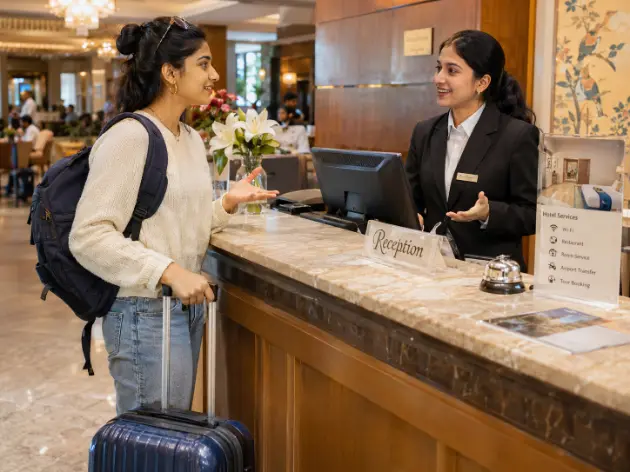
Conversation at the Hotel Reception
- Guest: Hello. I have a reservation under the name Ahmed Khan.
- Receptionist: Certainly. May I see your ID, please?
- Guest: Yes, here it is.
- Receptionist: You have booked a double room for three nights.
- Guest: That’s correct. What time is breakfast?
- Receptionist: Breakfast is served from 7 to 10 a.m.
- Guest: Thank you. What time is check-out?
- Receptionist: Check-out is at 11 a.m.
Useful Hotel Sentences
- I have a booking for two nights.
- Is breakfast included?
- Is Wi-Fi available?
- Could I have another towel, please?
- The air conditioner is not working.
- Could someone check the room, please?
- Can I leave my luggage here after check-out?
- Could I have the bill, please?
If there is a problem with your room, describe it simply and politely. For example: “The shower is not working. Could someone help me?”
Transport and Directions: Ask How to Reach Your Destination
When using buses, trains, taxis or other public transport, you may need to ask about the route, ticket price, departure time or correct stop.

Useful Transport Phrases
- I’d like a one-way ticket, please.
- I’d like a return ticket, please.
- What time does the train leave?
- Which platform do I need?
- Does this bus go to the city centre?
- Where should I get off?
- How much is the fare?
- Could you tell me when we reach my stop?
- Could you take me to this address, please?
Conversation: Asking for Directions
- Traveller: Excuse me. How can I get to the city centre?
- Local: You can take bus number 10 from the next stop.
- Traveller: Where is the nearest bus stop?
- Local: It’s across the street, next to the bank.
- Traveller: How long does it take?
- Local: About 15 minutes, depending on traffic.
- Traveller: Thank you for your help.
- Local: You’re welcome.
Useful follow-up questions include “Could you show me on the map?” and “Is this the correct stop for the museum?”
Sightseeing English: Visit Attractions and Explore New Places
When sightseeing, you may ask about opening hours, entrance fees, guided tours, photography rules and nearby attractions. These phrases can help you enjoy a visit without needing complicated sentences.
Useful English Phrases for Tourist Attractions
- What are the best places to visit nearby?
- How much is the entrance fee?
- What time does the museum close?
- Are guided tours available?
- Can I buy tickets here?
- Is photography allowed?
- Could you take a photo of us, please?
- Is this place within walking distance?
- Is there a public restroom nearby?
- Where can I find a local guide?
Conversation: Asking About a Sightseeing Tour
- Traveller: Hello. Are there any guided tours today?
- Guide: Yes. The next tour starts at 11 a.m.
- Traveller: How long does the tour take?
- Guide: It takes about two hours.
- Traveller: How much is the ticket?
- Guide: It’s 20 dollars per person.
- Traveller: Great. Can I buy two tickets here?
- Guide: Yes, certainly.
Prices and times in practice dialogues are examples only. Check the current details at the attraction.
Talking to Locals and Meeting New People
Short conversations with local people can help you ask for recommendations, learn about the area and communicate more naturally. Start with friendly questions and respect the other person’s time and privacy.
Conversation Starters for Meeting People
- Hello. Is this your first time here?
- I’m visiting from Pakistan.
- I’ve never been here before.
- Do you live around here?
- What places do you recommend?
- Is there a good local market nearby?
- What’s a popular local dish?
- Thank you. It was nice talking to you.
Conversation: Asking a Local for Recommendations
- Traveller: Excuse me. I’m visiting this city for the first time.
- Local: Welcome! I hope you enjoy your visit.
- Traveller: Thank you. What places do you recommend?
- Local: You should visit the old town and the city museum.
- Traveller: That sounds interesting. How can I get there?
- Local: You can walk to the old town, or take a bus to the museum.
- Traveller: Thanks for the advice.
- Local: You’re welcome. Have a great day!
If someone seems busy or does not want to talk, thank them and move on politely.
Restaurant and Dining Conversations in English
At a restaurant, you may need to book a table, ask for the menu, explain a food preference, check ingredients or request the bill. Learn the words and expressions before you dine out.

Restaurant Vocabulary and Useful Phrases
- Book a table / make a reservation: reserve a table before arriving.
- Menu: a list of food and drinks.
- Starter: a small dish served before the main course.
- Main course: the main meal.
- Side dish: food served with the main dish.
- Dessert: a sweet dish served after a meal.
- Bill / check: the amount you need to pay.
- Allergen: an ingredient that may cause an allergic reaction.
Useful sentences
- A table for two, please.
- Could I see the menu, please?
- What do you recommend?
- I’d like the chicken with rice, please.
- Does this dish contain nuts?
- Could we have the bill, please?
Conversation: Ordering Food at a Restaurant
- Waiter: Good evening. Do you have a reservation?
- Guest: Yes, I booked a table for two under the name Ali.
- Waiter: Certainly. Please follow me.
- Guest: Could we have the menu, please?
- Waiter: Of course. Would you like something to drink?
- Guest: A bottle of water, please.
- Waiter: Are you ready to order?
- Guest: Yes. I’d like the grilled chicken with rice.
- Waiter: Certainly. Anything else?
- Guest: No, thank you.
Dietary Needs, Paying and Asking for the Bill
- I’m vegetarian.
- Do you have a vegetarian menu?
- Does this contain dairy?
- I’m allergic to peanuts.
- Could you tell me what ingredients are in this dish?
- Could we have separate bills, please?
- Can I pay by card?
- Could I have the receipt, please?
If you have a serious food allergy, explain it clearly and confirm the ingredients and preparation with the restaurant staff. Do not rely on a guess or a vague description.
Health and Pharmacy English: Ask for Medical Help
When you feel unwell while travelling, simple and clear English can help you explain your symptoms and ask where to find professional care. These phrases are for communicating your needs; a pharmacist or qualified medical professional should advise you about treatment.
Useful Health and Pharmacy Phrases
- Where is the nearest pharmacy?
- Where is the nearest clinic or hospital?
- I have a headache.
- I have a fever.
- I don’t feel well.
- I’m allergic to this medicine.
- Could you help me explain this to the pharmacist?
- Do I need a prescription for this medicine?
- Could you call a doctor, please?
- I need medical help.
If you have an allergy, tell the healthcare professional clearly and show the name of the medicine or ingredient if you know it. Do not guess about medication or dosage.
Conversation at a Pharmacy
- Traveller: Excuse me. Could you tell me where the pharmacy is?
- Local: There is one next to the supermarket.
- Traveller: Thank you. I have a headache. Could I speak to the pharmacist?
- Pharmacist: Certainly. Do you have any allergies?
- Traveller: Yes. I’m allergic to penicillin.
- Pharmacist: Thank you for telling me. I’ll help you with the next steps.
Shopping Sentences in English: Shops, Markets and Grocery Stores
Shopping is a common travel activity. You may buy clothes, souvenirs, snacks, groceries or daily essentials. These shopping sentences in English help you ask about prices, sizes, locations, payment and receipts, whether you are speaking with a shop assistant or a shopkeeper.
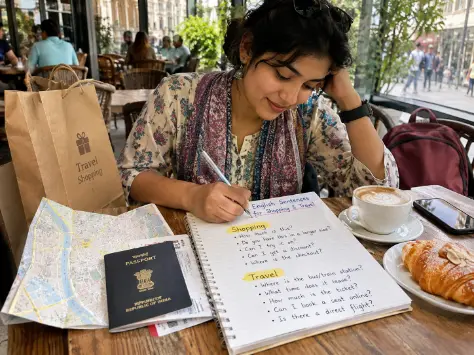
English Sentences for a Shopkeeper
Use these English sentences for shopkeeper conversations when you need help finding an item or checking its price.
- Hello. I’m just looking, thank you.
- I’m looking for a jacket.
- How much is this?
- Do you have this in a medium?
- Can I try this on?
- Do you have another colour?
- Is this on sale?
- Can I pay by card?
- I’ll take it, please.
- Could I have a receipt, please?
Conversation: Buying a shirt
- Customer: Excuse me. How much is this shirt?
- Shopkeeper: It’s 25 dollars.
- Customer: Do you have it in a large size?
- Shopkeeper: Yes, here you are.
- Customer: Can I try it on?
- Shopkeeper: Certainly. The changing room is over there.
- Customer: It fits well. I’ll take it.
Grocery Shopping English and Supermarket Phrases
In a supermarket, you may need to ask where products are, compare prices, check quantities or find the checkout.
- Where can I find the milk?
- Which aisle has the cereal?
- Where are the fresh vegetables?
- How much is this per kilo?
- Could I have one kilogram of apples?
- Is this fresh?
- Where can I find bottled water?
- Where is the checkout?
- Can I have a shopping bag, please?
- Could I have the receipt, please?
Conversation: Finding milk in a grocery store
- Customer: Excuse me. Where can I find the milk?
- Staff: It’s in aisle four, near the cheese.
- Customer: Thank you. Is there a smaller carton?
- Staff: Yes, the small cartons are on the lower shelf.
- Customer: Great. Thank you for your help.
Useful English Sentences for Online Shopping
When ordering online, use these questions to check delivery, payment, tracking and returns before you place an order.
- Is this item available online?
- How much is the delivery fee?
- How long will delivery take?
- Can I track my order?
- What is your return policy?
- Can I return this if it doesn’t fit?
- Is cash on delivery available?
- Could you confirm my order, please?
Conversation: Checking an online order
- Customer: Hello. I’d like to ask about my order.
- Support agent: Certainly. Do you have your order number?
- Customer: Yes. Could you tell me when it will be delivered?
- Support agent: It is expected to arrive on Friday.
- Customer: Thank you. Can I track the delivery?
- Support agent: Yes. I’ll send you the tracking details.
Simple Shopping Sentences in English for Class 4
Young learners can practise short and easy sentences. If you need a shopping sentence in English for Class 4, begin with everyday words and simple requests.
| Simple English sentence | Roman Urdu meaning |
|---|---|
| I want an apple. | Mujhe aik saib chahiye. |
| How much is this? | Yeh kitne ka hai? |
| Please give me a bag. | Meherbani karke mujhe bag dein. |
| I need a bottle of water. | Mujhe pani ki aik bottle chahiye. |
| Where is the milk? | Doodh kahan hai? |
| I like this toy. | Mujhe yeh khilona pasand hai. |
| Thank you. | Shukriya. |
Ask the learner to read each sentence, understand it and practise saying it without looking at the Roman Urdu meaning.
Emergency Travel Phrases: Ask for Help Clearly
During an emergency, use short and direct sentences. Try to explain what happened, where you are and what kind of help you need.
Important Emergency Phrases in English
- I need help, please.
- Please call an ambulance.
- Please call the police.
- Where is the nearest hospital?
- I don’t feel well.
- I’ve lost my passport.
- My bag has been stolen.
- I need to contact my embassy.
- Can you help me contact my family?
- I need a doctor.
- I’m lost. Could you show me where I am on the map?
Conversation: Asking for Help
- Traveller: Excuse me. I need help, please.
- Staff member: What happened?
- Traveller: I’ve lost my passport.
- Staff member: Do you know where you last had it?
- Traveller: I think I left it in the taxi.
- Staff member: You should report it to the police and contact your embassy.
- Traveller: Could you help me find the police station?
Emergency numbers and procedures vary by country. Before travelling, check the official local emergency number and keep your embassy or consulate contact details accessible. In immediate danger, contact local emergency services.
Common Travel English Mistakes and How to Avoid Them
Small communication mistakes can cause confusion when you are booking transport, ordering food or asking for directions. Practise the corrected expressions below.
Use Polite Requests Instead of Direct Commands
Too direct: Give me water.
More polite: Could I have some water, please?
Too direct: Tell me the way.
More polite: Could you tell me how to get there, please?
Too direct: I want a table.
More natural: Could I have a table for two, please?
Direct language may be understood, but polite requests are often more suitable when speaking to staff or strangers.
Check Important Details Before You Agree
- Confirm whether you need a one-way or return ticket.
- Check the date, time, destination and platform.
- Ask whether a quoted price is per person or for the whole group.
- Confirm the currency before paying.
- Check whether breakfast, baggage or other services are included.
- Repeat an address or booking name if it is important.
Do not pretend you understand a number or instruction. Ask the speaker to repeat it or write it down.
Avoid Word-for-Word Translation
Some expressions sound unnatural when translated word by word from another language. Learn complete English phrases instead.
- Natural: Where is the restroom?
- Natural: I’d like to book a table.
- Natural: Could I have the bill, please?
- Natural: I’m looking for the train station.
Also remember that words can vary by region. For example, people may say “restroom”, “toilet” or “washroom” in different places.
Also choose the word that clearly describes the place. In some regions, “hotel” may be used informally for an eating place, but in many international contexts a hotel means accommodation. Say restaurant or café when you mean a place to eat, and hotel when you mean a place to stay.
Practise Travel English Conversation Before Your Trip
Reading examples is a useful first step, but speaking practice helps you recall the phrases when you need them. Use this Travel English routine to build confidence in conversations and prepare for common situations.
Five-Step Travel English Speaking Practice
- Choose one situation. For example, checking in at an airport or ordering food.
- Learn five useful phrases. Understand the meaning instead of memorising sounds only.
- Read a short dialogue aloud. Practise both roles if you are learning alone.
- Change the details. Use your own destination, hotel, food choice or travel date.
- Practise without reading. Record yourself and notice which phrases you need to review.
Short Travel English Conversation: A Complete Practice
- Local: Hello. Can I help you?
- Traveller: Yes, please. I’m looking for the train station.
- Local: It’s about five minutes from here.
- Traveller: Could you show me the way on the map?
- Local: Of course. Go straight and turn left.
- Traveller: Thank you. Is it easy to walk there?
- Local: Yes, it’s within walking distance.
- Traveller: That’s great. Thanks for your help.
After practising, replace “the train station” with “the museum”, “the hotel” or “the bus stop”.
More Travel English Practice From Trusted Learning Resources
Use these free learning resources to review travel vocabulary and practise listening or recognition skills alongside the examples in this guide.
- British Council: Air travel vocabulary exercises — beginner-level vocabulary practice with exercises and worksheets.
- Cambridge English: Vocabulary games and activities (PDF) — printable vocabulary activities that include travel words and example sentences.
Download the Travel English PDF: Phrases and Vocabulary Practice
Use the printable travel English PDF to review English sentences for shopping and travel. It includes useful phrases for grocery shopping, airports, immigration, airplanes, transport, directions, sightseeing, restaurants, emergencies and asking someone to repeat information. Roman Urdu meanings help beginners understand each sentence.
Travel English Phrases PDF
What is included?
- Shopping and grocery shopping sentences
- Airport, immigration and airplane phrases
- Transport, directions and sightseeing expressions
- Restaurant and dining sentences
- Emergency phrases and requests for help
- Essential travel vocabulary with Roman Urdu meanings
The PDF is a practice sheet for revision. Use this full guide for explanations, example conversations and additional speaking practice.
If you need a travel English phrases PDF or a travel English vocabulary PDF, this printable sheet gives you a compact set of useful expressions and meanings to review before travelling. It is designed as a quick revision resource to use alongside the examples in this article.
Frequently Asked Questions About English for Travel
These answers cover common questions from beginners who want to use English during a trip.
How Can I Learn English for Travel as a Beginner?
Start with polite expressions, directions, numbers, transport words and phrases for airports, hotels, restaurants and shops. Practise short conversations aloud, learn the meaning of each phrase, and change the details to match your own trip.
What Are the Most Useful Travel Phrases in English?
Useful phrases include “Excuse me, could you help me?”, “Where is the check-in desk?”, “How much is this?”, “Could you speak more slowly?”, “I have a reservation” and “Could I have the bill, please?”
Can I Download a Travel English PDF?
Yes. Use the travel English PDF practice sheet on this page. It includes English sentences for shopping and grocery stores, airports, immigration, airplanes, transport, directions, sightseeing, restaurants, emergencies and clarification, with Roman Urdu meanings.
What Travel English Vocabulary Should I Learn First?
Begin with passport, boarding pass, luggage, check-in desk, departure, arrival, reservation, platform, destination, one-way ticket, return ticket, receipt and entrance fee. Learn each word in a short sentence.
What Sentences in English Should I Learn for Shopping?
Practise examples such as “How much is this?”, “Do you have this in another size?”, “Where can I find the milk?”, “Can I pay by card?” and “Could I have a receipt, please?” These are useful shopping sentences in English for everyday situations.
What English Sentences Can I Use With a Shopkeeper?
You can say “Hello, how much is this?”, “I am looking for a jacket”, “Do you have this in a medium?”, “Can I try this on?”, “I’ll take it” and “Could I have a receipt, please?”
What Is a Simple Shopping Sentence in English for Class 4?
Simple examples include “I want an apple”, “How much is this?”, “Please give me a bag”, “I need a bottle of water”, “Where is the milk?” and “Thank you.” These short sentences are suitable for basic classroom practice.
Do I Need Fluent English to Travel Abroad?
No. Basic English can help with common travel situations. Learn clear questions, polite requests, numbers, important travel words and phrases for asking someone to repeat or explain information. Use translation support when needed.