
English Conversation for Everyday Life: Real-Life Dialogues, Common Phrases and Speaking Practice
English Conversation for Everyday Life brings together practical dialogues, daily-use sentences and speaking practice for situations learners actually face. Use these real-life English conversation examples at home, in restaurants and cafés, at a doctor’s clinic, at work or college, while shopping, and when meeting someone new. The guide covers family routines, breakfast, housework, grocery lists, dinner plans, household problems, appointments, symptoms, food orders, introductions, small talk, travel and study conversations. You will also find 100 common daily English conversation phrases, 100 basic words, question-and-answer practice, role-play guidance and a free PDF with 100 short English conversations for speaking practice.
- Everyday situationsHome, restaurant, clinic, work, study and social conversations
- 100 short dialoguesPrintable practice for everyday communication
- Speaking practiceUseful vocabulary, questions, answers and role-play

Practise conversations for:
- Family routines, meals and household tasks
- Restaurant visits, food orders and payment
- Clinic appointments, symptoms and tests
- Introductions, work, college, travel and small talk
Read both roles aloud, change the details, and practise responding without memorising every line.
English Conversation at a Restaurant
Restaurant conversations involve more than ordering food. You may need to speak with a host, waiter or server, ask about a reservation, choose a table, understand the menu, discuss ingredients, make special requests and complete payment. This English Conversation for Everyday Life section takes you from arrival to payment, with examples you can rehearse before visiting a restaurant.
Learning these expressions helps you communicate naturally whether you visit a restaurant, café or coffee shop. If you are also practising conversations for journeys and shopping trips, explore English sentences for shopping and travel.
For extra listening practice with restaurant language, use the BBC Learning English transcript: Real Easy English: Restaurants Listen to or read the conversation and notice how speakers discuss food and meals.

1. Making a Reservation and Getting a Table
When entering a restaurant, the host may ask whether you have a reservation and how many people are in your group.

Example conversation:
Host: Good evening. Welcome to our restaurant.
Customer: Good evening. I’d like a table for two, please.
Host: Certainly. Do you have a reservation?
Customer: No, I don’t. Is there a table available?
Host: Yes. Would you prefer a table near the window?
Customer: That would be lovely.
Host: Please follow me. Here is your table.
Customer: Thank you. This is perfect.
Useful expressions:
- I’d like to book a table for two.
- Do you have any tables available?
- Is there a table near the window?
- Could we sit outside?
- Is this table reserved?
- How long is the waiting time?
- Could we have a quieter table?
Important vocabulary:
| Entity | Meaning |
|---|---|
| Reservation | An advance booking |
| Host | Person who welcomes and seats customers |
| Customer | Person visiting the restaurant |
| Table for two | Seating for two people |
| Waiting area | Place where customers wait |
| Window seat | Table or seat near a window |
2. Asking for the Menu and Choosing a Meal
After getting a table, you will usually receive a menu. It may include starters, main courses, side dishes, desserts and beverages. Use this English Conversation for Everyday Life example to practise asking for recommendations and checking what a meal includes.

If you do not understand a dish, ask the waiter about its ingredients or preparation.
Example conversation:
Customer: Excuse me, could I see the menu, please?
Waiter: Of course. Here you are.
Customer: Thank you. What would you recommend?
Waiter: Our grilled chicken is very popular.
Customer: What does it come with?
Waiter: It comes with rice and a fresh salad.
Customer: That sounds good. Is it spicy?
Waiter: No, it’s mildly seasoned.
Customer: Great. I’ll have that.
Useful expressions:
- Could I see the menu, please?
- What is today’s special?
- What do you recommend?
- What comes with this dish?
- Is this a vegetarian meal?
- Does this contain nuts?
- What ingredients are used?
- Is this dish spicy?
Restaurant food vocabulary:
| Word | Meaning |
|---|---|
| Starter | Food served before the main meal |
| Main course | The principal dish |
| Side dish | Additional food served with the main meal |
| Dessert | Sweet food served after a meal |
| Ingredients | Items used to prepare food |
| Beverage | A drink |
| Grilled | Cooked using direct heat |
| Vegetarian | Food that does not contain meat |
3. Ordering Food and Drinks
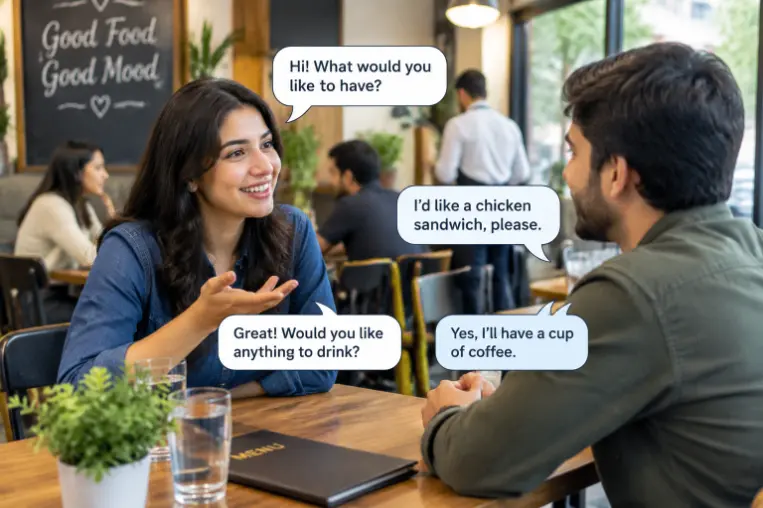
Once you decide what to eat, use polite expressions to place your order.
“I’d like…” and “I’ll have…” are two natural ways to order.
Example conversation:
Waiter: Are you ready to order?
Customer: Yes. I’d like a chicken sandwich, please.
Waiter: Would you like fries or salad with that?
Customer: I’ll take the salad.
Waiter: And what would you like to drink?
Customer: Just water, please. No ice.
Waiter: Certainly. Anything else?
Customer: No, that’ll be all for now.
Waiter: Your order will be ready in about ten minutes.
Customer: Perfect. Thank you.
Useful ordering sentences:
- I’ll have the grilled chicken.
- Could I have a cup of tea?
- I’d like a glass of orange juice.
- Can I have some extra sauce?
- Could you make it without onions?
- I’d prefer rice instead of fries.
- That’s all for now.
- Could you confirm my order?
4. Asking About Ingredients, Allergies and Dietary Preferences
Sometimes customers need to check the ingredients before ordering. This is particularly important when someone has a food allergy or follows a particular diet.
Example conversation:
Customer: Excuse me. Does this dish contain peanuts?
Waiter: Let me check with the kitchen.
Customer: Thank you. I have a peanut allergy.
Waiter: I’ll confirm the ingredients before you order.
Customer: I appreciate that.
Useful expressions:
- I’m allergic to peanuts.
- Does this contain dairy?
- Is this meal vegetarian?
- Does this contain eggs?
- Could you prepare it without garlic?
- Do you have gluten-free options?
- Could you check with the kitchen?
5. Making Requests and Handling Restaurant Problems
Real conversations can involve unexpected situations. Your order might be incorrect, your food might arrive cold, or you may need extra cutlery.

Learn how to explain these problems politely.
Wrong order:
Customer: Excuse me. I ordered tea, not coffee.
Waiter: I’m sorry about that. I’ll replace it.
Customer: Thank you.
Cold food:
Customer: Excuse me. My food is a little cold.
Waiter: I’m sorry. I’ll take it back to the kitchen.
Customer: Thank you.
Asking for something extra:
Customer: Could I have another fork, please?
Waiter: Certainly. Here you are.
Customer: Thank you.
Other useful expressions:
- Could we have some more water?
- May I have extra napkins?
- Could you bring the takeaway box?
- How long will our food take?
- Could you check our order?
- Where is the restroom?
- Do you have free Wi-Fi?
6. Asking for the Bill and Making Payment
After finishing your meal, you may need to ask for the bill, check the total, choose a payment method and request a receipt. This part of English Conversation for Everyday Life also gives you a natural way to confirm the total and pay politely.

Example conversation:
Customer: Excuse me. Could I have the bill, please?
Waiter: Certainly. I’ll bring it right away.
Customer: Thank you.
Waiter: Here’s your bill.
Customer: Let me check it. Everything looks correct.
Waiter: How would you like to pay?
Customer: I’d like to pay by card.
Waiter: Certainly. Your payment has gone through.
Customer: Could I have a receipt, please?
Waiter: Of course. Here you are.
Customer: Thank you for the excellent service.
Useful payment vocabulary:
- Bill or check
- Receipt
- Cash
- Credit card
- Debit card
- Payment
- Service charge
- Separate payment
- Split the bill
- Takeaway box
7. A Complete Café Conversation: Sandwich, Wi-Fi and Dessert
This longer example follows a customer from choosing a seat to ordering a meal, asking for Wi-Fi, choosing dessert and finishing the visit. It adds natural expressions that short ordering examples often leave out.
Waiter: Hello. Welcome to Sunny Cafe. Table for one?
Customer: Yes, just me. Can I sit by the window?
Waiter: Of course. Please have a seat here. Here’s the menu.
Customer: Thank you. Everything looks good. I’ll have the chicken sandwich, please.
Waiter: Would you like fries or salad with that?
Customer: I’ll take the salad. And just water, please, no ice.
Waiter: Certainly. Your order will be ready in about ten minutes.
Customer: Thank you. Do you have free Wi-Fi?
Waiter: Yes. The password is on the napkin holder.
Customer: Great. Could I see the dessert menu when you have a moment?
Waiter: Our chocolate cake is very popular.
Customer: That sounds lovely. I’ll have one slice and a cup of tea.
Waiter: Coming right up. Enjoy your meal.
Customer: Thank you. Everything was delicious. Could I have the bill, please?
Useful expressions: “Can I sit by the window?”, “No ice, please”, “I’m looking forward to it”, “What do you recommend?” and “Could I have the bill, please?”
English Conversation at a Doctor’s Clinic
A doctor’s clinic involves several different conversations. You may speak with a receptionist when booking an appointment, a nurse during registration or an examination, and a doctor when explaining your symptoms. The English Conversation for Everyday Life clinic examples move step by step from reception to the consultation room and follow-up.
You may also need to discuss a prescription, medical test, laboratory results or follow-up appointment.
1. Booking a Medical Appointment
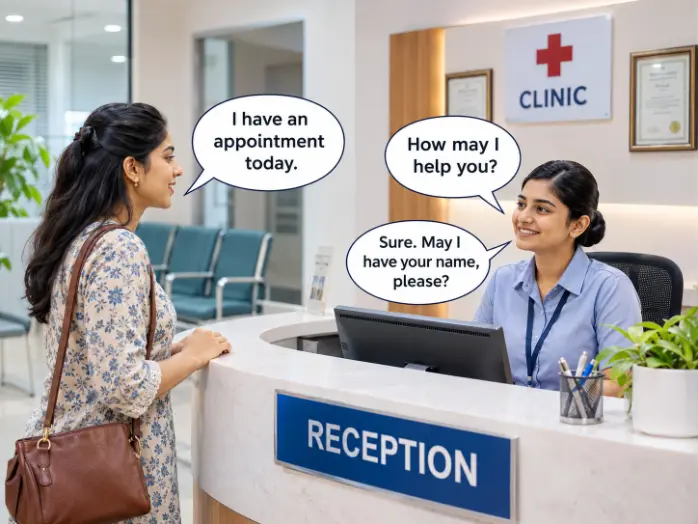
You can contact a medical clinic by telephone or visit the reception desk to arrange an appointment. For English Conversation for Everyday Life role-play, practise giving your name, explaining why you need an appointment and confirming the time.
Example conversation:
Receptionist: Good morning. Green Valley Medical Clinic. How may I help you?
Patient: Good morning. I’d like to book an appointment with a doctor.
Receptionist: Certainly. Is this your first visit?
Patient: Yes, it is.
Receptionist: What would you like to see the doctor about?
Patient: I’ve been feeling unusually tired and having frequent headaches.
Receptionist: Would you prefer an appointment today or tomorrow?
Patient: Do you have anything available tomorrow morning?
Receptionist: Yes. We have an appointment at 9:30 a.m.
Patient: That would be perfect.
Receptionist: May I have your full name, date of birth and contact number?
Patient: Certainly. My name is Ahmed Khan.
Receptionist: Thank you. Your appointment is confirmed.
Patient: Thank you very much.
Useful appointment expressions:
- I’d like to book an appointment.
- Is the doctor available today?
- Do you have an appointment tomorrow?
- Could I get an earlier appointment?
- I need to reschedule my visit.
- I’d like to cancel my appointment.
- What are your clinic hours?
- Is the appointment confirmed?
2. Checking In at the Reception Desk
When you arrive at the clinic, the receptionist may ask for your name, appointment time and identification.
Example conversation:
Patient: Good morning. I have an appointment at 10 a.m.
Receptionist: May I have your name, please?
Patient: My name is Ahmed Khan.
Receptionist: Thank you. Could you show me your identification card?
Patient: Of course. Here you are.
Receptionist: Have you brought your previous medical reports?
Patient: Yes, I have them with me.
Receptionist: Please take a seat in the waiting room. The nurse will call you shortly.
Patient: All right. Thank you.
Important clinic entities:
| Entity | Purpose |
|---|---|
| Reception desk | Appointment and patient registration |
| Receptionist | Manages appointments and patient information |
| Waiting room | Area where patients wait |
| Patient | Person receiving medical care |
| Identification card | Document used to confirm identity |
| Medical records | Previous health information |
| Examination room | Room where the doctor examines patients |
| Nurse | Healthcare professional who assists with patient care |
3. Explaining Symptoms to a Doctor
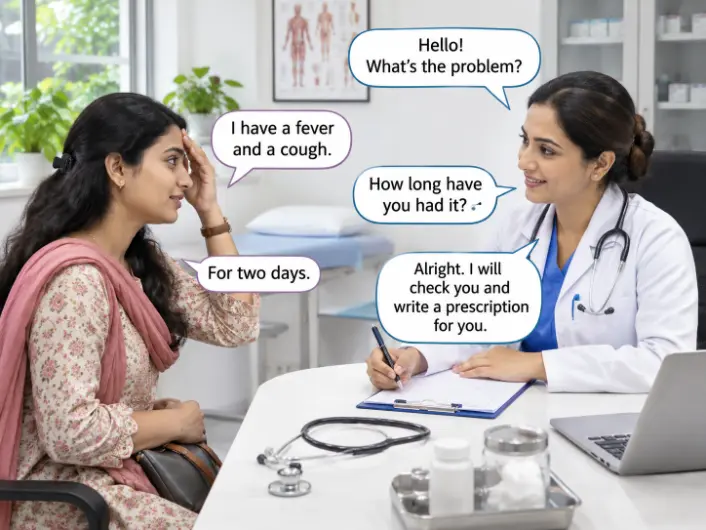
During a medical consultation, the doctor may ask about your symptoms, when they started and how they affect you. This English Conversation for Everyday Life exchange helps you practise describing symptoms clearly and briefly.
Use complete sentences to describe what you are experiencing.
Example conversation:
Doctor: Good morning. What brings you in today?
Patient: Good morning, doctor. I’m not feeling well.
Doctor: What symptoms are you experiencing?
Patient: I have a runny nose, a sore throat and a headache.
Doctor: Do you have a cough?
Patient: Yes, especially at night.
Doctor: Have you had a fever?
Patient: I felt feverish last night.
Doctor: When did these symptoms begin?
Patient: They started about three days ago.
Doctor: Are you taking any medication?
Patient: Yes, I take medicine for seasonal allergies.
Doctor: Do you have any known allergies?
Patient: Yes, I’m allergic to penicillin.
Doctor: Thank you for explaining. I’ll examine you now.
Common symptoms and medical vocabulary:
| Word or expression | Meaning |
|---|---|
| Headache | Pain in the head |
| Stomachache | Pain in the stomach |
| Sore throat | Pain or irritation in the throat |
| Cough | Repeated action of coughing |
| Fever | Higher-than-normal body temperature |
| Runny nose | Liquid coming from the nose |
| Blocked nose | Difficulty breathing through the nose |
| Dizziness | Feeling light-headed |
| Fatigue | Extreme tiredness |
| Allergy | Reaction to a particular substance |
Useful sentence patterns:
- I’ve had a headache since yesterday.
- My throat has been hurting for two days.
- I feel unusually tired.
- The pain started this morning.
- It hurts on the right side.
- I have difficulty sleeping.
- I’m taking medication for allergies.
4. Understanding a Medical Examination
During an examination, the doctor or nurse may use medical equipment to check your condition.
Common equipment includes:
- Stethoscope
- Thermometer
- Blood pressure monitor
- Weighing scale
- Examination bed
- Medical computer
Example conversation:
Doctor: Please have a seat.
Patient: Thank you.
Doctor: I’m going to check your temperature first.
Patient: All right.
Doctor: Now, let me check your blood pressure.
Patient: Sure.
Doctor: Please take a deep breath.
Patient: Like this?
Doctor: Yes, that’s right. Now you can relax.
Patient: Thank you, doctor.
Useful expressions:
- Please take a deep breath.
- Could you roll up your sleeve?
- Let me check your temperature.
- Please sit on the examination bed.
- Could you explain what you’re checking?
- Is everything normal?
5. Asking About Blood Tests and Laboratory Procedures
Sometimes a doctor requests a blood test or another laboratory investigation.
You may need to speak with a nurse or laboratory technician about the test, preparation and results.
Example conversation:
Patient: Good morning. My doctor has requested a blood test.
Nurse: May I see your laboratory request form, please?
Patient: Certainly. Here it is.
Nurse: Have you been fasting for this test?
Patient: Yes. I followed the doctor’s instructions.
Nurse: Please roll up your sleeve and relax your arm.
Patient: All right.
Nurse: That’s it. We’re finished.
Patient: Thank you. When will my results be ready?
Nurse: They should be available tomorrow afternoon.
Patient: Will I receive them by email?
Nurse: Yes, you can also access them through the patient portal.
Patient: That’s convenient. Thank you.
Useful laboratory vocabulary:
| Term | Meaning |
|---|---|
| Laboratory | Place where medical tests are performed |
| Blood sample | Small amount of blood collected for testing |
| Blood test | Medical test using a blood sample |
| Fasting | Not eating for a specified period before a test |
| Test results | Information produced by a medical test |
| Patient portal | Online system for accessing patient information |
6. Understanding Prescriptions and Follow-Up Appointments
After a consultation, the doctor may explain a treatment plan, provide a prescription or recommend another appointment.
Example conversation:
Doctor: I’ve reviewed your examination results.
Patient: All right, doctor.
Doctor: I’ll provide a prescription with the instructions for your medication.
Patient: Should I take it with food?
Doctor: Follow the dosage and directions written on the prescription.
Patient: How long should I take it?
Doctor: Follow the prescribed course and contact the clinic if you have questions.
Patient: When should I come back?
Doctor: I’d like to see you again in two weeks.
Patient: Should I book a follow-up appointment?
Doctor: Yes. The receptionist can arrange that for you.
Patient: Thank you, doctor.
Important expressions:
- Could you explain the prescription?
- What does this dosage mean?
- Should I take this medicine after meals?
- Are there any possible side effects?
- When should I return?
- I’d like to book a follow-up appointment.
- Could you explain that more simply?
These examples teach clinic communication. For actual medical decisions, follow a qualified healthcare professional’s instructions.
7. Booking an Appointment for a Family Member
You may need to call a clinic on behalf of a family member. The receptionist can ask for the patient’s name, date of birth, reason for the visit and preferred appointment time.
Receptionist: Good morning. Dr. Smith’s office. How can I help you?
Caller: Hello. I’d like to make an appointment for my wife.
Receptionist: Certainly. What is the patient’s first name?
Caller: Her name is Jen.
Receptionist: What is her last name and date of birth?
Caller: Her last name is Sanders. Her date of birth is January tenth, 1996.
Receptionist: What seems to be the problem?
Caller: She’s not feeling well and would like a checkup.
Receptionist: We have an appointment at 1:30 p.m. today. Would that work?
Caller: Yes, that would be perfect. Thank you.
Receptionist: You’re welcome. Please arrive a little early to check in.
Useful expressions: “I’d like to make an appointment for my wife”, “Is anything available this afternoon?”, “Could I get an earlier appointment?” and “Can I reschedule for next week?”
8. Asking About Blood Test Results and a Follow-Up Visit
After a test, you may need to ask when the results will be ready, how you will receive them and whether you need another appointment.
Patient: Excuse me. When will my blood test results be available?
Receptionist: Most results should be ready tomorrow afternoon.
Patient: Will I receive them by email?
Receptionist: Yes. You can also view them through the patient portal.
Patient: Will I get a notification when the report is ready?
Receptionist: Yes, you’ll receive a notification.
Patient: Thank you. I’d also like to arrange a follow-up appointment.
Receptionist: Certainly. The doctor has recommended a follow-up in two weeks.
Patient: That works for me. Could you tell me which times are available?
Useful vocabulary: blood sample, laboratory request form, test results, patient portal, notification and follow-up appointment.
English Conversation with a New Person
Meeting someone new can happen at work, school, college, university, an English club or a social gathering. Learners who want more structured practice can also work through these beginner dialogues in English. The English Conversation for Everyday Life examples here begin with simple introductions and build towards longer conversations. For workplace discussions, client communication and professional vocabulary, see the Business English lessons.
A natural conversation usually starts with a greeting, followed by an introduction, simple questions and shared interests. For a focused lesson on the first few lines of meeting someone, practise these English self-introduction examples. You can continue by asking follow-up questions and responding to what the other person says.
For more beginner practice with introductions and checking understanding, try the British Council’s A1 speaking lessons: British Council A1 speaking practice The lessons include short videos and useful phrases to listen to and repeat.
1. Introducing Yourself and Asking Someone’s Name
When meeting someone for the first time, begin with a friendly greeting.
Example conversation:
Ali: Hi! Is this seat taken?
Sara: No, go ahead.
Ali: Thank you. My name is Ali. What’s your name?
Sara: I’m Sara. Nice to meet you.
Ali: Nice to meet you too. Are you new here?
Sara: Yes, I joined the English club this week.
Ali: That’s great. I’m also a member.
Sara: Really? How long have you been attending?
Ali: For about three months.
Useful expressions:
- Hi, I’m Ahmed.
- What’s your name?
- Nice to meet you.
- Is this seat taken?
- Is this your first time here?
- May I join you?
- Are you new to this area?
- Where are you from?
2. Office English Conversation: Talking About Work and Colleagues
At a workplace, you may meet a new colleague or introduce yourself to someone in another department. Use this English Conversation for Everyday Life dialogue to practise introducing yourself to a colleague and asking about their role.
Example conversation:
Laura: Hi! Are you the new member of our sales department?
Alex: Yes, I am. My name is Alex.
Laura: Nice to meet you, Alex. Welcome to the team.
Alex: Thank you. I’m happy to be here.
Laura: Have you worked in sales before?
Alex: Yes, I worked for a small company for two years.
Laura: That’s interesting. What was your position?
Alex: I was a sales assistant.
Laura: Great. Your desk is over there. Let me know if you need anything.
Alex: Thank you. I appreciate your help.
Useful workplace vocabulary:
- Colleague
- Coworker
- Department
- Manager
- Sales assistant
- Accountant
- Position
- Job responsibilities
- Office
- Meeting
- Lunch break
- Work experience
This office English conversation for daily use helps you practise asking about tasks, checking progress, speaking politely with colleagues and making simple workplace plans.
3. English Conversation for Students at School, College and University
Students often need English conversation to introduce themselves, talk about their studies, meet classmates and participate in group discussions. These English Conversation for Everyday Life examples also help students talk about classes, subjects and group projects.
Example conversation:
Maria: Hello. Are you a first-year student?
Jennifer: No, I’m in my third year. What about you?
Maria: I just started university.
Jennifer: That’s nice. What’s your major?
Maria: I’m studying business management.
Jennifer: Interesting. How are you finding your classes?
Maria: They’re good, but I’m still getting used to the university.
Jennifer: Don’t worry. You’ll make friends soon.
Maria: Thank you. Are you a member of any university clubs?
Jennifer: Yes, I attend the English speaking club.
Useful academic vocabulary:
- University
- College
- Student
- Classmate
- Lecturer
- Course
- Major
- Assignment
- Project
- Discussion
- English club
- Library
- Campus
- Graduation
These examples are useful English conversation for everyday life for students, including classroom introductions, group projects, campus activities and conversations with classmates.
These examples give students practical English conversation for everyday life at school, college and university, including introductions, group projects and conversations with classmates.
4. Talking About Hobbies and Personal Interests
Hobbies are an easy way to discover shared interests and keep a conversation going.
You can talk about reading, music, photography, sports, cooking, films or travelling.
Example conversation:
Daniel: What do you enjoy doing in your free time?
Emma: I enjoy reading and listening to music.
Daniel: That’s interesting. What kind of books do you read?
Emma: Mostly novels and short stories.
Daniel: Do you enjoy sports?
Emma: Yes, I like swimming. What about you?
Daniel: I enjoy playing tennis and football.
Emma: That’s great. We should play together sometime.
Useful questions:
- What are your hobbies?
- What do you do in your free time?
- What kind of music do you like?
- Do you enjoy reading?
- Have you seen any good films lately?
- Do you enjoy travelling?
- Which sports do you play?
- What do you usually do on weekends?
5. Making Small Talk and Asking Follow-Up Questions
Small talk is friendly conversation about familiar topics. It helps people become comfortable with each other.
Common topics include weather, weekend activities, food, travel, work and studies.
Example conversation:
Ayesha: Hi, how was your weekend?
Nadia: It was great, thanks. I visited my family.
Ayesha: That sounds lovely. Did you travel far?
Nadia: No, they live nearby.
Ayesha: What did you do together?
Nadia: We had dinner and watched a movie.
Ayesha: That sounds nice. What movie did you watch?
Nadia: A comedy film. It was really funny.
Useful follow-up questions:
- What happened next?
- Why do you like it?
- How often do you do that?
- Who do you usually go with?
- How did you get interested in it?
- Can you tell me more?
- What about you?
A follow-up question connects your response to something the other person has already said. This is more natural than asking unrelated questions one after another.
6. Making Plans, Invitations and Ending Conversations
After discovering a shared interest, you can invite someone to join an activity.
Example conversation:
Ali: Do you enjoy visiting cafés?
Hamza: Yes, I do.
Ali: Would you like to get coffee sometime?
Hamza: That sounds nice.
Ali: Are you free on Saturday afternoon?
Hamza: Yes, I’m free after four.
Ali: Great. Shall we meet at the café near the park?
Hamza: Sure. See you there.
Ali: See you!
Useful expressions:
- Would you like to join me?
- Are you free this weekend?
- Shall we meet tomorrow?
- What time works for you?
- That sounds like a good idea.
- I’d love to join you.
- Thanks, but I can’t today.
- I should get going now.
- It was nice talking to you.
- Would you like to exchange numbers?
7. Handling Awkward Moments and Personal Questions
Sometimes you may not understand a question, forget a word or feel uncomfortable discussing a personal subject.
You can politely ask for clarification or set a boundary.
Example conversation:
Person A: How long have you lived here?
Person B: About five years.
Person A: Do you live alone?
Person B: I’d rather not discuss that just yet.
Person A: No problem.
Person B: Thank you for understanding.
Other useful expressions:
- Sorry, could you repeat that?
- Could you speak more slowly?
- I didn’t catch your name.
- Let me think for a moment.
- I’m not sure how to explain it.
- I’d prefer not to answer that.
- Could you explain what you mean?
These expressions are useful because real conversations are not always predictable.
Daily Conversation Vocabulary for Meeting New People
| Word | Meaning |
|---|---|
| Introduction | Telling someone who you are |
| Acquaintance | Someone you know but may not know well |
| Hometown | Place where someone grew up |
| Nationality | Country a person belongs to |
| Occupation | A person’s job |
| Housemate | Person sharing a home |
| Commute | Regular journey between home and work or study |
| Sibling | Brother or sister |
| Interest | Activity or subject someone likes |
| Invitation | Request to attend or join something |
| Small talk | Friendly conversation about everyday subjects |
| Contact details | Information used to communicate with someone |
8. Talking About Travel, Work and Other Cultures
Travel is a natural small-talk topic. Ask where someone has travelled, what they do for work and what they enjoy about visiting other countries.
Emily: Are you interested in travelling?
Archie: Yes, I love travelling, although I don’t get much free time.
Emily: Do you travel a lot?
Archie: I do. I’m a photographer, so I travel for my job.
Emily: How interesting. Do you work for a magazine?
Archie: Sometimes. I work freelance for magazines and newspapers, and I also take pictures for travel books.
Emily: That sounds wonderful. Where are you going next?
Archie: I’m going to Chile for a magazine assignment. I’ll be there for a few months.
Emily: What do you enjoy most about travelling?
Archie: Meeting people, learning how they live and experiencing different cultures.
Useful expressions: “Do you travel a lot?”, “What do you do for a living?”, “Where are you going next?” and “I enjoy experiencing different cultures.”
9. Meeting a New Classmate and Working on a Project
This situation is useful for students who need English conversation for everyday life at school, college or university.
Destiny: It looks like we’ve been put in a group together. What’s your name?
Thomas: I’m Thomas, but you can call me Tom. Nice to meet you.
Destiny: Nice to meet you too. Where are you from?
Thomas: I’m from Germany. I moved here last week.
Destiny: How are you finding the college so far?
Thomas: It’s good, but I’m still trying to make new friends.
Destiny: What do you like doing in your free time?
Thomas: I enjoy swimming and playing sports. What about you?
Destiny: I like tennis. We should play sometime.
Thomas: Good idea. Let’s finish our project first.
Useful expressions: “We’ve been put in a group together”, “How are you finding the class?”, “Do you understand the project?” and “Let’s work on it together.”
10. Meeting a New Housemate at University
When sharing a home, you may talk about rooms, household facilities, daily routines, pets and university life.
Jennifer: Hi, you must be Maria. Come in and make yourself at home.
Maria: Thank you. It’s nice to meet you.
Jennifer: Are you a first-year student?
Maria: Yes. What about you?
Jennifer: I’m in my third year. We’ve been living here for two years.
Maria: Where is the washing machine?
Jennifer: It’s downstairs. I’ll show you after dinner.
Maria: Thank you. Do you have any pets?
Jennifer: No. One of our housemates is allergic to animal fur.
Maria: I enjoy running. Do you ever go running?
Jennifer: Yes, we usually go in the morning.
Useful expressions: “Make yourself at home”, “Where is the washing machine?”, “Which room is mine?” and “What time do you usually get up?”
11. Joining an English Club and Starting a Group Discussion
An English club gives learners a friendly place to introduce themselves, talk about their studies and practise group discussions.
Paul: Hello everyone. I’m a new member of the English club. My name is Paul.
Laura: Hi Paul. Nice to meet you. You can sit with us.
Paul: Thank you. How long have you been learning English?
Laura: I’ve been learning for about two years. What about you?
Paul: Only three months. I’m still a beginner.
Laura: Don’t worry. We can practise together.
Paul: What is today’s discussion topic?
Laura: Today we’re talking about the environment.
Paul: That sounds interesting. I’d like to share an idea.
Laura: Great. Go ahead.
Useful expressions: “I’m a new member”, “Can I sit here?”, “What’s today’s topic?”, “I’d like to share an idea” and “What do you think?”
12. Introducing a Friend at Dinner
Social dinners often include introductions, questions about food and plans for an activity after the meal.
John: Hi, everyone. This is Alice, my girlfriend.
Alice: Hello. Nice to meet you.
Susan: Nice to meet you too. Please have a seat.
Peter: What’s your favourite food, Alice?
Alice: I love beef steak. What about you?
Peter: That’s one of my favourites too.
John: Are we ready to order?
Susan: Yes. I’d like the beef steak, please.
Alice: That sounds good. I’ll have the same.
John: Would you like to go to the cinema after dinner?
Peter: That’s a great idea.
Useful expressions: “This is my friend…”, “What’s your favourite food?”, “Are you ready to order?” and “Would you like to go to the cinema?”
Daily Conversation in English at Home
Home is one of the easiest places to practise everyday English because you repeat familiar activities every day. You can reinforce these dialogues with more daily-use English sentences for familiar situations. These daily conversation dialogues cover getting ready in the morning, preparing breakfast, cleaning rooms, making a grocery list, deciding what to eat, fixing household problems and discussing family expenses. They provide practical English conversation for daily use without introducing unfamiliar situations. The home dialogues make English Conversation for Everyday Life easier to practise because the situations repeat in familiar routines.
1. Morning Routine, Weather and Breakfast
This dialogue follows a family getting ready for school and preparing breakfast. It includes daily routine English conversation sentences and food vocabulary. This English Conversation for Everyday Life practice starts with greetings, getting ready and talking about breakfast.
Mother: Good morning, Nicholas. It’s time for school. Come on, get out of bed.
Nicholas: Good morning, Mom. What’s the weather like today?
Mother: It’s a little cloudy and windy. We should take our umbrellas.
Nicholas: What are we having for breakfast?
Mother: Egg bagel sandwiches and a strawberry-blueberry smoothie.
Nicholas: Can I help make the smoothie?
Mother: Of course. Add the almond milk, strawberries, blueberries and yogurt to the blender.
Nicholas: Should I add a banana?
Mother: Not this time. We want the berry flavour to stand out.
Nicholas: It looks delicious. Breakfast is ready!
Mother: Great. Eat quickly, then brush your teeth and get dressed.
Useful daily sentences: “It’s time to get up”, “What’s the weather like?”, “Breakfast is ready”, “Can I help?” and “We should get going.”
2. Cleaning the House and Sharing Chores
Use these expressions when family members divide housework, organise rooms or decide what to keep, donate or throw away.
Mother: Today we’re going to clean the whole house.
Daughter: What do we need to do first?
Mother: Please clear your beds and chairs, put everything in its proper place and clean under the beds.
Son: Do we need to make the beds too?
Mother: Yes. Use fresh bed sheets, then vacuum the room and dust the shelves.
Daughter: That’s quite a lot of work.
Mother: I know. I’ll clean the kitchen while your father takes care of the living room.
Son: What should we do with the old things in the attic?
Mother: Make four piles: keep, donate, sell and throw away.
Daughter: We could have a garage sale next weekend.
Mother: That’s a good idea. Let’s finish the cleaning first.
Useful vocabulary: chores, laundry, vacuum, mop, dust, shelves, fresh linens, donate, garage sale and tidy up.
3. Grocery Shopping and Making a Shopping List
This example practises quantities, food names and polite questions before someone goes to the supermarket. Use this English Conversation for Everyday Life shopping example to practise quantities, food names and checking a list.

Sara: Mom asked me to go grocery shopping, but I need to finish my homework. Can you go for me?
Nicholas: Sure. What do we need?
Sara: Some fish, vegetables, fruit, milk and bread.
Nicholas: Which fish should I buy?
Sara: Four salmon fillets and four pieces of cod. Make sure they’re fresh.
Nicholas: What vegetables do we need?
Sara: Carrots, potatoes, cabbage and lettuce.
Nicholas: Do we need any fruit?
Sara: Yes, apples and bananas. Please buy bottled water instead of soft drinks.
Nicholas: Should I get one loaf of bread or two?
Sara: Two loaves, please. Don’t forget the milk.
Nicholas: All right. I’ll be back soon.
Useful expressions: “What do we need?”, “How much should I buy?”, “Make sure it’s fresh”, “Add it to the list” and “Don’t forget the bread.”
4. Deciding What to Have for Dinner at Home
Families often discuss food preferences before deciding whether to cook or order takeaway. Practise agreeing, disagreeing and making suggestions politely.
Dad: What would you like for dinner?
Son: I’d like something spicy, maybe chili.
Daughter: I’m not in the mood for spicy food.
Mother: I’ve been busy all day, so I don’t feel like cooking.
Dad: Why don’t we order something?
Son: Can we have Chinese food?
Daughter: What about pizza?
Mother: There’s a new Greek restaurant downtown. I’ve heard good things about it.
Dad: We could order a pizza instead. It would be easier.
Son: I’ll have pepperoni.
Daughter: I’d prefer chicken pizza. I don’t like pineapple on pizza.
Mother: All right. Let’s choose a few pizzas and share.
Useful expressions: “I’m not in the mood for…”, “Why don’t we…?”, “What about…?”, “I’d prefer…” and “Let’s order something.”
5. Fixing a Household Problem and Planning Home Improvements
Use these phrases to discuss a broken appliance, ask for help or plan small repairs and decorating work.
Husband: The clothes dryer has stopped working. We may need to call a repair person.
Wife: Is it completely broken?
Husband: I think it needs a new moisture sensor. I watched an instructional video.
Wife: Are you sure you can fix it?
Husband: I’ll try. I’ve repaired household appliances before.
Wife: All right. Please be careful.
Husband: It’s working again. The new sensor fixed the problem.
Wife: That’s great. We should also measure the windows for new curtains.
Husband: Good idea. We can repaint the walls next weekend.
Wife: Let’s make a list of the materials we need.
Useful vocabulary: repair, appliance, moisture sensor, instruction manual, tape measure, curtains, paint and redecorate.
6. Discussing the Household Budget and Saving Electricity
This conversation practises money, monthly expenses, receipts and simple ways to reduce household energy use.
Wife: I’ve checked our household budget. We’ve spent more than usual this month.
Husband: We should look at the receipts and see where the money went.
Wife: We spent quite a lot on groceries, fuel, clothes and entertainment.
Husband: We could eat at home more often. That would reduce restaurant expenses.
Wife: That’s a good idea. We should also check our electricity bill.
Husband: Was it higher than usual?
Wife: Yes, it was almost double.
Husband: Let’s unplug devices we’re not using and switch to LED bulbs.
Wife: We can also wash clothes in cold water and run full loads.
Husband: And remember to adjust the heating or cooling when we leave home.
Wife: If we make these small changes, we can save money.
Useful vocabulary: budget, expenses, receipt, savings account, electricity bill, unplug, energy-efficient, full load and reduce costs.
Useful Daily Conversation Sentences at Home
- Could you help me set the table?
- I’ll wash the dishes after dinner.
- Have you finished your homework?
- Where did you put the shopping list?
- We need to buy some milk and bread.
- Could you turn off the lights?
- I’ll take care of the laundry.
- Let’s clean the kitchen together.
- What time are we leaving tomorrow?
- I’ll be back in a few minutes.
Basic English Conversation Questions and Answers for Daily Use
Many learners search for simple English conversation in daily life because they need ready-to-use questions and answers, not grammar explanations alone. If you are building your foundation, start with these basic English sentences and practise changing the details. Practise these short exchanges aloud. Replace the names, places, times and details with information from your own life. These short exchanges turn English Conversation for Everyday Life into manageable question-and-answer practice.
Personal Information
Q: How are you?
A: I’m fine, thank you. How are you?
Q: What is your name?
A: My name is Anna.
Q: Where are you from?
A: I’m from the United States.
Q: What do you do?
A: I’m a teacher.
Q: Where do you live?
A: I live in New York.
Q: How old are you?
A: I’m 25 years old.
Q: What is your nationality?
A: I’m American.
Q: Do you speak English?
A: Yes, I do.
Q: What languages do you speak?
A: I speak English and Spanish.
Q: What day is it today?
A: Today is Monday.
Family and Friends
Q: Do you have any brothers or sisters?
A: Yes, I have one brother.
Q: Who is your best friend?
A: My best friend is Lisa.
Q: Do you visit your family often?
A: Yes, I visit them every weekend.
Q: Do you go out with friends?
A: Yes, we usually go out on Saturdays.
Q: Do you live with your family?
A: Yes, I do.
Q: What is your father’s name?
A: His name is John.
Q: What does your mother do?
A: She is a nurse.
Q: Do you have grandparents?
A: Yes, I do.
Q: Do you call your friends every day?
A: Not every day, but quite often.
Q: Do you like meeting new people?
A: Yes, I do.
Daily Routine and Work
Q: What do you do in the morning?
A: I brush my teeth and take a shower.
Q: What do you eat for breakfast?
A: I usually eat bread and eggs.
Q: How do you go to work?
A: I go by bus.
Q: What time do you start work?
A: I start at nine in the morning.
Q: What do you do after work?
A: I relax and watch TV.
Q: What time do you finish work?
A: I finish at five p.m.
Q: Do you work on Saturdays?
A: No, I don’t.
Q: Do you go to the gym?
A: Yes, twice a week.
Q: What do you do on Sundays?
A: I relax and visit my family.
Q: Do you listen to music?
A: Yes, every day.
Home, City and Transport
Q: Do you live in a house or an apartment?
A: I live in an apartment.
Q: How many rooms are there?
A: There are four rooms.
Q: Do you have a car?
A: No, I don’t. I usually take the bus.
Q: What is your favourite place in the city?
A: I like the park.
Q: Is there a library near your home?
A: Yes, there is.
Q: Do you have a garden?
A: No, I don’t.
Q: Do you go to the library?
A: Yes, sometimes.
Q: Do you have a car?
A: No, I don’t.
Q: Do you walk to work?
A: Yes, I do.
Q: Is the bus fast?
A: No, it’s quite slow.
Health, Food and Hobbies
Q: Are you feeling well today?
A: Yes, I feel good.
Q: Do you sleep well?
A: Yes, I usually sleep for eight hours.
Q: Can you swim?
A: Yes, I can.
Q: Do you like reading books?
A: Yes, I love reading.
Q: What is your favourite season?
A: My favourite season is winter.
Q: Do you feel sick today?
A: No, I feel good.
Q: Do you take medicine?
A: Only when I need it.
Q: Do you sleep well?
A: Yes, I usually sleep eight hours.
Q: Can you ride a bike?
A: No, I can’t.
Q: Do you like animals?
A: Yes, I do.
Practice tip: Answer each question with your own information. Then ask the same question to a partner. This turns daily English conversation sentences into a real speaking activity.
Daily English Conversation Words and Sentences: 100 Common Phrases
These common English conversation sentences are organised by situation, so you can use them in real conversations instead of memorising isolated expressions. Practise ten at a time, then change the details to fit your own daily routine, home, workplace or social life. The 100 phrases give English Conversation for Everyday Life learners ready-to-use expressions for common situations.
Greetings and introductions
- Hello, how are you?
- Good morning. How was your night?
- Nice to meet you.
- What’s your name?
- Where are you from?
- How is your day going?
- It’s good to see you.
- How have you been?
- Please have a seat.
- Make yourself at home.
Daily routine and home
- What time do you get up?
- I’m getting ready for work.
- Breakfast is ready.
- I’ll be there in a minute.
- What are we having for dinner?
- Could you help me with this?
- I’ll do it after lunch.
- Let’s tidy up the room.
- Have you seen my keys?
- I’m running a little late.
Shopping and restaurant
- I’d like a table for two, please.
- Could I see the menu?
- What do you recommend?
- I’ll have the chicken, please.
- Could I have some water?
- Does this contain nuts?
- Can I pay by card?
- Could I have the bill?
- How much does this cost?
- Do you have this in another size?
Doctor’s clinic
- I’d like to book an appointment.
- I’m not feeling well.
- I’ve had a headache since yesterday.
- I have a sore throat.
- How long will I have to wait?
- Could you explain that again?
- Should I take this with food?
- When will the results be ready?
- I’d like to reschedule my appointment.
- Thank you for your help.
Meeting people and small talk
- What do you do?
- What are you studying?
- What do you enjoy doing?
- What do you do in your free time?
- Have you lived here long?
- How was your weekend?
- What kind of music do you like?
- Would you like to join us?
- Are you free this Saturday?
- It was nice talking to you.
Clarification and understanding
- Could you repeat that, please?
- Could you speak more slowly?
- What do you mean?
- I didn’t catch that.
- Let me think for a moment.
- I’m not sure I understand.
- Could you give me an example?
- How do you spell that?
- Did you say Tuesday or Thursday?
- Thanks for explaining.
Opinions and reactions
- I think that’s a good idea.
- That sounds interesting.
- I agree with you.
- I’m not sure about that.
- In my opinion, it’s useful.
- I’m happy to hear that.
- That’s a shame.
- No worries.
- It depends.
- I see what you mean.
Plans and invitations
- What are your plans for tomorrow?
- Shall we meet at six?
- That works for me.
- Can we change the time?
- I’d love to come.
- Sorry, I can’t make it.
- Let’s keep in touch.
- I’ll call you later.
- See you tomorrow.
- Have a safe trip.
Polite requests
- Could you help me, please?
- Would you mind opening the window?
- May I ask you a question?
- Could I borrow your pen?
- Would you like some tea?
- Please give me a moment.
- Could you show me the way?
- Is it okay if I sit here?
- Thank you, I appreciate it.
- You’re welcome.
Everyday responses
- Of course.
- Not at all.
- That’s fine with me.
- I’m on my way.
- Just a moment, please.
- I’ll think about it.
- I don’t know yet.
- That sounds great.
- Maybe next time.
- See you soon.
100 Basic English Words Used in Daily Conversation
Start with these common words. Learn their meanings and use them in short sentences. The groups make it easier to revise vocabulary by situation.
People
family, friend, neighbour, teacher, doctor, waiter, student, colleague, child, customer
Time
morning, afternoon, evening, night, today, tomorrow, yesterday, weekend, minute, hour
Home
house, room, kitchen, bedroom, bathroom, door, window, table, chair, key
Food
bread, rice, egg, milk, water, coffee, tea, fruit, vegetables, chicken
Actions
go, come, get, make, take, give, ask, answer, help, need
Places
school, college, office, clinic, restaurant, shop, market, station, park, library
Health
pain, fever, cough, headache, medicine, appointment, test, nurse, symptom, rest
Conversation
hello, please, thanks, sorry, yes, no, maybe, because, when, where
Travel
bus, train, ticket, road, map, hotel, airport, trip, luggage, passport
Feelings and descriptions
happy, tired, hungry, thirsty, busy, free, easy, difficult, good, important
For example: “My family is at home”, “I need a bus ticket”, “The doctor has an appointment available” and “I’m tired after work.” Learning words in context helps you use them naturally in conversation.
How to Practise English Conversation for Everyday Life
Knowing phrases and vocabulary is only the beginning. Regular English conversation practice helps you turn what you read into spoken responses. You also need to listen carefully, understand questions, respond appropriately and maintain a natural exchange. These are core English conversation skills to develop through repeated practice. To make English Conversation for Everyday Life more natural, practise each expression aloud and then use it in a new sentence. If speaking hesitation is a challenge, these English speaking confidence tips offer another useful practice direction.
You can also choose extra level-based speaking activities from Cambridge English: Cambridge English speaking activities Filter activities by level and skill to find practice that matches your current ability.
Use these seven practical habits:
- Listen actively: Focus on the speaker’s main message rather than trying to understand every word.
- Repeat useful expressions: Practise sentences from real-life dialogues aloud.
- Learn vocabulary in context: Remember words such as reservation, receptionist and prescription through complete sentences.
- Use follow-up questions: Ask relevant questions to continue the discussion.
- Practise role-play: Act as a customer, patient, waiter, receptionist or new colleague.
- Record your voice: Listen for pronunciation, pauses and unclear words.
- Practise without memorising: Change names, places, food choices and situations to create original conversations.
A 10-Minute Routine to Learn Daily English Conversation
If you are wondering how to learn daily English conversation, follow this short routine. It turns a written dialogue into speaking practice you can use in real life. This simple English Conversation for Everyday Life routine gives you a short speaking task to repeat each day.
- Choose one situation: Pick a dialogue about home, a restaurant, a clinic or meeting someone.
- Read for meaning: Read the complete conversation once and check unfamiliar words.
- Speak both roles: Read each person’s lines aloud, then repeat with a partner if possible.
- Change the details: Use your own name, food, time, workplace or family details to make a new version.
- Try it from memory: Cover the dialogue and answer naturally. Record yourself if you want to check clarity.
Make Everyday English Sound Natural
Real conversations often use contractions and short follow-up responses. Practise forms such as “I’m”, “you’re” and “don’t”, and keep a conversation moving with expressions like “How about you?”, “That sounds good”, “Could you explain that again?” and “Give me a moment, please.” Choose polite or casual wording to suit the person and situation.
100 Short English Conversations for Everyday Life PDF
The free printable PDF contains 100 short dialogues divided into the three situations covered in this article. This free daily conversation PDF is a practical companion for learners who want English conversation for daily use and speaking practice offline. The printable resource extends English Conversation for Everyday Life practice beyond the screen and can be used offline.
- Restaurant: 34 conversations about reservations, menu choices, food orders, allergies, takeaway and payment.
- Doctor’s clinic: 33 conversations about appointments, registration, symptoms, examinations, blood tests and follow-up.
- Meeting a new person: 33 conversations about introductions, work, studies, hobbies, small talk, invitations and social interaction.
Download the Free 100 Short English Conversations PDF
To practise, read both speakers’ lines aloud, cover one speaker’s answers, respond from memory and then switch roles. Focus on clear communication rather than memorising every sentence.
Free printable practice resource
Keep the 100 short dialogues together with this HTML lesson so you can practise offline. Use the English Conversation for Everyday Life PDF to practise one dialogue at a time, then try the same situation without reading.
Frequently Asked Questions About English Conversation for Everyday Life
How to talk English in daily life?
Start with simple greetings, everyday questions and polite responses. Practise situations such as ordering food, visiting a clinic and meeting someone new. Learn complete expressions and use them in your own conversations rather than translating every sentence word for word.
What are some good daily topics for English conversation?
Useful topics include daily activities, family, work, studies, hobbies, food, weather, travel and weekend plans. Choose familiar subjects first so you can focus on expressing your thoughts rather than searching for ideas.
What are the 7 types of conversation?
There is no single universally accepted classification of seven conversation types. For practical speaking practice, you can work on:
- Greetings and introductions.
- Small talk.
- Asking and sharing information.
- Making requests.
- Expressing opinions and feelings.
- Clarifying misunderstandings.
- Making plans and invitations.
What are 100 common English phrases?
The phrase bank in this guide gives 100 everyday expressions grouped by situation, including greetings, home routines, restaurant visits, clinic conversations, small talk, clarification, opinions, plans and polite requests. Open the 100-phrase practice list.
Can you give me 100 basic English words?
Yes. The vocabulary section includes 100 useful words grouped into people, time, home, food, actions, places, health, conversation, travel and feelings. See the 100-word list.
How can I improve my English speaking skills?
Practise listening and speaking together. Read short dialogues, repeat sentences, learn vocabulary in context, answer everyday questions and use role-play activities. Recording your voice can also help you notice pronunciation problems and improve your responses.
What are the 7 powerful speaking tips?
- Listen before responding.
- Use simple sentence structures.
- Learn useful expressions.
- Speak at a comfortable speed.
- Practise complete dialogues.
- Ask follow-up questions.
- Keep speaking even when you make small mistakes.
How can I speak more clearly?
Pay attention to pronunciation, word stress, sentence rhythm and pauses. Speak at a comfortable speed, listen to clear English recordings and repeat short sentences. Record your voice to identify sounds and words that need more practice.
What are the five skills of English?
The four core English language skills are listening, speaking, reading and writing. Some educational frameworks also identify viewing or visual literacy as an additional skill. For everyday conversation, listening and speaking are particularly important.
What are the 7 rules for excellent English speaking?
- Listen carefully before responding.
- Use clear and suitable sentence patterns.
- Pronounce words as clearly as you can.
- Learn vocabulary in context.
- Speak regularly at a comfortable speed.
- Ask questions when you need clarification.
- Continue communicating even when you make small mistakes.
What are 10 benefits of learning English?
Learning English can support international communication, education, career opportunities, travel, online learning, professional networking, reading, entertainment, cultural exchange and access to information.
What are the four main English skills?
The four main skills are listening, speaking, reading and writing. Listening and reading help you understand language, while speaking and writing help you communicate your ideas.
What is the best skill to learn English?
The best skill depends on your learning goal. If you want to communicate in everyday situations, prioritise listening and speaking while continuing to develop vocabulary, grammar and pronunciation.
What are the four pillars of English?
The four pillars commonly refer to listening, speaking, reading and writing. Developing all four helps you understand English and communicate effectively.
How can I learn a language quickly?
Set a realistic daily practice routine, listen to comprehensible material, learn frequently used expressions, review vocabulary regularly and use the language in meaningful conversations. Consistent active practice is more useful than trying to memorise large amounts of information at once.
What’s the best way to learn English?
Combine listening, speaking, reading and writing with practical daily exercises. For conversation, use realistic dialogues, practise both roles, ask follow-up questions and apply new expressions in your own situations.
Is English really the easiest language to learn?
Not necessarily. Difficulty depends on your first language, previous language-learning experience, exposure and learning environment. Some learners find English vocabulary familiar, while others struggle with pronunciation, spelling and grammar.
Why is English hard to learn?
English can be challenging because spelling does not always match pronunciation, some verbs are irregular, and words can have different meanings depending on context. Phrasal verbs, articles and sentence patterns can also require practice.
What is the best age to learn English?
There is no single best age. Children, teenagers and adults can all learn English. Regular exposure, meaningful practice and suitable learning materials are important at every stage.
What’s the hardest part of learning English?
For many learners, speaking spontaneously is difficult because it requires listening, understanding, selecting vocabulary and constructing a response quickly. Practising complete conversations can help develop these abilities.
What is the most commonly used vocabulary in English conversation?
Everyday conversations often use short, frequent words such as I, you, we, it, the, a, is, are, do, have, can, will, want, like, go, get, make, need, please and thanks. Learn them in complete sentences because their meaning and grammar depend on context.
Can I download English conversation for daily use as a free PDF?
Yes. Use the free 100 Short English Conversations PDF linked in this article. It is designed for speaking practice. Keep the HTML lesson and PDF in the same folder when uploading them to your website so the download link continues to work.
Are these English conversations useful for students?
Yes. The examples include meeting classmates, joining an English club, working on a group project, talking about subjects and making plans. Students can practise the dialogues with a partner or read both roles aloud.
How many daily English sentences should I practise?
Start with five to ten useful sentences a day. Say each sentence aloud, use it in a short exchange and review it the next day. Regular practice is more useful than trying to memorise a long list in one sitting.
What is the difference between daily-use English and formal English?
Daily-use English is usually shorter and more conversational, such as “Can I have some water?” Formal English may use more complete or carefully phrased requests, such as “Could I please have a glass of water?” Choose the level of politeness that fits the situation.
Can I practise real-life English conversations without a speaking partner?
Yes. Read both parts of a dialogue aloud, cover one speaker’s lines and answer from memory, then switch roles. You can also record yourself and compare your pronunciation with a clear audio model.
Why is English conversation important in everyday life?
English conversation helps you share information, ask for help, build relationships and manage familiar situations such as shopping, studying, working, travelling and visiting a clinic. Practising realistic dialogues helps you choose suitable words and respond more confidently.
How can I practise daily English conversation for speaking?
Choose one short dialogue, read both roles aloud, switch speakers and replace the names or details with your own. Then cover the lines and try the conversation from memory. A few minutes of active speaking practice each day can help you use everyday phrases more naturally.