
English Conversation Skills: How to Keep Conversations Going Naturally
Improving your English conversation skills is not just about learning more vocabulary or memorizing grammar rules; it is about understanding what someone says, responding naturally, asking relevant follow-up questions, and expressing your thoughts without long pauses. If you often give one-word answers, struggle to think of what to say next, or feel nervous speaking English, this guide will help you overcome those problems. You will learn how to keep conversations going, use natural English replies instead of short answers, ask 100 useful conversation questions, and practise speaking independently at home. With practical examples, simple speaking frameworks, and a seven-day practice plan, you can develop the confidence to participate in everyday English conversations more comfortably. For steady progress, treat English conversation skills as a daily communication habit rather than a memorization task.

What Are English Conversation Skills?
English conversation skills are the abilities you use to communicate with another person through spoken English. They involve more than speaking correctly: you listen, interpret the other person’s message, respond, take turns, and adjust what you say as the conversation develops. Conversation is co-constructed, so both speakers help create the meaning and direction of the exchange.
For example, knowing how to say “How are you?” is useful, but knowing how to respond when someone describes their day is an important part of real communication. These small exchanges show how English conversation skills combine listening, understanding and a relevant reply. These core English conversation skills help turn separate sentences into a meaningful two-way exchange.
For a wider foundation, explore the free lessons in our Spoken English learning hub.
Good conversation skills help you:
- Start conversations with new people.
- Respond naturally to questions.
- Express your thoughts and opinions.
- Ask meaningful follow-up questions.
- Understand different speakers.
- Handle misunderstandings.
- Continue conversations without unnecessary pauses.
- End conversations politely.

The Difference Between Speaking English and Having a Conversation
Speaking English means producing words and sentences. Having a conversation means exchanging information, ideas, experiences, and opinions with another person.
Consider this example:
Person A: What did you do last weekend?
Person B: Nothing.
This response is understandable, but it gives the other person very little information to work with.
Now consider a more developed response:
Person A: What did you do last weekend?
Person B: I mostly stayed home and watched a movie. I wanted to relax after a busy week. What about you?
The second response gives the other person something to discuss and includes a question that encourages them to participate.
That is the difference between simply speaking English and developing conversational English skills.
The Essential Components of Good Conversation Skills
Effective conversations involve several connected abilities:
| Skill | What it means | Example |
|---|---|---|
| Active listening | Understanding the speaker’s message and intention | “I see what you mean.” |
| Turn-taking | Knowing when to enter, continue or finish a turn | “Can I add something here?” |
| Co-operating | Building on earlier contributions and inviting others in | “That connects with your point about timing.” |
| Asking questions | Getting relevant information | “How did that happen?” |
| Responding | Giving a relevant answer with useful detail | “I enjoyed it because…” |
| Clarifying | Checking meaning instead of guessing | “Do you mean the meeting starts at nine?” |
| Monitoring and repair | Rephrasing or correcting when meaning breaks down | “Let me put that another way.” |
| Expressing opinions | Sharing a view while respecting other perspectives | “Personally, I think…” |
| Paraphrasing | Explaining an idea in different words | “What I mean is…” |
| Social appropriateness | Choosing suitable politeness and formality | “Could you explain that again, please?” |
| Prosody | Using stress, rhythm and intonation to support meaning | “I REALLY enjoyed it.” |
| Non-verbal communication | Using facial expression, gesture and posture to support a message | A natural nod to show you are following. |
Effective spoken interaction draws on several connected behaviours: opening and closing conversations, taking turns, showing interest, asking for clarification, paraphrasing, and responding to what other people say.
English Conversation Skills at Different Levels
The Common European Framework of Reference for Languages (CEFR), developed by the Council of Europe, describes how learners develop their spoken interaction abilities.
| English level | Conversation ability |
|---|---|
| A1 | Use short, familiar phrases for greetings and basic questions; signal simply when you do not understand. |
| A2 | Handle short routine exchanges; use simple ways to start, maintain and close a conversation; ask for repetition. |
| B1 | Maintain conversations on familiar topics; join a discussion with a suitable phrase; ask for details or clarification. |
| B2 | Contribute more spontaneously; manage turns; use follow-up questions to clarify ambiguous points; adjust formality. |
| C1 | Choose suitable phrases to take or hold the floor; reformulate difficulties smoothly; clarify complex ideas and maintain a natural flow. |
These are simplified examples, not a complete CEFR assessment. A learner may be stronger in one conversation skill than another, so use the descriptions as practice goals rather than fixed labels.
You do not need advanced vocabulary to begin improving. Start with simple conversations and gradually develop your ability to express longer, more detailed ideas.
Why Do English Conversations Stop?
Have you ever started talking to someone in English but suddenly found yourself with nothing to say?
This is a common difficulty among English learners. You may understand grammar and know many words, but using them in a real conversation requires a different kind of practice. Real-time English conversation skills need repeated practice because learners must listen and respond at the same time.
Recognising these barriers helps you decide which English conversation skills to practise first. Here are some common reasons conversations stop. Improving English conversation skills begins with noticing which part of an exchange feels difficult.
Giving One-Word Answers
Responses such as “Yes,” “No,” “Fine,” and “Okay” are sometimes appropriate. However, using them for almost every question makes it difficult for the other person to continue.
Instead of:
A: Do you like reading?
B: Yes.
Try:
A: Do you like reading?
B: Yes, I really enjoy reading short stories. I usually read before going to bed.
Not Knowing What to Say Next
Sometimes you understand the question but cannot think of an appropriate response.
This often happens when you try to construct a perfect sentence before speaking.
Instead, focus on one clear idea. Give a simple answer, explain your reason, and add an example if necessary.
Not Asking Follow-Up Questions
A conversation becomes difficult to maintain when you answer a question but never ask anything in return.
For example:
A: Where do you work?
B: I work at a bank.
A: That’s nice.
The conversation may stop there.
A better response would be:
A: Where do you work?
B: I work at a bank. I’ve been working there for two years.
A: That’s interesting. What do you enjoy most about your job?
Translating Every Sentence From Your Native Language
Thinking of a sentence in Urdu or another language and translating it word by word into English can slow down your responses.
Instead, learn common English sentence patterns and practise using them directly.
For example:
- I usually…
- I would like to…
- I prefer…
- I’m planning to…
- The reason is…
- What I mean is…
These patterns make it easier to express ideas without constructing every sentence from scratch.
Fear of Making Grammar and Pronunciation Mistakes
Many learners avoid conversations because they are afraid someone will judge their English.
Remember that the purpose of communication is to exchange meaning. Perfect grammar is not a requirement for every everyday conversation.
Start with familiar topics, accept small mistakes, and improve gradually.
Listening Without Understanding the Context
Sometimes learners focus so much on individual words that they miss the overall meaning.
Try to understand the speaker’s main idea, feelings, and important details instead of translating every word.
If something is unclear, ask:
- Could you say that again?
- What do you mean by that?
- Could you explain it a little more?
How to Keep an English Conversation Going
Keeping a conversation going is one of the most useful English conversation skills you can develop.
You do not need to memorize hundreds of complicated sentences. You need to learn how to respond to information and build on what another person says. The aim is to make English conversation skills part of an active exchange, not a memorized script. Strong English conversation skills make it easier to build on the details another speaker shares.
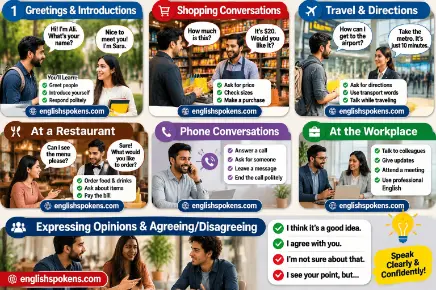
1. Listen Carefully Before Responding
Good conversations begin with good listening. Listening first is one of the English conversation skills that makes follow-up replies relevant.
When someone speaks, pay attention to the main message rather than preparing your next sentence immediately.
Notice:
- What happened?
- What is the person talking about?
- How do they feel?
- What details could you ask about?
For example:
A: I went to Lahore last weekend.
Instead of immediately changing the subject, you could ask:
B: Really? What did you do there?
A: I visited some historical places with my family.
B: That sounds interesting. Which place did you enjoy the most?
Your questions come directly from what you heard.
2. Use the Initiate–Respond–Follow-Up Method
A useful interaction pattern is to initiate, respond, and follow up. It gives each speaker a clear way to connect a new turn to what was just said.
It is a simple way to understand how conversations develop.
Step 1: Initiate
A: What did you do last weekend?
Step 2: Respond
B: I went shopping with my sister.
Step 3: Follow up
A: Oh, really? What did you buy?
The conversation can continue naturally because each response creates an opportunity for another question.
Practise this pattern with different everyday topics.
3. Give More Than a Short Answer
A useful technique is:
Answer + Reason + Detail + Return Question
For example:
Question: Do you enjoy cooking?
Answer: Yes, I really enjoy cooking because it helps me relax. I usually try new recipes on weekends. What about you?
Break it down:
- Answer: Yes, I really enjoy cooking.
- Reason: Because it helps me relax.
- Detail: I usually try new recipes on weekends.
- Return question: What about you?
You do not need to use all four parts every time. Choose the details that fit the conversation.
4. Show Interest With Natural Reactions
People generally appreciate it when you respond to what they say.
Use expressions such as:
| Expression | When to use it |
|---|---|
| Really? | When something surprises you |
| That’s interesting! | When you find information interesting |
| I didn’t know that. | When you learn something new |
| That sounds exciting. | When someone shares an exciting experience |
| I can understand that. | When you relate to someone’s situation |
| Tell me more about it. | When you want additional details |
| That’s a good point. | When someone makes a useful observation |
These expressions help you acknowledge the speaker before asking another question.
5. Share Your Own Experiences
A conversation should not feel like an interview.
If you only ask questions, the other person may feel that they are being interviewed.
Share something related to the topic.
A: I love travelling during the summer.
B: That’s nice. I enjoy travelling too, especially visiting places with beautiful mountains. Have you visited any mountain areas recently?
This creates a more balanced exchange.
6. Change Topics Smoothly
Sometimes you want to introduce a different subject without making the conversation feel disconnected.
Useful expressions include:
- Speaking of that…
- That reminds me…
- By the way…
- On a similar note…
- I’ve been meaning to ask you…
- Talking about holidays…
Example:
A: I went to the beach last weekend.
B: That sounds lovely. Speaking of weekends, do you usually travel with your family?
7. Handle Awkward Silence Naturally
Silence does not always mean that something has gone wrong. People sometimes need time to think.
When you cannot think of anything to say, try:
- Let me think for a moment.
- That’s an interesting question.
- I haven’t thought about that before.
- By the way, how has your week been?
- What do you usually do in your free time?
You can also return to an earlier topic or politely end the conversation if it has naturally reached its conclusion.
Real-Life Example: Keeping a Conversation Going
Situation: Two people meet at a social event.
Emma: Hi! Is this your first time at this event?
Daniel: Yes, it is. I came here with a friend.
Emma: That’s nice. How did you hear about it?
Daniel: My friend told me about it. He attended last year and really enjoyed it.
Emma: Oh, really? What did he like most about it?
Daniel: He enjoyed meeting new people and listening to the speakers.
Emma: That sounds interesting. Are you interested in meeting new people too?
Daniel: Yes, definitely. I’m trying to improve my communication skills.
Emma: That’s great. What are you doing to improve them?
Daniel: I’m practising English conversations and trying to speak more confidently.
Emma: That’s a good idea. Would you like to join our conversation group?
Daniel: Sure! That would be great.
What makes this conversation work?
- Emma listens to Daniel’s answers.
- She asks questions connected to his previous statements.
- Daniel gives additional information instead of one-word replies.
- Both speakers show interest in each other’s experiences.
Turn-Taking, Clarification, and Repair in Real Conversations
Natural conversation is not a series of separate speeches. Speakers listen, respond to one another, manage turns, check understanding and repair problems together. These are essential English conversation skills for group discussions, meetings and everyday exchanges. Practising these interaction strategies develops English conversation skills for meetings and informal group discussions.
The Council of Europe CEFR Companion Volume (2020) identifies turn-taking, co-operating and asking for clarification as interaction strategies. It also describes monitoring and repair, such as correcting a slip or changing the wording when communication breaks down. A 2023 review of second-language speaking describes speaking proficiency as both language production and social interaction, including listening, message design and conversation management.

Take a Turn Without Interrupting
In a group, listen for a natural pause and connect your comment to the point that was just made. Keep your first contribution brief so other people have room to respond.
Useful expressions:
- “Can I add something here?”
- “That connects with what you said about…”
- “Could I ask a quick question?”
- “Before we move on, I would like to mention…”
- “I agree with that point, and I would add…”
Co-operate and Build on What Others Say
Show that you have followed the discussion. Refer to another person’s idea, add a related detail, summarise what the group has agreed, or invite someone else to contribute.
Useful expressions:
- “So, the main issue is the timing. Have I understood correctly?”
- “I agree with Sara’s point, and I would add one example.”
- “Does anyone see it differently?”
- “What do you think about that, Ali?”
- “We seem to agree on the goal. What should we do first?”
Ask for Clarification Instead of Guessing
If you did not hear a word, ask for repetition. If you heard the words but are unsure of the meaning, check your understanding in your own words. This prevents a small confusion from becoming a larger misunderstanding.
Useful expressions:
- “Sorry, could you repeat the last part?”
- “When you say “flexible”, do you mean the schedule can change?”
- “Do you mean that we should meet before lunch?”
- “Could you give me an example?”
- “Have I understood you correctly?”
Repair a Misunderstanding and Self-Correct
Communication repair is what you do when your words do not express your meaning clearly or the listener has understood something different. Do not simply repeat the same sentence more loudly. Pause, use simpler words, give an example or start the sentence again.
Useful expressions:
- “Sorry, I wasn’t clear. What I meant was…”
- “Let me put that another way.”
- “I used the wrong word. I meant…”
- “Let me start that sentence again.”
- “That’s not quite what I meant. I was trying to say…”
End a Conversation Politely
Ending a conversation is also part of managing interaction. Give a short closing signal, acknowledge the exchange and leave room for the other person to respond.
- “It was nice talking with you. I should get going now.”
- “Thanks for explaining that. I’ll let you get back to work.”
- “I enjoyed our conversation. See you next time.”
- “Before I go, is there anything else we need to cover?”
Research basis: Council of Europe (2020), CEFR Companion Volume, interaction strategies and monitoring/repair; de Jong (2023), “Assessing Second Language Speaking Proficiency,” Annual Review of Linguistics.
Follow-Up Questions for English Conversations
Follow-up questions are questions you ask based on something another person has already said.
They help you understand the topic more deeply and encourage the speaker to share additional information. Asking relevant follow-up questions is one of the most useful English conversation skills because it shows that you are listening.
A 2017 study published in the Journal of Personality and Social Psychology examined live two-person conversations and found that asking more questions, especially relevant follow-up questions, was linked with greater perceived responsiveness and partner liking in those settings. The practical lesson is to show that you listened—not to ask question after question or turn a conversation into an interview. Good English conversation skills include asking questions that connect naturally to the other person’s answer.
This highlights the social value of showing genuine interest through questions. It does not mean you should ask questions constantly; listening and sharing your own thoughts are equally important.
Open-Ended vs. Closed-Ended Questions
Understanding the difference between these two question types can help you develop better conversations.
| Closed-ended question | Open-ended question |
|---|---|
| Do you like your job? | What do you enjoy about your job? |
| Did you travel? | Where did you travel, and what was it like? |
| Are you happy? | What makes you happy? |
| Do you like cooking? | What do you enjoy cooking? |
| Was the movie good? | What did you like about the movie? |
Closed-ended questions are useful for obtaining specific information. Open-ended questions encourage more detailed responses.
Use both naturally.
8 Types of Follow-Up Questions
1. Detail questions
Ask for additional information.
- What exactly happened?
- Can you tell me more?
2. Experience questions
Learn about someone’s experience.
- What was it like?
- How did you find it?
3. Opinion questions
Understand their point of view.
- What do you think about it?
- What’s your opinion?
4. Reason questions
Discover why someone made a decision.
- What made you choose it?
- Why did you decide to do that?
5. Feeling questions
Ask about someone’s reaction.
- How did you feel?
- Were you excited about it?
6. Preference questions
Understand someone’s choices.
- Which one do you prefer?
- What do you enjoy most?
7. Future questions
Continue discussing plans.
- Are you planning to do it again?
- What would you like to try next?
8. Clarification questions
Make sure you understand correctly.
- What do you mean by that?
- Could you explain that again?
100 Questions You Can Ask in an English Conversation
If you are unsure what to ask during an English conversation, these 100 questions will give you practical ideas.
They are organized into everyday topics so you can choose questions according to the situation.
1. Getting to Know Someone
- What’s your name?
- Where are you from?
- Where do you live?
- What do you do?
- What do you enjoy doing in your free time?
- Do you have any brothers or sisters?
- What languages do you speak?
- What is your favourite thing about your hometown?
- How would you describe yourself?
- What do you usually do on weekends?
2. Daily Routine and Everyday Life
- What time do you usually wake up?
- What do you normally have for breakfast?
- How do you spend your mornings?
- What do you usually do after work or school?
- How do you relax after a busy day?
- Do you prefer mornings or evenings?
- What is the busiest part of your day?
- How do you organize your daily routine?
- What do you usually do before going to bed?
- Is there anything you would like to change about your routine?
3. Hobbies and Free Time
- What do you enjoy doing in your free time?
- Do you have any interesting hobbies?
- How did you become interested in that hobby?
- How often do you practise it?
- Do you prefer indoor or outdoor activities?
- What new hobby would you like to try?
- Do you enjoy playing sports?
- Do you prefer spending time alone or with friends?
- What activity helps you relax?
- Have you learned any new skills recently?
4. Work and Studies
- What do you do for a living?
- What do you enjoy most about your job?
- What is the most challenging part of your work?
- What subject did you enjoy most at school?
- Are you learning anything new at the moment?
- Why did you choose your current field?
- What skills would you like to develop?
- Do you prefer working alone or in a team?
- What does a typical working day look like for you?
- What are your future career goals?
5. Food and Restaurants
- What is your favourite food?
- Do you enjoy cooking?
- What do you usually eat for lunch?
- Do you prefer eating at home or in restaurants?
- What is your favourite restaurant?
- Have you tried any new dishes recently?
- Do you prefer tea or coffee?
- What food do you dislike?
- What would you recommend ordering here?
- What is a traditional dish from your country?
6. Travel and Holidays
- Do you enjoy travelling?
- What is the best place you have ever visited?
- Where would you like to travel next?
- Do you prefer travelling alone or with friends?
- What do you usually pack for a trip?
- Do you prefer beaches or mountains?
- What is your favourite holiday memory?
- Have you ever travelled abroad?
- What is your dream travel destination?
- What do you enjoy most about travelling?
7. Movies, Books and Entertainment
- What kind of movies do you enjoy watching?
- Who is your favourite actor?
- What was the last movie you watched?
- Do you prefer movies or television series?
- What kind of music do you listen to?
- Do you enjoy reading books?
- What is your favourite book?
- Do you prefer watching movies at home or at the cinema?
- Have you watched anything interesting recently?
- What would you recommend watching?
8. Experiences and Memories
- What is your happiest childhood memory?
- What is the most interesting place you have visited?
- Have you ever tried something completely new?
- What is something you are proud of?
- What is the most useful thing you have learned?
- Have you ever met someone famous?
- What was your favourite school memory?
- What is an experience you will never forget?
- Have you ever done something outside your comfort zone?
- What is one thing you would like to experience again?
9. Opinions and Preferences
- Do you prefer living in a city or a small town?
- What makes a good friend?
- Do you think technology makes life easier?
- What is more important to you: time or money?
- Do you prefer shopping online or in stores?
- What makes a conversation interesting?
- Do you think people should learn new languages?
- What is one habit everyone should develop?
- How do you usually make important decisions?
- What makes you feel motivated?
10. Future Plans and Goals
- What are your plans for this weekend?
- What would you like to achieve this year?
- Is there a new skill you want to learn?
- Where do you see yourself in five years?
- What is one personal goal you are working towards?
- Would you like to start your own business?
- What country would you like to visit in the future?
- What would you do if you had more free time?
- What is one thing you want to improve about yourself?
- What are you looking forward to?
Practice tip: Do not memorize all 100 questions at once. Choose five questions each day, answer them aloud, and prepare one follow-up question for every answer.
How to Ask Follow-Up Questions Without Sounding Like an Interview
Asking questions is useful, but asking too many questions without contributing anything can make a conversation feel unnatural.
Follow these simple principles:
- Ask one relevant question at a time.
- Listen carefully to the answer.
- Share your own experience when appropriate.
- Avoid asking overly personal questions.
- Give the other person time to speak.
- Change the subject when the current topic is finished.
For example:
A: I started learning photography recently.
B: That’s interesting! What made you interested in photography?
A: I enjoy taking pictures when I travel.
B: I like taking travel photos too. What kind of camera do you use?
Notice how the second speaker combines questions with personal experiences.
Natural English Replies Instead of One-Word Answers
One of the easiest ways to improve English conversation skills is to learn how to expand short answers.
You do not need to give a long explanation every time someone asks you a question. However, adding one or two relevant details can make your responses more engaging. Strong English conversation skills also depend on giving the other person enough information to respond naturally. These response patterns make English conversation skills more useful outside textbook exercises.
Why One-Word Answers Can Make Conversations Difficult
Imagine someone asks:
“How was your weekend?”
You answer:
“Good.”
The answer is correct, but the conversation has little information to continue with.
Now compare:
“It was really good. I spent some time with my family and watched a movie on Sunday.”
The second answer gives the other person several possible topics to discuss.
Use the Answer–Reason–Detail–Question Formula
Try this simple pattern:
Answer: Give a direct response.
Reason: Explain why.
Detail: Add a related example or experience.
Question: Invite the other person to participate.
Example:
A: Do you like your city?
B: Yes, I do. It’s a lively place with lots of interesting things to do. I especially enjoy the local restaurants. What do you like most about your city?
20 Common Short Answers and Their Natural Alternatives
| Short answer | More natural response |
|---|---|
| Yes. | Yes, definitely. I really enjoy it. |
| No. | No, not really. It’s not my favourite. |
| Fine. | I’m doing well, thanks. How about you? |
| Good. | Pretty good. I’ve had a productive day. |
| Okay. | That sounds fine to me. |
| Maybe. | Maybe. It depends on how much time I have. |
| Nothing. | Nothing special. I just relaxed at home. |
| Busy. | I’ve been quite busy with work lately. |
| Tired. | I’m a little tired because I had a long day. |
| Interesting. | That’s interesting. I’d like to know more. |
| I don’t know. | I’m not completely sure, but I think… |
| Not really. | Not really, although I might try it someday. |
| Sure. | Sure, I’d be happy to help. |
| Great. | That’s great news. I’m happy for you. |
| Same. | Same here. I feel that way too. |
| Probably. | Probably, but I haven’t decided yet. |
| Sometimes. | Sometimes, especially when I have free time. |
| Of course. | Of course. I’d be glad to. |
| No problem. | No problem at all. I’m happy to help. |
| I agree. | I completely agree because that makes sense. |
Natural Replies for Different Situations
When you agree:
- I completely agree.
- That’s exactly what I think.
- You have a good point.
- I feel the same way.
When you disagree politely:
- I see your point, but I think differently.
- That’s an interesting perspective.
- I’m not sure I completely agree.
- I understand what you mean, although…
When you are surprised:
- Really? I didn’t expect that.
- That’s surprising!
- Are you serious?
- I had no idea!
When you are uncertain:
- I’m not entirely sure.
- Let me think about it.
- It depends on the situation.
- I haven’t decided yet.
When you don’t understand:
- Could you explain that again?
- What exactly do you mean?
- Could you give me an example?
- Sorry, I didn’t quite catch that.
When someone shares a problem:
- I’m sorry to hear that.
- That must have been difficult.
- I hope things get better.
- Is there anything I can do to help?
Natural English Expressions That Make Responses Flow
Learn useful expressions as complete phrases instead of memorizing individual words.
| Expression | Example |
|---|---|
| To be honest… | To be honest, I prefer staying at home. |
| Actually… | Actually, I’ve never tried that. |
| I think… | I think it’s a great idea. |
| In my experience… | In my experience, practice makes a difference. |
| It depends on… | It depends on the weather. |
| What I mean is… | What I mean is that we need more time. |
| As far as I know… | As far as I know, the shop closes at six. |
| The way I see it… | The way I see it, both options are useful. |
How to Sound Natural Instead of Memorized
Natural communication is not about using difficult expressions in every sentence.
Instead:
- Learn common sentence patterns.
- Use contractions such as “I’m,” “don’t,” and “I’ve” in appropriate informal situations.
- Choose expressions that match the situation.
- Practise responding to different questions.
- Avoid repeating the same phrases unnecessarily.
- Focus on communicating your actual thoughts.
Pronunciation, Body Language, and Choosing the Right Tone
A conversation is more than vocabulary and grammar. The listener also responds to how clearly you speak, how you show attention, and whether your language suits the person and situation.
The CEFR Companion Volume treats phonological control and sociolinguistic appropriateness as parts of communication. Its phonology descriptors focus on intelligibility, sound articulation and prosody—not on removing every trace of a learner’s accent. Clear speech and natural intonation support confident English conversation skills. Pronunciation and body language are supporting parts of English conversation skills, not separate performance tricks.
Speak for Intelligibility, Not to Copy an Accent
Your goal is to make your message easy to understand. You do not need to sound like a native speaker. Pay attention to important sounds, pronounce key words clearly, and avoid rushing through a sentence.
Try this routine: choose one short sentence, listen to a clear model, repeat it at a comfortable pace, record your version, and check whether the key words are easy to understand.
- “Could you tell me where the station is?”
- “I usually practise English after work.”
- “I would like to ask one more question.”
Use Word Stress, Rhythm, and Intonation
Prosody helps listeners understand which information matters and whether you are asking, confirming or reacting. Stress the important word, group words into meaningful chunks, and let your voice rise or fall naturally.
Practise saying “I really enjoyed the conversation” with extra emphasis on “really” to show strong feeling. Then say it again with a calm, neutral emphasis. Notice how the focus changes.
- Pause briefly between complete ideas instead of stopping after every word.
- Use a comfortable pace; faster speech is not automatically more fluent.
- Read a short dialogue aloud and mark the words you want to emphasise.
Use Non-Verbal Signals to Show Attention
Facial expression, posture, gestures and small listening signals can support what you say. A natural nod, an interested expression or a brief “I see” can show that you are following.
Use eye contact only in a way that feels comfortable and appropriate for the person and culture. Non-verbal expectations differ, so do not treat one style of eye contact or gesture as a universal rule.
- Face the speaker when practical.
- Avoid looking at your phone while someone is speaking.
- Use gestures to support meaning, not to replace every word.
- Notice whether the other person seems comfortable and give them space.
Choose Formal or Informal Language for the Situation
The same message can sound friendly, distant or impolite depending on the words and tone you choose. Consider your relationship with the listener, the setting and the reason for speaking. For workplace situations, see our guide to Business English phrases and communication skills.
For example, “Could you explain that again, please?” is suitable in many formal situations. “What do you mean?” may be natural with a friend but can sound abrupt in a professional meeting.
- Polite request: “Would you mind repeating that, please?”
- Friendly request: “Could you say that again?”
- Polite disagreement: “I see your point, but I look at it a little differently.”
- Avoid forcing slang into a situation where it does not fit.
Develop the Topic Instead of Changing It Too Quickly
A strong response connects to the previous speaker’s idea before adding something new. You can explain a reason, give an example, compare two experiences or briefly summarise the point.
Useful connectors include “for example”, “because”, “that reminds me”, “on the other hand” and “so what you’re saying is…”. Use them to make the relationship between your ideas clear.
- Acknowledge the previous point.
- Add one relevant detail or example.
- Explain how your detail connects to the topic.
- Invite the other person to respond when appropriate.
Research basis: Council of Europe (2020), CEFR Companion Volume, phonological control and sociolinguistic appropriateness; de Jong (2023), review of linguistic and social-interactional speaking proficiency.
What to Say When Your Mind Goes Blank
Sometimes you know what you want to say, but you cannot organize your thoughts quickly enough.
This can happen during conversations, meetings, interviews, or unexpected questions. Managing a pause is one of the practical English conversation skills that can keep an exchange comfortable.
The solution is not to memorize hundreds of answers. It is to develop a simple way to organize your thoughts. Thinking-time expressions help you use English conversation skills even when you need a moment to plan your answer.
Use Thinking-Time Expressions
You can use these natural expressions when you need a few seconds:
- Let me think for a moment.
- That’s an interesting question.
- I’ve never thought about that before.
- Well, I would say…
- Give me a second to explain.
- That’s a good question. I think…
These phrases give you time without forcing you to remain silent.
Try the 3–2–1 Speaking Framework
Use the 3–2–1 speaking prompt as a simple way to organize an answer when a topic feels unfamiliar. It is a practice aid, not a formal CEFR scale or a test.
It means:
- Three steps.
- Two types or options.
- One main thing.
You do not need to use all three every time. Choose the easiest approach for the topic.
Example: Topic — Travel
One main thing:
The best thing about travelling is discovering new cultures.
Two types:
There are two main types of travel: domestic and international.
Three steps:
The three basic steps to plan a trip are choosing a destination, booking your transport, and preparing your luggage.
This gives you a starting point when you are asked to speak about an unfamiliar subject.
Focus on One Clear Idea at a Time
Instead of trying to explain everything in one long sentence:
- Decide what you want to say.
- Express your main idea.
- Explain your reason.
- Give a short example.
For example:
“I enjoy reading because it helps me relax. I usually read short stories before going to bed.”
This is clearer than trying to communicate several unrelated ideas at once.
Focus on Connecting, Not Impressing
You do not need advanced vocabulary to have a meaningful conversation.
Concentrate on understanding the other person, responding appropriately, and sharing your ideas.
Making a small grammar mistake is not the end of a conversation. If necessary, correct yourself and continue.
How to Improve English Conversation Skills Through Daily Practice
Consistent practice is more useful than studying for several hours once a week and then avoiding English for the next few days. Short, repeated sessions gradually strengthen English conversation skills through use rather than memorization alone. A consistent routine helps turn English conversation skills into habits you can use without planning every sentence.
Here are practical ways to develop your speaking and conversational abilities. You can reinforce these patterns with our 100 daily used English sentences. For level-based lessons and useful phrases, try the British Council speaking practice activities.
1. Practise for 15 Minutes Every Day
Choose an activity you genuinely enjoy. Choose activities that let you use English conversation skills in realistic speaking situations.
You can:
- Watch an easy English video.
- Listen to a short podcast.
- Read an interesting story.
- Practise answering everyday questions.
- Describe your daily activities in English.
The important thing is to make English part of your regular routine.
2. Observe How People Construct English Sentences
When watching English videos or listening to conversations, pay attention to how speakers organize their ideas.
Notice:
- How they start their responses.
- How they explain reasons.
- Which expressions they repeat.
- How they change topics.
- How they react to other speakers.
For example, notice how someone uses “Actually, I think…” or “The reason is…” to introduce an explanation.
Write down useful patterns and try using them in your own conversations.
3. Build Imitation Practice in Stages
Imitation is a useful speaking exercise when you want to learn natural sentence patterns.
This progressive exercise moves from short phrases to full ideas, giving you more language to understand, repeat and eventually express in your own words.
Level 1: Repeat short phrases
Listen to a speaker and repeat expressions such as:
- How are you doing?
- That sounds interesting.
- What do you think about it?
Level 2: Repeat complete sentences
Listen to one sentence and repeat it while paying attention to pronunciation, rhythm, and stress.
Level 3: Retell a complete idea
Listen to someone explaining an experience. Pause and explain the same idea in your own words.
Level 4: Retell the whole story
Listen to a short conversation or story. Close the transcript and explain what happened without reading.
The final level is particularly useful because you must understand the meaning and organize your own sentences rather than simply repeat the original speaker.
4. Record Yourself Speaking
Recording your voice allows you to notice things that you may not recognize while speaking.
Try this exercise:
- Choose a familiar topic.
- Speak about it for one minute.
- Record your response.
- Listen carefully.
- Notice unnecessary pauses and repeated words.
- Repeat the same topic and try to improve.
Do not focus on every mistake. Choose one or two things to improve each time.
5. Practise Speaking in Front of a Camera
You do not need to publish videos online.
Simply open your camera and speak about your daily life.
You can discuss:
- What happened today.
- What you learned recently.
- Your favourite activities.
- Your weekend plans.
- Something you want to achieve.
Start with two or three minutes and gradually increase the time.
This gives you an opportunity to practise organizing thoughts without relying on another person.
6. Read to Expand Your Vocabulary and Ideas
Reading helps you discover words and expressions in context.
Choose material that matches your current English level.
For example:
- Short stories.
- Simple news articles.
- Everyday conversations.
- Beginner English books.
- Informative articles about topics you enjoy.
When you find a useful expression, write down the complete sentence rather than only the new word.
Then try using it in a spoken response.
7. Accept Mistakes and Build Speaking Confidence
Do not wait until you know every grammar rule before speaking.
Instead:
- Start with simple sentences.
- Accept that mistakes are part of learning.
- Avoid comparing yourself with fluent speakers.
- Focus on expressing your message.
- Ask for corrections when useful.
- Practise with people who support your learning.
Confidence develops through experience. The more opportunities you create to speak, the more familiar communication becomes.
How to Practice English Conversation Without a Speaking Partner
Not everyone has a friend, family member, or colleague who can practise English with them. Our English conversation practice guide also includes structured dialogues and speaking drills.
However, you can still develop useful speaking habits independently. Practising both sides of a dialogue is a practical way to strengthen English conversation skills without waiting for a partner. Self-practice can strengthen English conversation skills by helping you prepare and say complete responses aloud.

Practise Conversations With Yourself
Choose an everyday situation and imagine that you are talking to another person.
For example, imagine someone asks:
“How was your day?”
You could answer:
“My day was quite good. I finished my work early and spent some time reading. Later, I went shopping with my family.”
Then ask yourself a follow-up question:
“What did you buy?”
Answer that question too.
This simple activity helps you practise both sides of a conversation.
Use the Listen-and-Retell Method
Follow these steps:
- Choose a short English conversation.
- Listen carefully without reading the transcript.
- Identify the main ideas.
- Listen again if necessary.
- Close the transcript.
- Retell the conversation in your own words.
- Record your version and listen to it.
This exercise connects listening comprehension with spoken production.
Useful home exercises include recording yourself, practising with voice notes, and creating your own dialogue from a silent video clip.
Use AI and Online Speaking Practice Tools
AI conversation tools can help you practise when a human speaking partner is unavailable.
You can ask an AI tool to:
- Act as a restaurant waiter.
- Pretend to be a new colleague.
- Ask questions about your daily routine.
- Conduct a simple job interview.
- Practise unexpected conversation topics.
- Identify unclear or incorrect sentences.
For example, use this prompt:
“Act as my English conversation partner. Ask me one everyday question at a time. Wait for my answer, correct important mistakes, suggest a more natural response, and ask a relevant follow-up question. Keep the conversation suitable for an intermediate learner.”
AI can provide convenient practice and feedback, although real conversations are also important for learning to respond to different people and communication styles. Add structured listening and speaking exercises with Cambridge English activities for learners.
Create Your Own Conversation Practice Routine
Try this 15-minute activity at home.
| Time | Activity |
|---|---|
| 3 minutes | Listen to a short English conversation. |
| 3 minutes | Repeat useful expressions aloud. |
| 4 minutes | Answer five everyday questions. |
| 3 minutes | Ask yourself follow-up questions. |
| 2 minutes | Record and review your speaking. |
You can repeat this routine using a different topic every day.
Seven Practical Rules for Excellent English Conversation Skills
Use these research-informed habits as a checklist during everyday conversations. Applying them consistently makes your English conversation skills more reliable in real situations: These practical English conversation skills are most effective when you adapt them to the person and situation.
- Listen to understand. Focus on the speaker’s main point before planning your answer.
- Build on what was said. Acknowledge the previous contribution and connect your reply to it.
- Give a useful response. Add a reason, example or detail when the situation calls for it.
- Manage turns fairly. Join at a natural pause, avoid dominating, and invite others to contribute.
- Clarify and repair. Ask when you do not understand and rephrase when your meaning is unclear.
- Adapt your language. Choose polite, formal or informal expressions to suit the listener and setting.
- Speak clearly and practise. Use a comfortable pace, intelligible pronunciation, natural stress and intonation, then review your progress.
A 7-Day English Conversation Skills Practice Plan
Use this simple seven-day challenge to apply the techniques in this guide. Each day focuses on a different part of English conversation skills, from listening and answering to asking follow-up questions. The plan gives you repeated chances to practise English conversation skills in manageable daily steps.
| Day | Speaking activity | Main goal |
|---|---|---|
| Day 1 | Listen to a short conversation. Note the main idea and respond with natural listening signals. | Understand first and show that you are following. |
| Day 2 | Answer five everyday questions using an answer, reason and example. Add a return question. | Develop a relevant response instead of stopping at one word. |
| Day 3 | Ask five follow-up questions based on the speaker’s actual answers. Share one related experience too. | Show interest without turning the exchange into an interview. |
| Day 4 | Practise joining a group discussion, taking a turn and inviting another person to speak. | Manage turns and connect your contribution to the topic. |
| Day 5 | Role-play a misunderstanding. Ask for repetition, check meaning and rephrase one idea in two ways. | Use clarification, monitoring and communication repair. |
| Day 6 | Record the same short message in a casual and a formal style. Review pace, stress, intonation and body language. | Speak intelligibly and adapt your tone to the situation. |
| Day 7 | Record a three-to-five-minute role-play from greeting to closing, then review the checklist below. | Combine listening, responses, questions, turn-taking and repair. |
Check Your Progress
At the end of each day, ask yourself:
- Did I understand and respond to the speaker’s main point?
- Did I show that I was listening without interrupting?
- Did I add a relevant reason, detail or example?
- Did I ask a follow-up question that connected to the answer?
- Did I take my turn at a natural moment and leave space for others?
- Did I ask for clarification when I was unsure?
- Did I rephrase or correct myself when my meaning was unclear?
- Did I choose language that suited the person and situation?
- Could the listener understand my key words, stress and intonation?
- Did I close the conversation politely when it was time to finish?
You can use this checklist as a simple self-assessment sheet or save the practice plan for later.
Common Mistakes to Avoid When Developing English Conversation Skills
Even learners who practise regularly sometimes develop habits that make conversations difficult. Some mistakes reduce the effectiveness of English conversation skills even when individual sentences are grammatically correct.
Here are some mistakes to avoid. Recognising and correcting them can help you develop English conversation skills that work in real exchanges, not only rehearsed examples.
Memorizing Complete Conversations Instead of Learning Patterns
Memorized dialogues can help beginners, but real conversations rarely follow an exact script.
Learn useful expressions and sentence patterns so you can adapt your responses.
Translating Every Sentence Word by Word
Direct translation can make speaking slower and less natural.
Learn common English sentence structures and practise expressing simple thoughts directly.
Asking Too Many Questions Without Sharing Anything
Questions help maintain conversations, but you should also share your own opinions and experiences.
Try to balance listening, answering, and asking.
Using Complicated Vocabulary Unnecessarily
Difficult words do not automatically make your English better.
Choose clear and appropriate expressions that communicate your meaning.
Focusing Only on Grammar Instead of Communication
Grammar is important, but understanding and exchanging ideas are equally important in conversation.
Practise using grammar in real speaking situations instead of only completing written exercises.
Being Afraid of Making Mistakes
Avoiding conversations prevents you from gaining speaking experience.
Start with simple situations and gradually challenge yourself.
Practising Listening but Not Speaking
Listening provides examples of how English is used, but you also need to produce your own sentences.
Combine listening activities with speaking, imitation, retelling, and conversation practice.
Ignoring Tone, Politeness, and Context
An expression that sounds friendly with a close friend may sound abrupt in a workplace or formal conversation. Think about the relationship, setting and purpose before choosing your words.
Repeating the Same Sentence Instead of Repairing It
If the listener looks confused, do not keep repeating the same wording. Try a shorter sentence, a different expression, a concrete example or a quick check such as “Does that make sense?”
Trying to Eliminate Your Accent
A strong conversation goal is intelligibility, not copying a particular accent. Work on sounds that make your message hard to understand, along with word stress, rhythm and intonation.
Frequently Asked Questions About English Conversation Skills
How Can I Practice My English Conversation Skills?
Start with familiar topics such as your daily routine, hobbies, work, and family. Listen to short English conversations, answer questions aloud, and practise asking follow-up questions. If you do not have a speaking partner, use self-talk, voice recordings, or AI role-play. Try to practise consistently rather than waiting for the perfect opportunity.
How Do I Improve My English Conversation Skills?
Focus on three main abilities: listening carefully, giving meaningful responses, and asking relevant questions. Learn complete expressions instead of isolated vocabulary. Practise real-life situations and gradually increase the length and complexity of your conversations.
What Are Five Ways to Improve Your Speaking Skills?
- Speak English every day.
- Listen to natural English conversations.
- Record yourself and review your responses.
- Learn common expressions and sentence patterns.
- Practise conversations with people or AI tools.
What Are the Seven Powerful Speaking Tips?
Listen actively, build on the other person’s point, give relevant details, manage turns, ask follow-up questions, clarify and repair misunderstandings, and adapt your language to the situation. Practise clear, intelligible speech rather than trying to speak as quickly as possible.
How Can I Speak More Clearly?
Speak at a comfortable pace instead of rushing. Group words into meaningful chunks, pronounce key sounds clearly, and pay attention to word stress, rhythm and intonation. Record yourself and listen for unclear words or long pauses. You do not need to remove your accent; aim to make your meaning easy to understand.
How Can I Practice English Speaking Skills When I’m Alone?
You can practise by describing your daily activities, answering random questions, speaking in front of a camera, listening and retelling stories, and recording voice notes. You can also use AI conversation tools to simulate everyday situations.
How Can I Improve My Confidence in Speaking English?
Begin with short conversations about topics you already understand. Prepare a few useful expressions, practise your answers aloud, and gradually speak in more challenging situations. Do not wait until your English is perfect. Focus on communicating your ideas rather than worrying about every grammatical mistake.
How Can I Improve My English Speaking Skills by Myself Using a PDF?
A speaking-practice PDF can help organize your learning, but simply reading a worksheet will not develop conversational ability.
Use a practice sheet containing:
- Everyday conversation topics.
- Questions to answer aloud.
- Follow-up question exercises.
- Short role-play situations.
- A daily speaking checklist.
- Space to record common mistakes.
Spend time speaking rather than only reading the questions. You can use the 7-day plan in this guide as the basis for your own printable practice sheet.
What Are 20 Basic English Words?
Here are 20 useful words for everyday conversations:
| Word | Example |
|---|---|
| Hello | Hello, how are you? |
| Please | Please help me. |
| Thanks | Thanks for your help. |
| Sorry | Sorry, I’m late. |
| Yes | Yes, I understand. |
| No | No, thank you. |
| Maybe | Maybe I’ll come tomorrow. |
| Really | Really? That’s interesting. |
| Because | I stayed home because I was tired. |
| But | I like it, but it’s expensive. |
| And | My brother and I went shopping. |
| So | I was tired, so I went home. |
| Think | I think it’s a good idea. |
| Know | I know that person. |
| Want | I want to learn English. |
| Need | I need some help. |
| Like | I like reading books. |
| Prefer | I prefer tea to coffee. |
| Understand | I understand what you mean. |
| Mean | What do you mean? |
Learn these words in sentences and use them during speaking practice.
What Are the Seven Rules for Excellent English Speaking?
The seven useful habits are to listen carefully, connect your response to what was said, give meaningful details, manage turns fairly, ask for clarification and repair misunderstandings, use language that fits the situation, and practise clear speech consistently.
How Can I Improve English Speaking Skills Quickly at Home?
Create a daily speaking routine. Listen to a short conversation, repeat useful sentences, answer five questions, retell a short story, and record your voice. Practise with different everyday topics so you become comfortable discussing more than one subject.
What Should I Do If I Do Not Understand Someone?
Ask for repetition or clarification instead of pretending to understand. You can say, “Sorry, could you repeat the last part?”, “What do you mean by that?” or “Do you mean that the meeting has changed to Friday?” Repeat the meaning back briefly if you need to check.
How Can I Join a Group Conversation Politely?
Listen for a natural pause, connect your first sentence to the current topic and keep your contribution brief. Try, “Can I add something here?” or “That connects with what you said about…” Then give others room to respond.
Do I Need a Native English Accent to Communicate Well?
No. The practical goal is intelligibility: people should be able to understand your words and intended meaning. Work on clear sounds, word stress, rhythm and intonation, but you do not need to erase your accent or copy another speaker.
What Is Communication Repair in a Conversation?
Communication repair means fixing a problem when someone has not understood you or you have not understood them. Ask for clarification, repeat the key information in different words, give an example or correct the word you used. For example: “Sorry, I wasn’t clear. What I meant was…”
Final Thoughts on Developing Better English Conversation Skills
Developing better English conversation skills takes more than memorizing phrases or studying grammar. You need to listen carefully, respond with meaningful details, ask follow-up questions, and practise expressing your own ideas. Start with simple conversations, use natural replies instead of one-word answers, and gradually challenge yourself with unfamiliar topics. You can practise independently through imitation, retelling, self-talk, and AI role-play, even when a speaking partner is unavailable. Most importantly, do not wait until you feel completely confident before speaking. Choose one everyday topic today, answer five questions aloud, and add a follow-up question to each answer. Consistent practice will help you become a more comfortable and effective English communicator. The strongest English conversation skills develop when you combine practice with genuine listening and curiosity.