
Spoken English for Beginners
This spoken English for beginners guide shows you how to start speaking English step by step. You will learn 20 useful sentences with Urdu meanings, build vocabulary and sentences with basic grammar, understand common questions, improve listening and clear pronunciation, and practise everyday conversations. It also covers speaking confidence, common mistakes, a simple home-practice routine, and ways to check your progress.
کیا آپ انگریزی بولنا چاہتے ہیں مگر نہیں جانتے کہ شروع کیسے کریں؟ آج ہی سادہ اور کارآمد انگریزی سے آغاز کریں۔
- 5 starting pointsto find the one that fits you
- 20 useful sentenceswith Urdu meanings
- Guided conversationsfor everyday situations

What is spoken English? Spoken English is the English you use to communicate by speaking and listening in everyday situations. It includes greeting people, asking questions, giving answers, explaining what you need, and taking part in conversations.
اسپوکن انگلش سے مراد روزمرہ زندگی میں انگریزی بول کر بات چیت کرنا اور دوسروں کی بات سمجھنا ہے، مثلاً سلام کرنا، سوال پوچھنا، جواب دینا اور اپنی ضرورت بیان کرنا۔
Many people learn English as a second or additional language, often called ESL (English as a Second Language). If Urdu is the language you understand best, use the Urdu meanings in this guide to understand each example, then practise saying it in English.
Spoken English focuses on listening and speaking. Written English is used in messages, emails, books, and other text. Both are useful, but reading a sentence is not the same as being able to say it and respond in a conversation.
Maybe you know English words but cannot make sentences. Maybe you understand English videos but cannot answer when someone speaks to you. Or maybe you feel nervous because you are afraid of making mistakes.
You can start with simple, useful English.
Say these three sentences aloud:
- Hello. My name is Ali.
- I live in Lahore.
- I am learning English.
Now use your own name and city. Practise how to introduce yourself in English with a few details about your life.
You have just practised speaking English.
You do not need to know thousands of words or every grammar rule before saying your first sentence. Start with language you understand and can use.
Find the starting point that fits you:
- I know almost no English. Start with greetings, spoken words, meanings, and short sentences.
- I know words but cannot make sentences. Learn a useful sentence pattern and change the words.
- I understand English but cannot speak easily. Practise short answers without reading.
- I can speak a little but often stop or hesitate. Practise follow-up questions and short conversations.
- I can read English but find listening difficult. Use short audio with clear speech and check what you understand.
You may have different abilities in reading, listening, and speaking. That is okay. Choose practice that matches your current need.
Whether you are learning from scratch or already understand some English, the lessons below provide beginner-friendly speaking practice with simple explanations and Urdu meanings. You can use them at home and repeat each activity as often as you need.
You can use this page as a free beginner English speaking course. Follow the lessons in order to build basic sentences, understand common questions, speak in everyday situations, and check your progress.
Start Speaking English With Your First Simple Sentences
The best spoken English for beginners starts with sentences you can use today. These examples of spoken English for beginners are short, useful and easy to repeat.
Start with words and sentences you can use in real life.
You may want to greet someone, introduce yourself, ask for water, or tell someone that you need help.
You can learn these expressions before studying detailed grammar. They are useful in everyday conversations at home, school, work, and in shops.
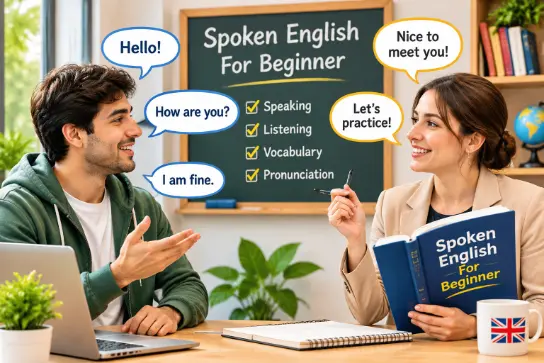
Understand Your First English Sentences With Urdu Meanings
Learn the meaning of these sentences. Then practise saying them.
| English sentence | Urdu meaning |
|---|---|
| Hello! | السلام علیکم / ہیلو! |
| Good morning. | صبح بخیر۔ |
| How are you? | آپ کیسے ہیں؟ |
| I am fine, thank you. | میں ٹھیک ہوں، شکریہ۔ |
| What is your name? | آپ کا نام کیا ہے؟ |
| My name is Ahmed. | میرا نام احمد ہے۔ |
| Where are you from? | آپ کہاں سے ہیں؟ |
| I am from Pakistan. | میں پاکستان سے ہوں۔ |
| I live in Karachi. | میں کراچی میں رہتا/رہتی ہوں۔ |
| I am a student. | میں ایک طالب علم ہوں۔ |
| I am learning English. | میں انگریزی سیکھ رہا/رہی ہوں۔ |
| Please help me. | براہِ کرم میری مدد کریں۔ |
| I need some water. | مجھے پانی چاہیے۔ |
| I don’t understand. | مجھے سمجھ نہیں آیا۔ |
| Please speak slowly. | براہِ کرم آہستہ بولیں۔ |
| Thank you. | شکریہ۔ |
| You’re welcome. | کوئی بات نہیں۔ |
| See you later. | پھر ملیں گے۔ |
| Take care. | اپنا خیال رکھیں۔ |
| Have a good day. | آپ کا دن اچھا گزرے۔ |
These are common English sentences for everyday use. You can use them in familiar situations.
For example, when you meet your teacher, you can say:
Good morning, sir.
When someone helps you, say:
Thank you very much.
When you leave, say:
Goodbye. Have a good day.
A few more daily English phrases are useful:
- Excuse me. — Use this to get someone’s attention politely.
- I’m sorry. — Use this when you apologise.
- Please come in. — Invite someone inside.
- After you. — Politely allow someone to go first.
- That’s all right. — Respond kindly to a small apology.
- It’s my pleasure. — A polite response when someone thanks you.
You do not need to memorise every expression today.
Choose five that you may actually use.
Your first speaking task
Say these sentences with your real information:
- “My name is ______.”
- “I am from ______.”
- “I live in ______.”
- “I am learning English.”
- “I want to speak English.”
Now look away and say them again.
If you cannot read English yet, that does not mean you cannot start learning spoken English. Listen to clear spoken examples, learn their meanings, and repeat useful phrases. You can learn reading alongside speaking.
Make Simple Sentences in Spoken English for Beginners
You can make many sentences using a few basic English sentence patterns.
A sentence pattern is a structure you can reuse.
Pattern 1: I am + information
- I am Ahmed.
- I am happy.
- I am tired.
- I am a student.
- I am from Pakistan.
Pattern 2: I live in + place
- I live in Lahore.
- I live in Delhi.
- I live in a village.
- I live with my family.
Pattern 3: I like + something
- I like tea.
- I like cricket.
- I like books.
- I like learning English.
Pattern 4: I have + something
- I have a phone.
- I have a bicycle.
- I have two brothers.
- I have some free time.
Pattern 5: I want + something
- I want some water.
- I want a pen.
- I want to learn English.
- I want to speak with you.
Pattern 6: I need + something
- I need help.
- I need a book.
- I need more time.
- I need to practise.
Pattern 7: I can + action
- I can read English.
- I can speak a little English.
- I can help you.
- I can make tea.
Pattern 8: I am + action ending in -ing
Use this for an action happening now.
- I am eating.
- I am studying.
- I am cooking.
- I am reading a book.
Pattern 9: I go to + place
- I go to school.
- I go to college.
- I go to work.
- I go to the market.
Pattern 10: There is + one thing
- There is a book on the table.
- There is a shop near my house.
- There is a chair in my room.
You do not need to learn 100 patterns before speaking. Begin with a few that solve your daily communication needs.
Make your own sentences
Complete these:
- I am ______.
- I live in ______.
- I like ______.
- I have ______.
- I need ______.
Now answer:
Can you change the words and make another correct sentence?
If you can only repeat one memorised sentence, practise the pattern with different information.
For example:
- I like tea.
- I like coffee.
- I like mangoes.
- I don’t like coffee.
This helps you use the pattern rather than memorise only one answer.
Say Your First Sentences Aloud Without Reading
You can understand a sentence on a page and still find it difficult to say it aloud.
That is why speaking needs its own practice.
Start with:
I live in Lahore.
Try this:
First: Read the sentence and understand its meaning.
Next: Listen to a clear spoken example, if available.
Then: Say the sentence aloud.
After that: Look away from the words.
Finally: Say the sentence using your own city.
Now change the message:
- I live in Lahore.
- I live with my parents.
- I live near a school.
If you make a mistake, check the example and try again.
You can also record your voice using your phone and use a speaking practice tool when you want guided repetition.
For example, say:
“My name is Sara. I am from Islamabad. I work in a school.”
Listen to the recording.
Can you hear every word clearly? Did you stop because you forgot a word?
If you have a reliable spoken model, compare the two recordings. A recording alone cannot tell you whether every sentence is correct, so use suitable feedback when available.
Try a small speaking challenge
Look away from the text.
Say:
- One sentence about yourself.
- One sentence about your family.
- One sentence about what you are doing now.
Do not worry if you need time to think. Practising in small steps can also help build English speaking confidence.
If it is too difficult, return to the examples. Use fewer words and try again.
When you can say the sentences without reading, change one detail and repeat.
Build Essential Skills for Everyday English Speaking
Strong spoken English for beginners needs four skills: words, grammar, listening and pronunciation. Practise all four so your spoken English for beginners improves evenly.
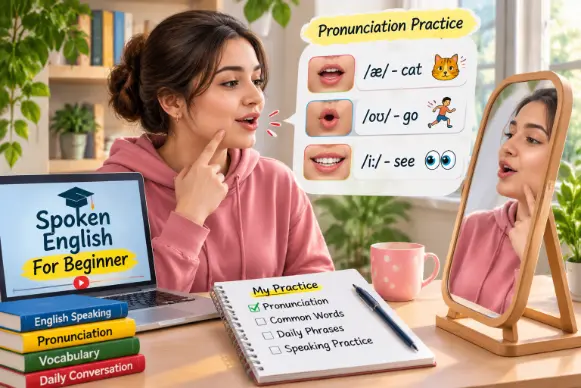
Speaking English uses several connected skills.
You need to understand words, put them into sentences, listen to others, and say your message clearly.
Reading and writing can also support learning. For example, you can read a short dialogue or write down a useful expression.
But reading an English sentence does not prove that you can say it without help.
You can develop these skills together. Listening and speaking practice, along with simple English speaking exercises, makes each skill easier.
Learn Common English Words and Useful Expressions
Start with words you meet in everyday life.
You may already know some English words, such as phone, pen, cup, table, and school.
The next step is to use them in sentences.
People
| Word | Urdu meaning | Sentence |
|---|---|---|
| Mother | والدہ | My mother is at home. |
| Father | والد | My father is working. |
| Brother | بھائی | I have one brother. |
| Sister | بہن | My sister is a student. |
| Friend | دوست | He is my friend. |
| Teacher | استاد | She is my teacher. |
Places and things
| Word | Urdu meaning | Sentence |
|---|---|---|
| Home | گھر | I am at home. |
| Room | کمرہ | This is my room. |
| Kitchen | باورچی خانہ | I am in the kitchen. |
| Shop | دکان | The shop is open. |
| Market | بازار | I am going to the market. |
| Door | دروازہ | Please close the door. |
| Window | کھڑکی | The window is open. |
| Phone | فون | This is my phone. |
Everyday actions
- Eat — I eat breakfast.
- Drink — I drink water.
- Go — I go to college.
- Come — Please come here.
- Sit — Please sit down.
- Read — I read a book.
- Write — I write my name.
- Listen — Please listen to me.
- Speak — I speak Urdu.
- Help — Please help me.
- Wait — Please wait here.
- Open — Open the door, please.
- Close — Close the window, please.
Notice how one word becomes part of a useful message. This is the core of basic English speaking: words you can actually use.
Learn words with real objects
Look around your room.
Point to a table and say: This is a table.
Look at your phone: This is my phone.
Look at a window: The window is open.
You can write English labels for familiar objects if this helps you remember their names.
But do not stop at learning the labels. Make a sentence about the object.
For example:
Door → The door is closed.
Cup → I have a cup of tea.
Book → My book is on the table.
Learn useful words in small groups
You do not have to learn 3,000 words before having a beginner conversation.
Start with words connected to a familiar situation, such as eating breakfast or travelling to college.
Learn the word, understand its meaning, and use it in a sentence.
Then try to remember the word again after some time.
Learn common word groups and collocations
A collocation is a group of words that people commonly use together. Learning the whole group can make spoken English sound more natural than translating each word separately.
- Have breakfast — I have breakfast at seven.
- Make tea — My mother makes tea.
- Take a bus — I take a bus to college.
- Go shopping — We go shopping on Sunday.
- Do homework — I do my homework after school.
Practise each word group in a sentence about your own life.
Common expressions you should recognise
- Just a moment, please.
- Come here, please.
- Go there.
- Stay here.
- Stop here.
- Wait for me.
- Listen to me.
- Please say something.
- Walk carefully.
- Take care.
- Let me know.
- I have no idea.
- I think so.
- I don’t think so.
- No problem.
- Of course.
- That’s a good idea.
- I am ready.
- I am busy.
- I’m not sure.
Some expressions contain phrasal verbs. These are verbs used with small words such as up, in, or on.
For example:
- Wake up — to stop sleeping.
- Get up — to leave your bed or stand.
- Sit down — to take a seat.
- Come in — to enter.
- Turn on — to start a light or device.
- Turn off — to stop a light or device.
- Pick up — to lift something.
You may also hear idioms in English. An idiom is an expression whose meaning is not always clear from each word.
For example: It’s a piece of cake.
This can mean something is very easy.
You do not need to memorise hundreds of idioms now. Learn useful everyday expressions first.
Word practice
Choose three familiar objects.
For each object:
- Say its English name.
- Make a sentence.
- Ask a question about it.
Example — Phone
- This is my phone.
- My phone is on the table.
- Where is my phone?
This helps you practise words in different ways.
Make Basic Sentences With Simple English Grammar
Grammar helps you make clear messages.
You do not need to finish a full grammar course before speaking. But some basic rules are useful for spoken English grammar.
1. Understand simple English word order
A common English statement follows this order:
Person or thing + action + other information
For example: I drink water.
- I tells us who.
- Drink tells us the action.
- Water tells us what I drink.
More examples:
- She reads books.
- We play cricket.
- They speak English.
Not every English sentence follows exactly the same pattern, but this is a useful place to start.
2. Use I, you, he, she, it, we, and they
These words help you talk about people and things.
- I am Ahmed.
- You are my friend.
- He is my brother.
- She is my sister.
- It is a book.
- We are students.
- They are teachers.
Use it for many objects and animals when you are not referring to a known animal as he or she.
For example: That is a cow. It is eating grass.
You can also use he or she for an animal when its sex is known.
3. Learn am, is, and are
- I am happy.
- He is tired.
- She is a teacher.
- You are kind.
- We are ready.
- They are at home.
For negative sentences:
- I am not busy.
- He is not here.
- We are not late.
In daily speech, you may hear:
- I’m not busy.
- He isn’t here.
- We aren’t late.
4. Use my, your, his, her, our, and their
These words tell us who something belongs to.
- My name is Ali.
- Your book is here.
- His phone is new.
- Her bag is on the chair.
- Our house is small.
- Their school is nearby.
Compare:
I am a student.
Please help me.
This is my pen.
This pen is mine.
Other useful words:
- Please help us.
- I know him.
- I know her.
- Please call them.
- This book is yours.
You do not need to memorise a large pronoun chart at once. Learn the forms as you use them.
5. Make simple present-tense sentences
Use the present simple for habits and things you do regularly.
- I wake up early.
- I drink tea.
- We go to school.
- They play football.
With he and she, many verbs take -s or -es.
- He works.
- She reads.
- My brother goes to college.
6. Talk about actions happening now
Use am/is/are + verb-ing.
- I am studying.
- She is cooking.
- We are watching a video.
- They are playing cricket.
Compare:
I study English every day. — A regular activity.
I am studying English now. — An action happening now.
7. Ask simple yes/no questions
- Are you a student?
- Is he your brother?
- Do you like tea?
- Does she work here?
- Can you help me?
Short answers:
- Yes, I am.
- No, he isn’t.
- Yes, I do.
- No, she doesn’t.
- Yes, I can.
8. Use a and an
- I have a pen.
- She has an apple.
- He is a teacher.
- I need an umbrella.
Use a before a consonant sound and an before a vowel sound.
9. Talk about what you can do
- I can read.
- I can cook.
- I can speak a little English.
- I cannot understand this sentence.
You can also say: I can’t understand this sentence.
10. Make polite requests
- Can you help me, please?
- Could you repeat that, please?
- Can I have some water, please?
- May I come in?
11. Talk about the past and future when needed
Start with easy examples:
- I went to school yesterday.
- I watched a video.
- I will call you tomorrow.
- I am going to study tonight.
You do not need to learn every tense before your first conversation.
12. Connect short ideas
Use simple connecting words.
- And: I have a pen and a book.
- But: I understand English, but I speak slowly.
- Because: I am happy because my friend is here.
- Then: I eat breakfast, then I go to work.
These words help you make longer, meaningful messages.
13. Use basic prepositions of place and time
Prepositions show where something is or when something happens. Start with in, on, and at:
- In: I am in the kitchen. I was born in July.
- On: The book is on the table. I study on Monday.
- At: I am at home. I wake up at seven.
These words have more than one use, so learn them through short examples instead of trying to memorise every rule at once.
Practice: Make different sentences
Start with: I want water.
Now change it:
- I want some tea.
- She wants water.
- Do you want water?
- I don’t want coffee.
- I want to drink water.
This is more useful than only memorising one grammar rule.
Listen to and Understand Slow, Clear English
You cannot answer a question well if you have not understood it.
That is why listening is important for speaking.
Start with short audio containing familiar English. You can also practise familiar exchanges through beginner dialogues in English.
This is listening comprehension: understanding the meaning of a spoken message, not merely hearing individual words.
For example:
Where do you live?
آپ کہاں رہتے ہیں؟
I live in Lahore.
میں لاہور میں رہتا/رہتی ہوں۔
You can practise listening in a simple way.
First listening: Listen for the main idea.
Ask yourself: Is the person asking about a name, a place, or an action?
Second listening: Listen for important words.
For example, listen for where and live.
Third listening: Answer or repeat.
Say: I live in Lahore. Then change the city.
If you cannot understand the audio:
- Choose a shorter recording.
- Use a slower version.
- Listen again.
- Read the transcript if necessary.
- Check the meaning of unfamiliar words.
- Return to the audio and try without reading.
A transcript is the written form of what someone says.
What about subtitles?
You do not have to watch every English video without subtitles.
If you are a complete beginner, Urdu subtitles may help you understand the situation.
When possible, try English subtitles with beginner-friendly audio.
Later, listen to a short part without subtitles and check what you understood.
The important point is to practise listening, not simply to watch a video.
Active listening and background listening
You may listen to English while cooking, cleaning, or travelling.
This can give you more exposure to English.
But focused practice is different.
When you practise actively, try to understand a specific question or message and respond to it.
Background audio should not replace that work.
Try short listening questions
Listen to a person asking:
- What is your name?
- Where are you from?
- Do you like cricket?
- What time do you wake up?
- What are you doing?
Try answering aloud.
If you need a free beginner audio lesson, these resources may help:
- British Council A1 Speaking — short videos, useful phrases, and practice.
- VOA Let’s Learn English — Level 1 — beginner video lessons and learning activities.
- ELLLO A1 English Lessons — short listening lessons and familiar questions.
- Oxford Online English — Where Are You From? — a beginner listening lesson with normal and slower audio.
These are external learning resources.
Listening check
After hearing a question, can you answer without reading it?
If you understand the written question but not the spoken one, continue practising listening with easier audio.
If you understand the question but cannot produce an answer, focus on speaking and sentence-building.
Practise Pronunciation in Spoken English for Beginners
Pronunciation means how you say words.
Pronunciation کا مطلب الفاظ کو ادا کرنے کا طریقہ ہے۔ مقصد یہ ہے کہ آپ کے الفاظ اتنے واضح ہوں کہ دوسرا شخص آپ کی بات سمجھ سکے۔
Your goal is to speak clearly enough for people to understand your message.
You do not need a perfect British or American accent.
English letters and sounds
The English alphabet has 26 letters.
There are five traditional vowel letters:
A, E, I, O, U
The other 21 letters are usually called consonant letters.
But letters and sounds are not the same thing.
One letter can represent different sounds.
For example, the letter a sounds different in:
- Cat
- Car
- Cake
The sound also depends on the word and the speaker’s accent.
If you are new to English sounds, basic phonics practice can help you connect letters or letter groups with the sounds they represent. Practise a sound in a familiar word, then listen for it in a short phrase. English spelling does not always match pronunciation one-to-one.
This is why listening to spoken English is helpful.
You do not have to study detailed speech anatomy before learning common sentences.
Practise clear articulation
Articulation means forming speech sounds clearly enough for other people to distinguish the words. Slow down slightly when a sound is difficult, listen to a reliable model, and practise the sound first in a word and then in a short phrase.
Start with useful words
Practise:
- Hello.
- Please.
- Thank you.
- School.
- Water.
- Teacher.
- Listen.
- Speak.
- English.
Notice that the t in listen is not pronounced in standard English.
Also listen carefully to words that differ by one sound.
For example:
- Ship / Sheep
- Sit / Seat
- Live / Leave
A small sound difference can change the word.
Listen to whole phrases
Words may sound slightly different when people speak naturally.
For example: What do you want?
In fast informal speech, some sounds may become shorter or connect together.
You do not need to copy every fast or informal pronunciation.
First learn to understand and say the clear form.
Later, you can practise recognising connected speech in recordings. This means noticing how words may link together or become shorter in natural speech.
Notice word stress, sentence stress, rhythm, and intonation
Word stress means making one syllable more prominent, as in TA-ble and be-GIN. Sentence stress means making the most important words clearer: I NEED some WATER.
Rhythm comes from grouping words into meaningful chunks. Intonation is the rise and fall of your voice. Yes/no questions often have a rising tone, while many information questions have a falling tone. These are common patterns, not rules for every speaker or situation.
Listen to a whole phrase and repeat its sound, stress, and melody instead of practising every word in isolation.
Use natural tone
Your voice can help express a question, a request, or a feeling.
Compare:
Thank you. — A polite response.
Really? — A surprised question.
Could you help me, please? — A polite request.
Speak naturally rather than trying to sound like a robot.
Pronunciation practice
- Choose one short phrase.
- Listen to a reliable spoken example.
- Repeat it slowly.
- Try it at a natural speed.
- Record yourself.
- Compare the recording with the model.
If you still cannot hear the difference, seek feedback from someone who can help, such as a teacher, an English speaking tutor, or a supportive speaking partner.
For short pronunciation activities, you can also use Cambridge English beginner activities.
Learn to Ask and Answer Basic English Questions
Questions and answers are the heart of spoken English for beginners. Every lesson of spoken English for beginners should include speaking aloud.
Real everyday English conversations include questions and answers.
You may know many English words, but if you cannot understand or answer a simple question, conversation can still feel difficult.
Begin with common questions about yourself. These questions form the foundation of simple English conversations.
Understand Common Questions About Yourself
Learn what each question is asking.
| English question | Urdu meaning |
|---|---|
| What is your name? | آپ کا نام کیا ہے؟ |
| Where are you from? | آپ کہاں سے ہیں؟ |
| Where do you live? | آپ کہاں رہتے ہیں؟ |
| How old are you? | آپ کی عمر کیا ہے؟ |
| What do you do? | آپ کیا کام کرتے ہیں؟ |
| Are you a student? | کیا آپ طالب علم ہیں؟ |
| Do you work? | کیا آپ کام کرتے ہیں؟ |
| Do you like tea? | کیا آپ کو چائے پسند ہے؟ |
| What time do you wake up? | آپ کتنے بجے اٹھتے ہیں؟ |
| What are you doing? | آپ کیا کر رہے ہیں؟ |
| Can you speak English? | کیا آپ انگریزی بول سکتے ہیں؟ |
| Why are you learning English? | آپ انگریزی کیوں سیکھ رہے ہیں؟ |
Learn common question words
| Question word | Urdu meaning |
|---|---|
| What | کیا |
| Who | کون |
| Where | کہاں |
| When | کب |
| Why | کیوں |
| How | کیسے |
| Which | کون سا |
Now look at these two questions:
What do you do?
This often asks about your work or usual role.
What are you doing?
This asks what you are doing now.
They look similar, but they ask different things.
Listen before answering
If someone asks: “Where are you from?”
You can answer: “I am from Pakistan.”
If someone asks: “Where do you live?”
You can answer: “I live in Lahore.”
Your country and your current city are not necessarily the same answer.
Question practice
Read a question.
Understand its meaning.
Look away.
Say the question aloud.
Then answer it.
Start with five familiar questions before trying more difficult ones.
Give Short Answers Using Your Own Information
You do not need a long speech to answer a simple question.
A short and correct answer is useful.
What is your name? My name is Ali.
Where are you from? I am from India.
Where do you live? I live in Delhi.
What do you do? I am a student.
Do you like tea? Yes, I do.
Can you speak English? I can speak a little English.
Why are you learning English? I want to speak with more people.
Now try adding one more detail.
Short answer: I am a student.
Longer answer: I am a college student.
More information: I am a college student in Lahore.
Another example:
Short answer: I like cricket.
Longer answer: I like cricket because it is fun.
You do not need to add a reason to every answer. Do it when it makes your message clearer.
Practise new answers, not only memorised ones
Question: What do you like?
Possible answers:
- I like reading.
- I like cooking.
- I like football.
- I like spending time with my family.
Say what is true for you.
Speaking check
Answer these without reading a model:
- What is your name?
- What do you like?
- Where do you live?
- What do you do every day?
- Why do you want to learn English?
If you forget a word, use a simpler sentence.
Ask Simple Questions and Request Clarification
Speaking is not only answering other people.
You should also learn to ask questions.
Start with:
- What is your name?
- Where do you live?
- Are you a student?
- Do you like coffee?
- Can you help me?
- What time is it?
- Where is the bus stop?
Make questions with do and does
- Do you work here?
- Do they live nearby?
- Does he work here?
- Does she like tea?
Make questions with can
- Can you speak English?
- Can I sit here?
- Can you repeat that?
- Can you help me?
When you do not understand
You can keep the conversation going by asking for help. This is an important part of English conversation practice.
Use these expressions:
Sorry, I don’t understand.
معاف کیجیے، مجھے سمجھ نہیں آیا۔
Could you say that again, please?
کیا آپ دوبارہ کہہ سکتے ہیں؟
Please speak more slowly.
براہِ کرم ذرا آہستہ بولیں۔
What does that mean?
اس کا کیا مطلب ہے؟
How do you spell that?
اس کے ہجے کیسے لکھتے ہیں؟
Could you give me an example?
کیا آپ ایک مثال دے سکتے ہیں؟
I didn’t hear you clearly.
میں آپ کی بات صاف نہیں سن سکا/سکی۔
These expressions are useful when the other person speaks too fast, uses an unfamiliar word, or says something you did not hear.
Short conversation
- A: Where do you live?
- B: Sorry, could you say that again?
- A: Where do you live?
- B: I live in Multan.
- A: Oh, nice!
You did not need to understand everything the first time. You asked for clarification and continued.
Practice
Imagine someone says something you cannot hear. Ask them to repeat it politely. Then practise asking for a word’s meaning.
Practise Guided English Conversations for Daily Life
These dialogues give practical spoken English for beginners in real situations. Use them as a model, then create your own spoken English for beginners conversations.

A conversation is an exchange between people.
You need to understand what someone says, give a relevant answer, and sometimes ask a follow-up question.
Start with short situations you may face at home, school, in a shop, or when meeting someone. The dialogues below give you practical daily English conversation practice.
Greetings in Spoken English for Beginners
Conversation 1: Meeting a new person
- Ali: Hello!
- Sara: Hi! How are you?
- Ali: I’m fine, thanks. How are you?
- Sara: I’m good, thank you.
- Ali: My name is Ali. What’s your name?
- Sara: I’m Sara.
- Ali: Nice to meet you.
- Sara: Nice to meet you too.
Now practise using your name.
Conversation 2: Asking where someone is from
- A: Where are you from?
- B: I’m from Pakistan.
- A: Which city?
- B: I’m from Islamabad.
- A: Do you live there now?
- B: Yes, I do.
Conversation 3: A student introduction
- A: Hi. Are you new here?
- B: Yes, I am.
- A: What’s your name?
- B: My name is Hamza.
- A: I’m Bilal. Welcome!
- B: Thank you.
- A: Nice to meet you.
- B: Nice to meet you too.
How to practise
First, read both speaking parts.
Next, speak them aloud.
Then change the names and places.
Finally, practise without reading.
If a friend is available, take turns asking and answering. If nobody is available, practise both roles yourself.
Talking About Home, Family and Daily Routines
Your home and daily activities are useful starting topics.
You already know the people, places, and actions. You only need to learn how to describe them in English.
Talk about family
- This is my mother.
- My father is at work.
- I have one brother.
- My sister is a teacher.
- My family lives in Lahore.
Talk about your home
- This is my house.
- My room is small.
- The kitchen is clean.
- The door is open.
- There is a table near the window.
- My bag is on the chair.
Talk about your daily routine
- I wake up at seven.
- I brush my teeth.
- I eat breakfast.
- I go to college.
- I study in the afternoon.
- I come home in the evening.
- I have dinner with my family.
- I go to bed at ten.
Use your real routine. Do not copy a time or activity that is not true for you.
Conversation: Daily routine
- A: What time do you wake up?
- B: I wake up at seven.
- A: What do you do after breakfast?
- B: I go to college.
- A: How do you go there?
- B: I go by bus.
- A: What do you do in the evening?
- B: I study and spend time with my family.
Practise English while doing everyday tasks
When you make tea, try saying:
- I’m in the kitchen.
- I’m making tea.
- I need some water.
- The water is hot.
- My tea is ready.
When you get ready to leave:
- I am getting ready.
- I need my bag.
- Where is my phone?
- I am leaving now.
This is called self-talk: speaking to yourself.
You can do it at home even when you have no speaking partner. It is a simple way to practise English speaking at home.
Turn a few sentences into a short description
Start with: “I am at home.”
Add: “I am at home. I am in the kitchen.”
Then: “I am at home. I am in the kitchen. I am making breakfast.”
You are connecting simple sentences into a short spoken description.
Do not rush into long stories. Start with two or three connected sentences.
Use pictures and objects
Look at an object in your room.
Say its name, describe it, and explain how you use it.
Example: “This is my desk. It is near the window. I study at this desk.”
If you cannot remember a word, use a simpler one or check its meaning.
Practice
Describe one room in your home using three sentences. Then talk about three things you do every day.
Asking for Help and Making Simple Requests
English is useful when you need something.
You may need help at school, information at a shop, or directions in a new place.
Start with simple and polite requests.
- Please help me.
- Can I ask you something?
- Can you open the door, please?
- Could you speak slowly, please?
- Can I have some water?
- Can you show me the way?
Conversation 1: Borrowing a pen
- A: Excuse me. Do you have an extra pen?
- B: Yes, I do.
- A: Can I borrow it, please?
- B: Sure. Here you are.
- A: Thank you.
- B: You’re welcome.
Conversation 2: At a shop
- A: Excuse me. How much is this notebook?
- B: It’s 100 rupees.
- A: Do you have a blue one?
- B: Yes, we do.
- A: I’ll take it, please.
- B: Thank you.

Conversation 3: Buying a bus ticket
- A: Hello. One ticket to Lahore, please.
- B: One-way or return?
- A: One-way, please.
- B: That’s 500 rupees.
- A: Here you are.
- B: Thank you.
The price is only an example for practising the conversation.
Conversation 4: Asking for directions
- A: Excuse me. Where is the bus stop?
- B: It’s near the bank.
- A: Is it far from here?
- B: No. It’s a short walk.
- A: Thank you for your help.
- B: You’re welcome.

Conversation 5: At a café
- A: Hello. Can I have a cup of tea, please?
- B: Of course. Anything else?
- A: No, thank you.
- B: Please take a seat.
- A: Thank you.
Conversation 6: On the phone
- A: Hello. Can I speak to Sara, please?
- B: She’s not here right now.
- A: Can you ask her to call me back?
- B: Yes, of course.
- A: Thank you.
Phone conversations can be harder because you cannot see the other person’s face.
If you do not hear a word clearly, say:
“Sorry, could you repeat that?”
Conversation 7: Asking a teacher for help
- Student: Excuse me, ma’am. Can I ask a question?
- Teacher: Yes, of course.
- Student: I don’t understand this word.
- Teacher: Which word?
- Student: This one, please.
- Teacher: Let me explain.
- Student: Thank you.
Practise real situations
Choose one conversation.
Read it first.
Then change the object, place, time, or question.
For example, change pen to notebook.
Or change bus stop to hospital.
The goal is to learn how to communicate, not to memorise every line.
Move From Example Dialogues to Your Own Responses
A written dialogue gives you a model.
But real people will not always ask the exact same question.
You need to practise creating your own answers.
Step 1: Read and understand
Example:
- A: Do you like tea?
- B: Yes, I do.
Step 2: Say it aloud
Speak both parts.
Step 3: Change the question
- A: Do you like coffee?
- B: No, I don’t.
Step 4: Add one detail
- A: Do you like cricket?
- B: Yes, I do. I play cricket with my friends.
Step 5: Answer without reading
Ask a friend to choose a new question.
If you are practising alone, write several familiar questions on small pieces of paper. Pick one without looking at its answer and respond aloud.
Practise quick responses
Start with easy prompts:
- What is your name?
- Where do you live?
- Are you a student?
- Do you like tea?
- What are you doing?
- Can you help me?
Answer clearly. You do not need to speak at high speed.
Use simple conversation starters
- How was your day?
- What do you like to do in your free time?
- What are you learning these days?
- Have you been here before?
Keep the conversation going with a short follow-up, such as Why do you like it?, When do you usually do that?, or Can you tell me more? Ask one question at a time and listen to the answer.
When these become easier, try a simple follow-up question:
- A: Do you like football?
- B: Yes, I do.
- A: Who do you play with?
- B: I play with my friends.
Use connected questions to practise a longer conversation
- A: Are you a student?
- B: Yes, I am.
- A: Where do you study?
- B: I study in Islamabad.
- A: What do you like about your college?
- B: I like my teachers.
This is more realistic than repeating unrelated sentences without meaning.
Practise with a speaking partner
A friend, classmate, family member, or teacher may help you practise. A beginner-friendly conversation group or speaking club can also provide regular interaction if one is available.
Start with familiar topics and short turns.
You can agree on a task such as introducing yourselves or asking about daily routines.
You do not have to ban Urdu completely. If a meaning is unclear, use a brief explanation, then return to speaking English.
If you do not have a partner:
- Use self-talk.
- Record questions and answers.
- Describe things around you.
- Practise both parts of a dialogue.
- Use an appropriate beginner speaking resource.
Solo practice helps you prepare, but real interaction is also important when your goal is to talk with other people.
Practise short stories carefully
You may enjoy listening to longer English stories about family, friendship, or everyday problems.
You can learn useful expressions from them, such as:
- I had a bad day.
- What happened?
- I don’t know.
- I need some help.
- Can we talk?
- I’m sorry.
- Thank you for understanding.
Start with a short scene that you can understand.
Listen to it, identify the main situation, and repeat useful phrases.
You do not need to memorise the complete story.
Your conversation check
Can you:
- Start with a greeting?
- Ask a related question?
- Give a clear answer?
- Ask for repetition when needed?
- Continue for several short turns?
If not, return to a simpler model and try again.
Build a 15-Minute Daily English Speaking Practice Routine
A short routine makes spoken English for beginners easier to follow every day. Fifteen minutes of focused spoken English for beginners practice is better than one long session each month.
You do not need to study for hours every day to begin practising. A short, focused routine can help you review useful language and use it aloud. Try this 15-minute plan at home, then adjust it to your level.
روزانہ لمبے وقت تک پڑھنا ضروری نہیں۔ آپ صرف 15 منٹ میں الفاظ دہرا سکتے ہیں، جملے بنا سکتے ہیں، انگریزی سن سکتے ہیں اور بولنے کی مشق کر سکتے ہیں۔
Minutes 1–3: Review Five Useful Words
Choose five words from your home, family, work, studies, or daily routine. Say each word aloud and use it in a short sentence.
- Phone — This is my phone.
- Water — I need some water.
- Teacher — My teacher is helpful.
You can use simple flashcards or a quick self-quiz: look at an object or its Urdu meaning, recall the English word, and then say a sentence with it.
Do not only read the words. Try to remember their meanings before checking your notes. Flashcards should support speaking aloud, not replace it.
Minutes 4–7: Build Four Simple Sentences
Choose one sentence pattern, such as I like + something, I need + something, or I am + information. Make four true sentences by changing the details.
- I like tea.
- I like reading.
- I like cricket.
- I like learning English.
Use your own information instead of memorising someone else’s answers.
Minutes 8–11: Listen and Repeat
Choose a short beginner audio or dialogue. Listen once for the main idea. Listen again for useful words, then repeat two or three sentences aloud.
If the audio is difficult, choose a shorter clip or use a transcript to understand it before listening again.
Try to understand the message; do not just play English audio in the background.
Minutes 12–14: Speak Without Reading
Talk for one or two minutes about a familiar topic, such as your family, your room, your daily routine, or something you like.
Start with short sentences. If you forget a word, describe it in simpler English and continue.
You can practise alone or take turns with a speaking partner.
Minute 15: Record and Review
Record a short voice note. Listen once and choose just one thing to improve, such as a missing word, a long pause, or an unclear sound.
Write down one sentence you said well and one sentence you want to practise again.
Keep a simple progress note with the date, topic, one thing you did well, and one target for your next practice session.
A recording helps you notice changes, but use a teacher or reliable model when you need accurate grammar or pronunciation feedback.
Repeat this routine regularly, and change the topic as your skills improve. Consistent practice is more useful than trying to memorise a large number of sentences in one day.
Overcome Common Problems in Spoken English for Beginners
Every learner of spoken English for beginners faces similar problems. Here is how to solve them one by one.
Many English learners report difficulties even after reading books, watching videos, or studying grammar.
But different problems can have different causes.
For example, a learner may know a word but forget it while speaking. Another learner may understand a written question but not recognise it in audio.
These tips can help you speak English confidently over time, without promising a fixed result.
Choosing practice that matches the problem is more useful than repeating the same lesson without knowing why you are struggling.
What to Do When You Forget English Words
Sometimes you know what you want to say in Urdu but cannot remember the English word.
You may stop, become nervous, or change the topic.
Try using words you already know.
If you forget refrigerator, you can say: “The machine that keeps food cold.”
If you forget umbrella, you can say: “The thing we use when it rains.”
If you forget charger, you can say: “The thing I use to charge my phone.”
The description may not be perfect, but it can help another person understand you.
You can also ask:
- What’s the word for this?
- How do you say this in English?
- I forgot the word.
- Can you help me?
Why can words be difficult to remember?
There are different possible reasons.
You may have seen the word many times but rarely used it aloud.
You may know its Urdu meaning but not know how it fits into a sentence.
Or the word may simply be unfamiliar.
Try learning words in context
Instead of only memorising: Umbrella — چھتری
Learn: “I need an umbrella. It is raining.”
Then change it:
- Where is my umbrella?
- My umbrella is in my bag.
Use the word in more than one meaningful sentence.
Review words you forget
Return to useful words after some time.
Try remembering them before checking the answer.
Reviewing words across different sessions can support retention. There is no single review schedule that works best for everyone.
Word-recall check
Look at an object.
Can you:
- Name it?
- Say one sentence about it?
- Explain it in simple words if you forget its name?
If you cannot do the third task yet, start with common descriptions such as:
- “It’s something we use for…”
- “It’s a place where…”
- “It’s a person who…”
How to Stop Translating Every Sentence From Urdu
You may first think in Urdu, translate the idea into English, and then speak.
Sometimes this takes time.
For example, you think:
مجھے پانی چاہیے۔
Then you search for the English words.
With practice, you can learn to recall the full expression: I need some water.
Use Urdu to understand. Use English to communicate.
Urdu explanations can help you learn a difficult word or sentence.
You do not need to stop using Urdu completely.
However, after understanding the meaning, practise the English expression as one complete message.
Connect English with real objects
Look at your phone: “This is my phone.”
Look at your door: “The door is open.”
Look at a glass: “I need some water.”
Try to connect the English sentence with the situation.
Describe what you are doing
- I am sitting.
- I am reading.
- I am making tea.
- I am going outside.
Start with a few sentences you know well.
Do not try to translate every complex thought.
Build sentences slowly
Start: “I am tired.”
Add information: “I am tired today.”
Then: “I am tired because I worked a lot.”
You are learning to express more meaning with familiar English.
Rephrase one thought
When a simple thought comes to you in Urdu, try expressing it in English.
For example:
مجھے بھوک لگی ہے۔
“I am hungry.”
مجھے جانا ہے۔
“I need to go.”
میں ابھی مصروف ہوں۔
“I am busy right now.”
If you do not know how to say something, learn the correct phrase instead of guessing repeatedly.
What about thinking in English?
You can practise thinking about familiar things in English.
For example: “It’s morning. I need breakfast. I have work today.”
This can be a useful activity for some learners.
But thinking in English is not a requirement before you can have a conversation. It may develop gradually as familiar expressions become easier to recall.
Practice
Choose three everyday Urdu expressions. Learn their natural English versions. Use them in a real situation or a short speaking practice. Try recalling them later without looking.
Practise Speaking When You Feel Nervous
You may know what to say but feel afraid when another person listens.
کبھی آپ کو بات معلوم ہوتی ہے، لیکن دوسروں کے سامنے بولتے ہوئے گھبراہٹ محسوس ہوتی ہے۔ چھوٹی اور آسان مشقوں سے آہستہ آہستہ اعتماد بڑھایا جا سکتا ہے۔
You may worry that someone will laugh at your mistakes.
You may also feel nervous because you do not understand the question or do not know enough words.
These are different problems.
Build speaking confidence and fluency step by step
Speaking confidence grows when you practise manageable tasks, repeat them, and gradually try new questions. Fluency does not mean speaking as fast as possible. At beginner level, aim to connect familiar words and sentences clearly, respond to the other person, and use fewer long pauses over time.
Start with a small speaking task
Say: “My name is Ayesha.”
Then: “I am learning English.”
Next: “I want to improve my speaking.”
Speak aloud in a comfortable place.
If you need to, use a model first.
Try speaking without an audience
You can:
- Talk to yourself.
- Practise in front of a mirror.
- Record a short voice message.
- Describe your day.
- Ask and answer familiar questions.
A mirror can help you become comfortable speaking aloud, but it cannot check whether your grammar or pronunciation is correct.
Move towards real interaction
When you are ready, practise with someone patient and supportive.
During face-to-face practice, body language—such as relaxed posture, comfortable eye contact, and simple gestures—can support your message. These are helpful extras; listening and clear words remain the priority.
Begin with a short exchange:
- A: How are you?
- B: I’m fine, thanks.
- A: What are you doing?
- B: I’m studying English.
Do not make the conversation too difficult.
What if you become nervous during a conversation?
Use a short phrase to give yourself time.
- Just a moment, please.
- Let me think.
- I’m not sure.
- Could you repeat that?
- I don’t know the word.
You can also ask a simpler question.
Do mistakes mean your English is bad?
No. A mistake shows that something in your language use needs more practice.
But mistakes should not be ignored forever. Learn from useful correction and practise the correct expression.
What if you are still unable to speak?
Check the task difficulty.
Can you say a prepared sentence but not answer a new question?
If yes, practise small changes to familiar questions.
Can you answer in writing but not understand spoken English?
If yes, practise easier listening tasks.
Do you understand the question but forget the words you need?
If yes, work on short independent responses and word recall.
You do not have to solve every problem by studying more grammar.
Recognise and Correct Common Speaking Mistakes
Correcting useful mistakes can help make your English clearer.
Start with common beginner errors.
Mistake 1
Incorrect: I am go to school.
Correct: I go to school.
Or, for an action happening now: I am going to school.
Mistake 2
Incorrect: She go to college.
Correct: She goes to college.
Mistake 3
Incorrect: I no understand.
Correct: I don’t understand.
Mistake 4
Incorrect: I am agree.
Correct: I agree.
Mistake 5
Incorrect: He my brother.
Correct: He is my brother.
Mistake 6
Incorrect: My brother name is Ali.
Correct: My brother’s name is Ali.
Mistake 7
Incorrect: She is teacher.
Correct: She is a teacher.
Mistake 8
Incorrect: It is pen.
Correct: It is a pen.
Mistake 9
Incorrect: I have two pen.
Correct: I have two pens.
Mistake 10
Incorrect: I am very exciting.
Correct: I am very excited.
Correct, if you mean you feel excitement. Compare: “I’m excited.” — I feel happy and interested. “This game is exciting.” — The game makes people feel excited.
Mistake 11
Incorrect: I spoken English yesterday.
Correct: I spoke English yesterday.
You can also say: “I have spoken English before.” These sentences have different meanings.
Mistake 12
Incorrect: Does she likes tea?
Correct: Does she like tea?
After does, use the basic verb form.
Correct pronunciation errors when they affect meaning
Some English words have similar sounds.
For example:
- Live / Leave
- Ship / Sheep
- Sit / Seat
Listen to a reliable model and practise the specific sound.
How to use feedback
When someone corrects you:
- Understand the correct sentence.
- Repeat it aloud.
- Make a new sentence using the same rule.
- Try it again in another situation.
For example: “She goes to school.”
Now make: “He goes to work.” “My sister goes to college.”
Correcting one sentence is useful. Using the correction in another sentence shows that you are learning how the pattern works.
Keep corrections manageable
If you make many mistakes, focus on the ones that prevent understanding or appear repeatedly.
Do not stop every sentence to check a grammar rule.
Try to communicate your message, then improve it.
Check Your Beginner Speaking Skills and Continue Learning
Checking your progress is an important part of spoken English for beginners. Use these checks after each lesson of spoken English for beginners.
How can you know whether your English speaking is improving?
Do not count only how many videos you have watched or how many grammar rules you know.
After each lesson, check what you can understand and say without reading. Becoming fluent takes time, so measure small improvements rather than expecting instant results.
A learner may speak well about a familiar topic but struggle to understand a new question.
That does not mean all progress has stopped. It shows which skill needs more support.
Check Whether You Can Make Simple Sentences Independently
Look away from this page.
Try saying five true sentences about yourself.
Include:
- Your name.
- Your city.
- Your work or studies.
- Something you like.
- Something you do every day.
Example: “My name is Hamza. I live in Faisalabad. I am a student. I like cricket. I study English every day.”
Now change the information.
Try: “I like tea.”
Then: “My brother likes tea.”
Then: “Do you like tea?”
Can you use familiar words in new sentences?
Simple self-check
With help: You can say the sentence while looking at a model.
On your own: You can say a familiar sentence without looking.
With a change: You can use the pattern with different information.
These are simple learning checks, not official English-proficiency scores.
If you need the model every time, continue with easier sentence-building. If you can change the sentence, move on to simple questions.
Check Whether You Can Understand and Answer Questions
A speaking check should include listening.
Ask a partner to say a few simple questions.
If nobody is available, use a beginner audio lesson.
Try:
- What is your name?
- Where do you live?
- Do you work or study?
- What do you like?
- What are you doing now?
Answer without reading.
Now try a changed question.
For example: Do you like tea?
Then: Does your brother like tea?
Listen carefully. The second question is about your brother, not you.
If you cannot understand the question
Ask for repetition.
Or use a slower recording.
Then practise the same type of question again.
If you understand but cannot answer
Try a short model answer.
Next, change it using your own information.
If you answer only memorised questions
Practise a few new questions about the same familiar topic.
Your goal is to respond meaningfully, not only to remember a fixed answer.
Check Your Ability to Complete a Short Conversation
Try speaking with another person.
You can use this simple conversation to begin:
- A: Hello. How are you?
- B: I’m fine, thank you.
- A: What’s your name?
- B: My name is Sara.
- A: Where are you from?
- B: I’m from Pakistan.
- A: Which city?
- B: I’m from Lahore.
- A: What do you do?
- B: I’m a student.
- A: Nice to meet you.
- B: Nice to meet you too.
Now practise without reading.
Ask your partner to change one question.
You can also practise:
- A: What do you like?
- B: I like reading.
- A: What do you read?
- B: I read short stories.
- A: Do you read in English?
- B: Yes, sometimes.
- A: That’s nice.
- B: Thank you.
Check these abilities
Can you:
- Greet someone?
- Introduce yourself?
- Understand a familiar question?
- Give a relevant answer?
- Ask a question?
- Answer a changed question?
- Request clarification when necessary?
- Complete several connected speaking turns?
You may need help with some of these skills.
Choose the one that is most difficult and practise it.
Compare your recordings carefully
You can record the same general speaking task on different occasions.
For example, describe your family now and again after more practice.
Listen for:
- Clearer words.
- More meaningful sentences.
- Fewer long pauses.
- Better responses.
- Correct use of a pattern you previously found difficult.
Also try a new question. Improvement on one memorised recording does not prove that you can handle every conversation.
Choose Your Next Lesson With the Start Here / Learning Roadmap
Your next lesson should match what you need.
If you know almost no English
Continue with familiar greetings, common spoken words, short audio, and simple personal sentences.
If you know words but cannot make sentences
Practise basic sentence patterns using your own information.
If you can make sentences but cannot understand spoken questions
Use beginner listening lessons with short questions and clear speech.
If you understand English but cannot answer quickly
Practise short independent responses and common follow-up questions.
If you can answer prepared questions but struggle with conversations
Practise connected exchanges, changed questions, and requests for clarification.
If you struggle with pronunciation
Use reliable spoken models and practise sounds or phrases that affect understanding.
If you become nervous when speaking
Start with manageable tasks and gradually practise with a supportive person.
This guide explains key ideas in simple English with Urdu meanings, so you can start learning spoken English from the beginning.
Use the 15-minute daily speaking routine earlier in this guide as your learning roadmap. It gives you a repeatable way to review words, build sentences, listen, speak, and choose one skill to improve. If you later decide to join an English speaking course, use the checks above to see whether it matches your level and gives you enough time to practise.
For one more beginner listening and introductions lesson, you can use this external resource:
- Oxford Online English — What’s Your Name? — listening, introductions, and asking for repetition.
If you need a beginner English PDF, choose one that includes clear examples and suitable practice. A PDF can support your learning, but reading it alone does not show that you can speak English.
You do not need to master every grammar rule, word list, or conversation before moving forward.
Start with one useful sentence.
Understand it.
Say it aloud.
Change it using your own information.
Try it in a real situation.
Then practise your next useful speaking skill.
Frequently Asked Questions About Spoken English for Beginners
These answers cover the most common questions about spoken English for beginners.
Here are practical answers to common questions beginners ask when they want to improve their English speaking skills.
How Should a Complete Beginner Start Speaking English?
Start with greetings and short sentences about yourself. Learn what each sentence means, say it aloud, change one detail, and practise answering simple questions. Build vocabulary, listening, grammar, and pronunciation step by step.
Can I Learn Spoken English at Home?
Yes. Practise with everyday objects, self-talk, short listening lessons, role-play, and voice recordings. Try to speak with another person when you can, because real conversations help you respond to different questions.
How Long Does It Take to Speak English Fluently?
There is no fixed timeline. Progress depends on your starting level, how often you practise, the kind of practice you do, and whether you receive useful feedback. Set small goals, such as answering familiar questions or completing a short conversation.
Can I Speak English Without Learning Grammar?
You can begin speaking with useful words and phrases before studying detailed grammar. However, basic grammar helps you build your own clear sentences. Learn simple patterns while you practise instead of waiting until you know every rule.
How Can I Practise English Speaking Without a Partner?
Use self-talk, describe objects and daily activities, practise both roles in a dialogue, answer recorded questions, and record short voice notes. When possible, add conversations with a supportive partner or teacher.
Do I Need a British or American Accent to Speak English Well?
No. You do not need to copy a particular accent. Focus on clear pronunciation, understandable words, natural sentence stress, and listening carefully to other speakers.
Should I Stop Thinking in Urdu When Learning English?
No. Urdu can help you understand meanings, especially at the beginning. After you understand a phrase, practise using the complete English expression in a real situation. With experience, familiar English phrases may become easier to recall directly.
Are English Speaking Classes Necessary for Beginners?
Not always. You can make progress with regular practice and reliable learning materials. A class or tutor may be useful if you need a structured course, speaking partners, or feedback on grammar and pronunciation. Choose one that matches your level and gives you time to speak.
Final Thoughts on Spoken English for Beginners
Spoken English for beginners becomes easier when you practise a little every day. Begin with simple sentences, listen carefully, speak aloud and review your progress. This guide to spoken English for beginners gives you a clear path: learn useful sentences, build basic grammar, practise conversations and check your skills.
Keep returning to this spoken English for beginners guide whenever you need a new lesson. For more learning topics, visit the EnglishSpokens spoken English blog or read about EnglishSpokens.