
Beginner Dialogues
Beginner dialogues in English help you learn what to say in familiar situations. Start with simple greetings and personal questions, then practise relaxed conversations between friends and polite exchanges at school or college. These short examples use natural English with Urdu meanings for useful English phrases. Read both roles aloud, repeat each exchange, and change the names or details to make the conversations your own with English conversation practice.
- 18 short dialoguesSimple questions, answers, and natural responses
- 3 familiar settingsBasic introductions, friends, and school or college
- English with Urdu meaningsUnderstand useful expressions and practise them aloud
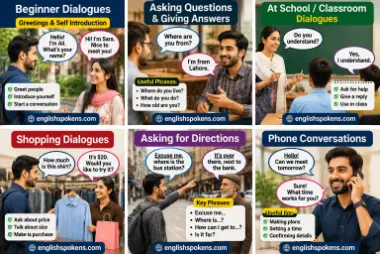
Try these simple conversation starters
- “How are you?”
- “What about you?”
- “Could you repeat that?”
- “That sounds interesting!”
آسان مکالموں سے انگریزی بولنے کی مشق کریں
Read both speakers’ lines, notice the responses, and practise the exchange aloud.
How to Practise Beginner Dialogues in English
Beginner Dialogues in English work best when you practise aloud instead of reading silently. Choose one short exchange, read both speakers’ lines, and repeat it until the responses feel natural. Use these beginner dialogues in English as a simple daily speaking exercise.

- Read both roles: Say each speaker’s lines aloud and notice the pronunciation.
- Personalise the conversation: Change names, places, and details to match your own life.
- Practise from memory: Repeat the exchange without looking, then record yourself and listen for areas to improve.
Beginner Dialogues in English for Basic Conversations
Use these beginner dialogues in English to practise familiar questions and short answers about greetings, personal information, family, jobs, and daily routines. The examples are suitable for ESL learners who want to build confidence in common first conversations.
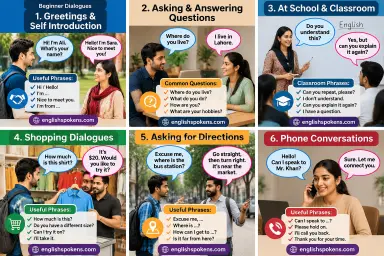
Dialogue 1 – Greetings and Introducing Yourself
Situation: Two people meet for the first time and introduce themselves.
Emma: Hello! How are you?
Jack: Hi! I’m fine, thank you. How are you?
Emma: I’m good, thanks. What’s your name?
Jack: My name is Jack. What’s your name?
Emma: I’m Emma. Nice to meet you.
Jack: Nice to meet you too.
Emma: Are you new here?
Jack: Yes, I am. I joined today.
Emma: Welcome! I hope you enjoy it here.
Jack: Thank you. That’s very kind of you.
Useful expressions and Urdu meanings
- Nice to meet you. — آپ سے مل کر خوشی ہوئی۔
- Are you new here? — کیا آپ یہاں نئے ہیں؟
- That’s very kind of you. — یہ آپ کی مہربانی ہے۔
Practice: Change the names and practise introducing yourself without reading the answers.
Dialogue 2 – Asking About Personal Information
Situation: Two people ask simple questions to get to know one another.
Anna: Hi! Can I ask you a few questions?
David: Sure. Go ahead.
Anna: Where are you from?
David: I’m from Lahore, Pakistan. What about you?
Anna: I’m from Delhi, India.
David: Nice! How old are you?
Anna: I’m 22 years old. And you?
David: I’m 24.
Anna: What do you do?
David: I’m a university student.
Anna: What do you study?
David: I study business.
Useful expressions and Urdu meanings
- Where are you from? — آپ کہاں سے ہیں؟
- What do you do? — آپ کیا کرتے ہیں؟
- What do you study? — آپ کیا پڑھتے ہیں؟
Practice: Answer the same questions about yourself. Keep each answer short and complete.
Dialogue 3 – Talking About Family and Friends
Situation: Two people talk about their families and the people they spend time with.
Sara: Do you have a big family?
Tom: Not really. I have a small family.
Sara: How many people are there in your family?
Tom: There are four people: my parents, my sister, and me.
Sara: Do you have any brothers?
Tom: No, but I have one younger sister.
Sara: What’s her name?
Tom: Her name is Lily. She’s very friendly.
Sara: Do you spend time together?
Tom: Yes, we usually watch movies and play games.
Sara: That sounds fun!
Tom: I love spending time with my family.
Useful expressions and Urdu meanings
- Do you have a big family? — کیا آپ کا خاندان بڑا ہے؟
- Younger sister — چھوٹی بہن
- Spend time together — اکٹھے وقت گزارنا
Practice: Replace the family details with your own. Practise asking one follow-up question.
Dialogue 4 – Asking About Jobs and Nationality
Situation: Two people discuss their work, where they are from, and what they enjoy doing.
Alex: Hello! What do you do?
Maria: I’m a teacher. What about you?
Alex: I’m a photographer.
Maria: Really? That’s interesting!
Alex: Thank you. Where are you from?
Maria: I’m from Spain. And you?
Alex: I’m from Canada.
Maria: Do you enjoy your job?
Alex: Yes, I do. I take pictures for travel magazines.
Maria: Do you travel a lot for work?
Alex: Sometimes. I enjoy visiting new places.
Maria: That sounds exciting!
Useful expressions and Urdu meanings
- What do you do? — آپ کا پیشہ کیا ہے؟
- Do you enjoy your job? — کیا آپ کو اپنا کام پسند ہے؟
- That sounds exciting! — یہ دلچسپ لگتا ہے!
Practice: Say your job or current role, then add one sentence about what you like about it.
Dialogue 5 – Talking About Daily Routines
Situation: Two people compare what they usually do during the day.
Ben: What time do you get up in the morning?
Lisa: I usually get up at seven.
Ben: What do you do first?
Lisa: I brush my teeth and take a shower.
Ben: Do you have breakfast at home?
Lisa: Yes, I usually eat eggs and bread.
Ben: What time do you go to work?
Lisa: I leave home at eight.
Ben: What do you do after work?
Lisa: I come home, have dinner, and watch TV.
Ben: What time do you go to bed?
Lisa: Around ten thirty.
Useful expressions and Urdu meanings
- Get up — اٹھنا
- Have breakfast — ناشتہ کرنا
- Go to bed — سونے جانا
Practice: Change the times and activities so the dialogue describes your real daily routine.
Dialogue 6 – Asking Simple Questions and Giving Answers
Situation: Two people practise short questions about interests, abilities, and everyday life.
Ryan: Do you speak English?
Mia: Yes, I do, but I’m still learning.
Ryan: Do you like reading books?
Mia: Yes, I do. I like short stories.
Ryan: Can you cook?
Mia: Yes, I can cook simple meals.
Ryan: Can you swim?
Mia: A little. What about you?
Ryan: Yes, I can.
Mia: Do you live in a house or an apartment?
Ryan: I live in an apartment.
Mia: That’s nice!
Useful expressions and Urdu meanings
- I’m still learning. — میں ابھی سیکھ رہا/رہی ہوں۔
- What about you? — اور آپ؟
- Can you…? — کیا آپ … کر سکتے ہیں؟
Practice: Answer each question about yourself. For questions beginning with “Can you”, use “Yes, I can” or “No, I can’t”.
Beginner Dialogues in English Between Two Friends
These beginner dialogues in English show how friends can keep a conversation moving with natural follow-up questions. Practise talking about meeting again, daily activities, a café visit, hobbies, travel, weekend plans, and birthdays.
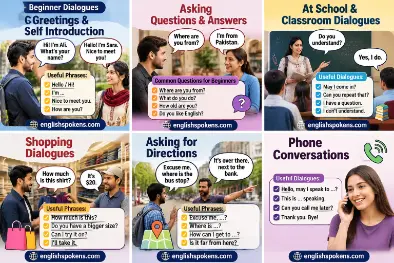
Dialogue 1 – Two Friends Meeting Each Other
Situation: Two friends meet after not seeing each other for several weeks.
Emma: Hey, Jack! How are you?
Jack: Emma! I’m great. How about you?
Emma: I’m fine. It’s been a long time!
Jack: Yes, I haven’t seen you for weeks.
Emma: What have you been doing?
Jack: I’ve been busy with work.
Emma: I see. Are you free this weekend?
Jack: Yes, I think so. Why?
Emma: Let’s meet and have lunch.
Jack: That’s a great idea!
Useful expressions and Urdu meanings
- It’s been a long time! — کافی عرصہ ہو گیا ہے!
- What have you been doing? — آپ آج کل کیا کر رہے ہیں؟
- That’s a great idea! — یہ بہت اچھا خیال ہے!
Practice: Practise greeting a friend and asking one question that helps continue the conversation.
Dialogue 2 – Talking About Daily Activities
Situation: Two friends talk about what they do after work or study.
Sam: What do you usually do after work?
Lucy: I usually go home and relax.
Sam: Do you watch television?
Lucy: Sometimes. I also listen to music.
Sam: What kind of music do you like?
Lucy: I love pop music. What about you?
Sam: I enjoy watching movies.
Lucy: Do you watch movies every day?
Sam: No, mostly on weekends.
Lucy: We should watch a movie together sometime.
Sam: Sure! I’d love that.
Useful expressions and Urdu meanings
- What do you usually do? — آپ عام طور پر کیا کرتے ہیں؟
- What kind of music do you like? — آپ کو کس قسم کی موسیقی پسند ہے؟
- I’d love that. — مجھے یہ بہت اچھا لگے گا۔
Practice: Replace music and movies with activities you enjoy, then repeat the conversation.
Dialogue 3 – Meeting at a Café and Ordering Drinks
Situation: Two friends order drinks and a snack at a café.
Waiter: Hello! What can I get you?
Emily: A cup of tea, please.
Waiter: Would you like milk and sugar?
Emily: No milk, please, but a little sugar.
Waiter: Certainly. What about you, Jack?
Jack: I’d like a coffee, please.
Waiter: Would you like anything to eat?
Emily: Do you have chocolate cake?
Waiter: Yes, we do.
Emily: Great! Can we have one slice, please?
Waiter: Of course. I’ll bring your order shortly.
Jack: Thank you!
Useful expressions and Urdu meanings
- What can I get you? — میں آپ کے لیے کیا لاؤں؟
- I’d like a coffee, please. — مجھے ایک کافی چاہیے، براہِ کرم۔
- Would you like anything to eat? — کیا آپ کچھ کھانا پسند کریں گے؟
Practice: Change the drinks and food. Practise ordering politely as both the customer and the server.
Dialogue 4 – Talking About Hobbies and Traveling
Situation: Two friends discuss their interests and places they would like to visit.
Mia: Do you like traveling?
Oliver: Yes, I love it! What about you?
Mia: I enjoy visiting new places too.
Oliver: Which country would you like to visit?
Mia: I’d love to visit Japan.
Oliver: Why Japan?
Mia: I like its culture, food, and beautiful places.
Oliver: That sounds amazing!
Mia: What do you do in your free time?
Oliver: I enjoy photography and reading books.
Mia: Really? I love taking pictures too.
Oliver: Maybe we can plan a trip together someday.
Mia: That would be wonderful!
Useful expressions and Urdu meanings
- I’d love to visit… — میں … جانا پسند کروں گا/گی۔
- In your free time — اپنے فارغ وقت میں
- That would be wonderful! — یہ بہت اچھا ہوگا!
Practice: Name a place you would like to visit and give one simple reason for your choice.
Dialogue 5 – Discussing Weekend Plans
Situation: Two friends decide what to do together on Saturday.
Daniel: Hey, do you have any plans for Saturday?
Sophie: Not yet. Why do you ask?
Daniel: Would you like to go to the park?
Sophie: Sure! What time?
Daniel: How about ten in the morning?
Sophie: That works for me.
Daniel: We can walk and have lunch together.
Sophie: Sounds good. Should I bring anything?
Daniel: No, just bring yourself!
Sophie: Okay. See you on Saturday.
Daniel: See you!
Useful expressions and Urdu meanings
- Do you have any plans? — کیا آپ کا کوئی منصوبہ ہے؟
- How about ten in the morning? — صبح دس بجے کیسا رہے گا؟
- That works for me. — یہ میرے لیے ٹھیک ہے۔
Practice: Change the day, time, and activity to make a new plan with a friend.
Dialogue 6 – Talking About Birthdays and Special Occasions
Situation: Two friends talk about a birthday celebration.
Lily: Hey, is it your birthday today?
Anna: Yes! It’s my birthday.
Lily: Happy birthday! I hope you have a wonderful day.
Anna: Thank you so much!
Lily: Are you having a party?
Anna: Yes, I’m inviting a few friends.
Lily: What time does it start?
Anna: At seven in the evening.
Lily: Can I bring a gift?
Anna: Of course! But your presence is enough.
Lily: That’s so sweet. I’ll see you tonight!
Anna: See you!
Useful expressions and Urdu meanings
- Happy birthday! — سالگرہ مبارک!
- What time does it start? — یہ کتنے بجے شروع ہوتا ہے؟
- Your presence is enough. — آپ کی موجودگی ہی کافی ہے۔
Practice: Practise congratulating a friend and asking two polite questions about the celebration.
Beginner Dialogues in English at School or College
These beginner dialogues in English help students practise meeting classmates, asking teachers for help, understanding instructions, and discussing homework. The polite questions and clear answers can be adapted to a school, college, or classroom.
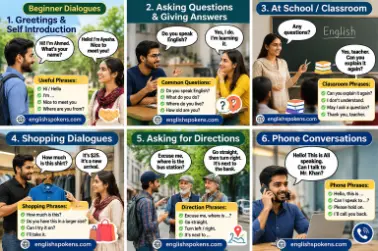
Dialogue 1 – Two Students Meeting for the First Time
Situation: Two students meet on their first day at college.
Ali: Hi! Is this your first day here?
Sara: Yes, it is. What about you?
Ali: It’s my first day too.
Sara: Nice! My name is Sara.
Ali: I’m Ali. Nice to meet you.
Sara: Nice to meet you too. Which class are you in?
Ali: I’m in the English class.
Sara: Really? So am I!
Ali: Great! Maybe we can sit together.
Sara: Sure. That would be nice.
Useful expressions and Urdu meanings
- Is this your first day here? — کیا آج آپ کا یہاں پہلا دن ہے؟
- Which class are you in? — آپ کس کلاس میں ہیں؟
- Maybe we can sit together. — شاید ہم ساتھ بیٹھ سکتے ہیں۔
Practice: Use your own name and class. Practise introducing yourself to a new classmate.
Dialogue 2 – Talking to a Classmate
Situation: Two classmates talk before their lesson begins.
John: Hi, Mike! How was your weekend?
Mike: It was great. I visited my grandparents.
John: That sounds nice. Did you enjoy it?
Mike: Yes, very much. What did you do?
John: I stayed home and watched movies.
Mike: Which movie did you watch?
John: I watched a comedy film.
Mike: I love comedy movies!
John: Really? We should watch one together.
Mike: Sure! That sounds fun.
Useful expressions and Urdu meanings
- How was your weekend? — آپ کا ویک اینڈ کیسا گزرا؟
- Did you enjoy it? — کیا آپ نے لطف اٹھایا؟
- That sounds fun. — یہ مزے کا لگتا ہے۔
Practice: Ask a classmate about one thing they did recently and respond with a follow-up question.
Dialogue 3 – Asking a Teacher for Help
Situation: A student asks a teacher to explain a difficult question.
Student: Excuse me, Miss.
Teacher: Yes, how can I help you?
Student: I don’t understand this question.
Teacher: Which part is difficult for you?
Student: I don’t understand how to start the answer.
Teacher: No problem. Let me explain it again.
Student: Thank you, Miss.
Teacher: First, read the question carefully. Then identify the main point.
Student: Oh, I understand now.
Teacher: Good! Let me know if you need more help.
Student: I will. Thank you!
Useful expressions and Urdu meanings
- Excuse me. — معاف کیجیے۔
- I don’t understand this question. — مجھے یہ سوال سمجھ نہیں آ رہا۔
- Let me explain it again. — مجھے اسے دوبارہ سمجھانے دیں۔
Practice: Practise asking for help politely. Replace “this question” with the part of a lesson you find difficult.
Dialogue 4 – Asking and Answering Questions in Class
Situation: A student asks the teacher to repeat an instruction.
Teacher: Does anyone have a question?
Ahmed: Yes, I have a question.
Teacher: Go ahead, Ahmed.
Ahmed: Could you please repeat the last sentence?
Teacher: Of course. I’ll say it again.
Ahmed: Thank you. Could you speak a little more slowly?
Teacher: Certainly. Is it clear now?
Ahmed: Yes, I understand now.
Teacher: Excellent. Any other questions?
Ahmed: No, thank you.
Useful expressions and Urdu meanings
- Go ahead. — جی، پوچھیں۔
- Could you please repeat that? — کیا آپ براہِ کرم اسے دوبارہ دہرا سکتے ہیں؟
- Could you speak a little more slowly? — کیا آپ تھوڑا آہستہ بول سکتے ہیں؟
Practice: Say the two polite requests aloud. Practise them when you need someone to repeat or slow down.
Dialogue 5 – Talking About Homework and Studies
Situation: Two classmates discuss an English homework question.
David: Have you finished your English homework?
Emma: Not yet. What about you?
David: Yes, I finished it last night.
Emma: Can you help me with question number five?
David: Sure. What’s the problem?
Emma: I don’t know which tense to use.
David: Let’s read the sentence together.
Emma: Okay. Oh, now I understand!
David: Great. Do you have any other questions?
Emma: No, that’s all. Thanks for your help.
David: You’re welcome!
Useful expressions and Urdu meanings
- Have you finished your homework? — کیا آپ نے اپنا ہوم ورک مکمل کر لیا؟
- Not yet. — ابھی نہیں۔
- Thanks for your help. — آپ کی مدد کا شکریہ۔
Practice: Replace the homework question with a real subject or task. Practise asking a classmate for help.
Dialogue 6 – Making Plans With Classmates
Situation: Two classmates arrange a study session before an examination.
Hassan: Are you free after college today?
Ayesha: Yes. Why?
Hassan: We have an English test next week. Shall we study together?
Ayesha: That’s a good idea!
Hassan: Where should we meet?
Ayesha: How about the library?
Hassan: Perfect. What time?
Ayesha: Let’s meet at three o’clock.
Hassan: Okay. I’ll bring my notes.
Ayesha: Great! I’ll bring my textbook.
Hassan: See you there!
Ayesha: See you!
Useful expressions and Urdu meanings
- Are you free after college? — کیا آپ کالج کے بعد فارغ ہیں؟
- Shall we study together? — کیا ہم اکٹھے پڑھیں؟
- Where should we meet? — ہمیں کہاں ملنا چاہیے؟
Practice: Change the meeting place and time. Say the invitation and response without looking at the dialogue.
Beginner Dialogues in English: Frequently Asked Questions
Open a question to read its answer. These beginner dialogues in English FAQs explain how to practise, build natural replies, and use simple conversations in everyday situations.
What are 100 simple sentences?
Simple sentences express one complete idea in clear, everyday English. Use these examples to practise common words, questions, requests, and daily activities. Read them aloud, then replace the names or details with your own.
- I am happy.
- I am tired.
- I am ready.
- I am at home.
- This is my book.
- That is your bag.
- It is a sunny day.
- The sky is blue.
- I like tea.
- I drink water.
- I eat breakfast.
- I wake up early.
- I brush my teeth.
- I take a shower.
- I get dressed.
- I go to school.
- I go to work.
- I study English.
- I read every day.
- I write in my notebook.
- I speak slowly.
- Please help me.
- Thank you very much.
- You are welcome.
- Excuse me, please.
- I am sorry.
- No problem.
- That is okay.
- I understand you.
- I do not know.
- I need some time.
- I have a question.
- Can you repeat that?
- Please speak slowly.
- What is your name?
- My name is Sara.
- Where do you live?
- I live nearby.
- How old are you?
- I am twenty years old.
- What do you do?
- I am a student.
- I work in an office.
- I like my job.
- My family is kind.
- I have two brothers.
- She is my sister.
- He is my friend.
- We are good friends.
- They are at school.
- The bus is late.
- The train is fast.
- I need a ticket.
- Where is the station?
- Turn left here.
- Go straight ahead.
- The shop is open.
- The door is closed.
- I want some coffee.
- I would like a sandwich.
- How much is this?
- It is too expensive.
- Do you accept cards?
- Keep the change.
- I am looking for my keys.
- I found my phone.
- It is getting dark.
- It is raining outside.
- Take an umbrella.
- The weather is nice.
- I feel better now.
- I need to rest.
- I enjoy music.
- I love reading.
- I play football.
- She likes cooking.
- He watches movies.
- We walk in the park.
- Let us go together.
- See you tomorrow.
- Have a nice day.
- I will call you later.
- I am on my way.
- Wait a moment.
- Hurry up, please.
- Do not worry.
- Be careful.
- Good luck.
- Congratulations!
- Happy birthday!
- That sounds great.
- I agree with you.
- I do not think so.
- Maybe next time.
- I am learning something new.
- Practice makes progress.
- Every day is a new chance.
- I can do this.
- I need a pen.
- The lesson starts at nine.
What is simple dialogue?
A simple dialogue is a short conversation between two or more people. It usually has a clear situation, easy vocabulary, and short questions and answers.
A: Hello! How are you?
B: I am fine, thank you. How are you?
A: I am good. What are you doing?
B: I am practising English.
What are 100 great small talk questions?
Small talk questions help people begin friendly, low-pressure conversations. Choose a question that fits the situation, listen to the answer, and ask a natural follow-up. You do not need to ask all 100; one or two thoughtful questions are enough to start.
Getting started
- How is your day going?
- How has your week been?
- Have you been busy today?
- Is this your first time here?
- How do you know the host?
- What brings you here today?
- Have you been to this event before?
- How are you finding the place?
- Did you have a good journey here?
- What have you been up to lately?
Everyday life
- What does a usual weekday look like for you?
- Are you more of a morning person or a night owl?
- What is one thing you enjoy doing after work?
- Do you prefer staying in or going out?
- What is your favourite way to relax?
- Have you tried anything new recently?
- What is something good that happened this week?
- Do you have any plans for later today?
- What is your favourite part of the day?
- Do you like keeping a daily routine?
Work and study
- What kind of work do you do?
- What do you enjoy most about your work?
- What are you learning at the moment?
- What subject did you enjoy most at school?
- Are you working on any interesting projects?
- How did you get interested in that field?
- Do you prefer working alone or with a team?
- What is one skill you would like to improve?
- What does a busy day look like for you?
- Is there a good place nearby to study or work?
Hobbies and interests
- What do you like doing in your free time?
- Have you picked up any new hobbies lately?
- Do you enjoy reading?
- What kind of books do you like?
- Do you play any sports?
- What music do you listen to?
- Do you enjoy cooking?
- What is something you would like to learn?
- Do you prefer indoor or outdoor activities?
- What hobby would you recommend to a beginner?
Food and drinks
- What is your favourite food?
- Do you prefer tea or coffee?
- Have you tried any good restaurants lately?
- What is a dish you enjoy making?
- Do you like spicy food?
- What is your go-to snack?
- Do you prefer eating at home or going out?
- Is there a local dish visitors should try?
- What is your favourite dessert?
- Do you like trying food from different countries?
Films, music, and books
- Have you watched any good films recently?
- What kind of films do you enjoy?
- Do you prefer films or TV series?
- What is a show you would recommend?
- Do you listen to podcasts?
- Who is a musician you enjoy listening to?
- Do you like going to the cinema?
- What is the last book you really enjoyed?
- Do you enjoy live music?
- What do you usually watch when you want to relax?
Travel and local places
- Have you travelled anywhere interesting recently?
- What is a place you would like to visit?
- Do you prefer the beach or the mountains?
- What is your favourite place in this area?
- Are there any cafés you would recommend nearby?
- Do you enjoy long road trips?
- What is the best trip you have taken?
- Do you prefer planning trips or being spontaneous?
- What do you like most about travelling?
- Is there a local place worth exploring?
Weekends and plans
- How do you usually spend your weekends?
- Did you do anything fun last weekend?
- Have you made plans for this weekend?
- Would you rather have a quiet weekend or a busy one?
- Is there an event you are looking forward to?
- Do you enjoy visiting markets?
- What do you like doing with friends?
- Is there a new place you would like to try?
- What is a perfect Saturday for you?
- Do you have any holiday plans coming up?
Weather and seasons
- How are you enjoying the weather today?
- What is your favourite season?
- Do you prefer warm or cool weather?
- Does the weather change your plans?
- What is the weather usually like here this time of year?
- Do you enjoy rainy days?
- What is your favourite thing to do on a sunny day?
- Do you like winter mornings?
- Is this weather typical for this area?
- What kind of weather is best for travelling?
Events and light topics
- Have you been to any interesting events lately?
- What is a celebration you enjoy?
- Do you have a favourite childhood game?
- What is a small thing that always makes you smile?
- What is something you are looking forward to this month?
- Have you learned something useful recently?
- What is a place you enjoy returning to?
- Who taught you something you still use today?
- What is one simple thing that makes a day better?
- What recommendation would you give to someone new here?
What is a good dialogue example?
A good dialogue sounds natural, gives each speaker a reason to talk, and moves the conversation forward.
Maya: Are you free after class?
Leo: Yes. Why do you ask?
Maya: Would you like to practise English together?
Leo: Sure. Let us meet in the library.
Maya: Great. See you there at three.
Leo: See you!
How do I start my dialogue?
First decide who is speaking, where they are, and what each person wants. Then begin with a line that fits the moment: a greeting, a question, a request, or a reaction. Give readers enough context to understand the situation.
- Greeting: “Hi, how are you?”
- Question: “Have you seen my notebook?”
- Request: “Could you help me for a minute?”
- Reaction: “You are here already!”
What are some famous dialogue examples?
Famous dialogue is often remembered because it reveals a character, creates tension, or expresses an idea in a few words. These short examples are recognizable lines from literature, theatre, and films:
- “To be, or not to be…” — Hamlet by William Shakespeare.
- “May the Force be with you.” — Star Wars.
- “I’ll be back.” — The Terminator.
- “Here’s looking at you, kid.” — Casablanca.
- “You can’t handle the truth!” — A Few Good Men.
A famous line is only an excerpt from a larger scene. When studying dialogue, notice the situation and the response around the line rather than memorizing it alone.
Can you give me a simple example of dialogue?
Yes. Here is a short everyday exchange:
A: What time is it?
B: It is half past nine.
A: Thank you.
B: You are welcome.
What is punch dialogue?
“Punch dialogue” is an informal term for a short, forceful, memorable line that makes an impact. It may sound witty, confident, dramatic, or surprising. It is not a fixed technical category. For example: “I may be quiet, but I never give up.”
What are three types of dialogue?
There is no single classification used by every writing guide. A practical way to understand dialogue in stories is to look at these three forms:
- Direct dialogue: the exact words a character says, usually shown in quotation marks.
- Indirect dialogue: a report of what someone said without repeating the exact words.
- Internal dialogue: a character’s thoughts or private conversation with themselves.
These are useful learning categories, not a universal list of all dialogue types.
How to write an interesting dialogue?
Give each speaker a clear reason to talk. Let them respond to what the other person actually says. Use distinct voices, natural questions, and reactions. A little disagreement or surprise can add interest when it fits the situation.
- Know what each speaker wants.
- Give each character a distinct voice.
- Use questions and reactions naturally.
- Keep the conversation relevant to the scene.
- Mix speech with action or description.
- Read it aloud and remove lines that feel unnecessary.
What are the 7 types of writing?
Different courses group writing in different ways. One commonly taught set of seven broad forms is:
- Narrative: tells a story or describes events.
- Descriptive: helps readers imagine a person, place, object, or experience.
- Expository: explains a topic with information and examples.
- Persuasive: tries to influence the reader’s opinion or action.
- Creative: uses imagination and artistic expression.
- Technical: explains specialist information or instructions clearly.
- Journalistic: reports news and events for an audience.
This is a broad teaching list; it is not the only accepted classification.
Is it a good idea to start a story with dialogue?
Yes, if the opening line creates curiosity, reveals character, or introduces a problem. Give readers context soon after the first line so they know who is speaking and what is happening. Avoid opening with a generic greeting unless it matters to the story.
Can I start a sentence with dialogue?
Yes. A sentence can begin with a character’s quoted words. For example: “Wait for me,” Sara called. Capitalize the first word inside the quotation marks and use punctuation that matches the sentence structure and the style guide you follow.
How much dialogue is too much?
There is no fixed percentage. Dialogue becomes excessive when it repeats information, slows the story, or replaces action and description readers need. Keep a conversation when it reveals character, creates tension, or moves the story forward; shorten it when it does not.
What are the five rules of dialogue?
These five rules are a useful starting point for standard fiction writing. Punctuation details can vary between style guides, especially American and British English.
- Start a new paragraph when a different speaker talks.
- Put spoken words inside quotation marks, using one style consistently.
- In standard American style, commas and full stops usually go inside the closing quotation marks.
- Use a comma before a dialogue tag when the spoken sentence continues into the tag: “I am ready,” she said.
- Keep dialogue tags simple and use action beats when a character does something while speaking.
How to begin a dialogue?
Start with the situation and choose a natural first line. For beginners, a greeting or a simple question is usually easiest.
A: Good morning!
B: Good morning. How can I help you?
A: Could you tell me where the library is?
What is the correct dialogue?
Correct dialogue is clear, natural, suitable for the speakers and situation, and punctuated consistently. It should sound like something the character would really say. For example:
A: Could you please help me?
B: Of course. What do you need?
Follow the punctuation conventions required by your school, publisher, or chosen English style guide.
What is basic dialogue?
Basic dialogue is a simple exchange of words between speakers. It often includes a greeting, a question, an answer, and a polite closing. It is useful for practising everyday English.
A: Hello. Are you new here?
B: Yes, I am. My name is Ali.
A: Nice to meet you, Ali.
B: Nice to meet you too.
Can you give me 10 examples of dialogue?
Here are ten short exchanges for familiar everyday situations. Each one practises a simple conversational purpose.
1. Greeting someone
A: Hello! How are you?
B: I am fine, thanks. And you?
2. Asking the time
A: Do you have the time?
B: It is ten o’clock.
3. At a café
A: Could I have a cup of tea, please?
B: Certainly. Anything else?
4. At a shop
B: It is five dollars.
5. Asking for directions
A: Where is the bus stop?
B: It is across the street.
6. Talking about the weather
A: It is cold today, isn’t it?
B: Yes. You should wear a coat.
7. Making a plan
A: Would you like to go for a walk?
B: Sure. What time?
8. In the classroom
A: Could you explain this word?
B: Of course. It means “begin”.
9. On the phone
A: Hello, may I speak to Sara?
B: Speaking. Who is calling, please?
10. Saying sorry
A: I am sorry I am late.
B: That is okay. Come in.
What is the full dialogue?
A full dialogue is a complete exchange with a clear beginning, middle, and ending. It introduces a situation, lets the speakers respond to one another, and finishes naturally. It does not mean copying an entire film or book scene.
Nina: Hi, Omar. Are you free this afternoon?
Omar: I think so. What is happening?
Nina: I need to buy a notebook. Would you like to come with me?
Omar: Sure. Which shop are you going to?
Nina: The bookshop near the bus station.
Omar: Great. Shall we meet at four?
Nina: That works for me.
Omar: See you there!
Nina: See you!
How can I write a simple dialogue?
Choose a familiar situation, decide who is speaking, and write a short exchange. Give each speaker a reason to talk, use easy words, and make each reply connect to the previous line. Finish with a natural closing.
- Choose a situation, such as meeting a friend.
- Choose two speakers.
- Write a simple opening line.
- Add questions and relevant answers.
- End the conversation politely.
- Read it aloud and correct anything that sounds unnatural.
What is mini dialogue?
A mini dialogue is a very short conversation, often only two to six lines. It focuses on one small purpose, such as greeting someone, asking for help, or making a request.
A: Are you ready?
B: Yes, let’s go!
What’s a good dialogue?
A good dialogue feels believable, has a clear purpose, and helps the reader understand the characters or situation. Each line should add information, emotion, action, or a useful question.
A: You look worried. Is everything okay?
B: I cannot find my keys.
A: When did you last see them?
B: On the kitchen table. Let’s check there.
What is the best short dialogue in English?
There is no single best dialogue for everyone. For beginners, a useful dialogue is short, practical, and easy to repeat. Try this everyday exchange:
A: How are you today?
B: I am doing well, thank you. How about you?
A: I am good, thanks.
What are 20 famous quotes?
Here are 20 widely recognized quotations and memorable lines from literature, public speeches, and popular culture. Some are excerpts, and wording can vary by edition or transcription.
- “To be, or not to be…” — William Shakespeare, Hamlet
- “All the world’s a stage.” — William Shakespeare, As You Like It
- “Brevity is the soul of wit.” — William Shakespeare, Hamlet
- “The course of true love never did run smooth.” — William Shakespeare, A Midsummer Night’s Dream
- “Knowledge is power.” — A phrase commonly associated with Francis Bacon
- “I think, therefore I am.” — René Descartes
- “The unexamined life is not worth living.” — Socrates, as recorded by Plato
- “The only thing we have to fear is fear itself.” — Franklin D. Roosevelt
- “I have a dream.” — Martin Luther King Jr.
- “Float like a butterfly, sting like a bee.” — Muhammad Ali
- “One small step for [a] man…” — Neil Armstrong
- “May the Force be with you.” — Star Wars
- “I’ll be back.” — The Terminator
- “Here’s looking at you, kid.” — Casablanca
- “You can’t handle the truth!” — A Few Good Men
- “There’s no place like home.” — The Wizard of Oz
- “My precious.” — The Lord of the Rings
- “I’m going to make him an offer he can’t refuse.” — The Godfather
- “Life is like a box of chocolates.” — Forrest Gump
- “Houston, we have a problem.” — Apollo 13
What is the most famous line?
There is no agreed worldwide ranking. Shakespeare’s “To be, or not to be…” is among the most recognizable lines in English literature, but the answer depends on the audience, country, and medium.
Which is the most famous dialogue?
No single dialogue is universally the most famous. In popular cinema, “May the Force be with you” from Star Wars is one of the best-known lines. Other widely recognized examples include “I’ll be back” and “Here’s looking at you, kid.”
What are Gen Z quotes?
Gen Z-style quotes often use short, casual internet expressions. Their meaning can vary by community and region. Examples include:
- “No cap.” — honestly; no lie.
- “Say less.” — I understand; no more explanation needed.
- “It’s giving…” — it has the feel or style of something.
- “That’s a whole vibe.” — that feels especially appealing or relatable.
- “I’m low-key excited.” — I am quietly or slightly excited.
- “It’s not that deep.” — it is not so serious.
- “We move.” — carry on; keep going.
- “IYKYK.” — “If you know, you know.”
- “Understood the assignment.” — did exactly what was expected.
Use slang with friends or in informal posts, not automatically in formal writing or professional conversations.
What is Alia Bhatt’s most famous dialogue?
There is no official ranking of Alia Bhatt’s most famous line. One of the memorable lines often associated with her role in Raazi is “Mujhe apne ghar jaana hai.” Entertainment coverage has highlighted this line among her best-known film dialogues. See The Daily Jagran’s Alia Bhatt dialogue list and The Times of India’s coverage.
What is life’s best line?
There is no single best line for everyone. A simple original line to remember is: “Keep moving forward, one small step at a time.” It encourages patience and steady progress.
What are 5 good quotes?
Here are five short original quotes that are easy to remember:
- Small steps can lead to big changes.
- Be kind, even when life feels difficult.
- Learn something new every day.
- Your progress matters more than perfection.
- A fresh start can begin at any moment.
Why am I unique quotes?
These original lines express individuality and self-confidence:
- I am unique because my story is my own.
- I do not need to copy others to make a difference.
- My strengths, ideas, and experiences make me who I am.
- I can belong and still be different.
- There is only one me, and that is my strength.
How simple life is quotes?
These original quotes celebrate a simple and peaceful life:
- A simple day can hold the happiest moments.
- Enjoy what you have while working for what you need.
- Peace often begins when we make room for less.
- The best moments are sometimes the simplest.
- A grateful heart makes ordinary days feel special.
What is a chill quote?
A chill quote is a relaxed, easygoing line that encourages calm or expresses a laid-back mood. For example: “No rush, no noise—just take the day one moment at a time.”
What are simplicity quotes?
Simplicity quotes express the value of keeping life, thoughts, or choices clear and uncomplicated. Here are five original examples:
- Simplicity makes room for what matters.
- Less clutter can mean more clarity.
- Choose what is useful; let go of what is not.
- A quiet mind can see a clear path.
- Simple does not mean ordinary; it means focused.
How hard life is quotes?
These original quotes acknowledge difficult times while offering encouragement:
- Hard days are part of life, not the whole story.
- You can rest without giving up.
- Even slow progress is still progress.
- You have made it through difficult days before.
- One difficult chapter does not decide the ending.