
Basic English Sentence Patterns for Beginners: 6 Easy Structures With Examples
This guide to basic English sentence patterns for beginners explains six common structures, from simple subject-and-verb sentences to patterns with objects, complements, and place or time details. You will learn what subjects, verbs, objects, complements, and adverbials do; see how English word order differs from Urdu; review common sentence-building mistakes; and follow five practical steps to practise making your own sentences. A progress check and FAQs help you review what you have learned and decide what to practise next.
- 6 basic English sentence patterns for beginnersfrom Subject + Verb to two-object sentences
- 5 practice stepsto make your own sentences
- Progress checkwith tasks and answers
You do not need to learn every grammar rule at once. Start by understanding the subject, verb, and other parts of a sentence. Then learn how these parts work together.
This lesson focuses on basic English sentence patterns for beginners, not a long list of memorized sentences.
What Are Basic English Sentence Patterns for Beginners?
A sentence pattern is the order of words and grammatical parts used to express an idea. Basic English sentence patterns for beginners are the simplest of these structures, and they are the best place for a beginner to start.
Look at these examples:
- I work.
- I am happy.
- I read books.
- She gave me a pen.
These basic English sentence patterns for beginners have different structures. Some need only a subject and a verb. Others need an object or more information.
For additional explanations and practice, explore the British Council LearnEnglish grammar section.
This means you should learn which parts a particular sentence needs instead of adding the same parts to every sentence.
The Parts Behind Basic English Sentence Patterns for Beginners
Before learning the six basic English sentence patterns for beginners, understand the sentence parts you will see in the examples.
Subject
Who or what the sentence is about.
Example: She reads books.
Verb
The action or state described in the sentence.
Example: She reads books.
Object
A person or thing that receives the action of a verb or completes its meaning.
Example: She reads books.
Complement
A word or phrase that completes the meaning of a subject or object by identifying or describing it.
Example: She is happy.
Adverbial
A word or phrase that adds information such as where, when, or how something happens.
Example: We study at home.
Linking Verb
A verb that connects the subject to a description or identification called a subject complement.
Example: The food tastes good.
Example:
I read books.
- Subject: I
- Verb: read
- Object: books
In this example, the subject comes first, the verb comes next, and the object follows it.
English commonly uses Subject–Verb–Object (SVO) order in simple statements. However, not every English sentence follows the SVO pattern.
Quick Reference: Six Basic English Sentence Patterns
Use this table to compare the six structures before studying each one in detail. The letters show the grammatical role of each part: S = Subject, V = Verb, O = Object, C = Complement, A = Adverbial, and IO = Indirect Object.
| Pattern | Structure | Example |
|---|---|---|
| 1 | Subject + Verb (S + V) | I sleep. |
| 2 | Subject + Verb + Complement (S + V + C) | She is happy. |
| 3 | Subject + Verb + Object (S + V + O) | I drink water. |
| 4 | Subject + Verb + Adverbial (S + V + A) | We study at home. |
| 5 | Subject + Verb + Indirect Object + Direct Object (S + V + IO + DO) | She gave me a pen. |
| 6 | Subject + Verb + Object + Complement (S + V + O + C) | They made him captain. |
Note: These are useful beginner patterns, not a rule that every English sentence must follow one fixed formula.
1. Subject + Verb (S + V)
This is the simplest of the basic English sentence patterns for beginners. It uses a subject and a verb.
Examples:
- I work.
- Birds fly.
- Children laugh.
- We sleep.
These sentences are complete without an object.
For example, in “Birds fly,” the word “birds” is the subject and “fly” is the verb. Nothing else is required to express the basic idea.
Remember: Do not add an object to every sentence. Some verbs can express a complete idea on their own.
2. Subject + Verb + Complement (S + V + C)
A complement gives necessary information about the subject. This is one of the most useful basic English sentence patterns for beginners, especially for describing people and things. The verb in this structure is often a linking verb, such as be, seem, or become. A linking verb connects the subject to its complement rather than showing an action directed at an object.
Examples:
- I am a student.
- She is happy.
- He is tired.
- The food tastes good.
In “She is happy,” the word “she” is the subject, “is” is the linking verb, and “happy” is the subject complement because it describes the subject.
In “I am a student”, the words “a student” tell us who the speaker is.
Notice the difference:
- She is a teacher.
- She is friendly.
The first sentence identifies her role. The second describes her.
A subject complement is not the same as an object. In these examples, the words after the linking verb describe or identify the subject rather than receive an action. Some verbs can work as linking verbs in one sentence and action verbs in another; their role depends on how they are used.
3. Subject + Verb + Object (S + V + O)
This is one of the most common basic English sentence patterns for beginners.
Examples:
- I drink water.
- She reads books.
- He plays cricket.
- We learn English.
In “I drink water”:
- Subject: I
- Verb: drink
- Object: water
The object answers the question “What do I drink?” The answer is “water.”
You can recognize the same pattern in many everyday sentences. The words may change, but the basic structure stays the same.
Compare:
- I read books.
- She reads books.
Both use the SVO pattern. The verb changes because the subject changes.
4. Subject + Verb + Adverbial (S + V + A): Place or Time
In this pattern, an adverbial adds information about where or when an action happens. For this lesson, the structure is written as Subject + Verb + Adverbial (S + V + A). In the examples below, the place or time phrase functions as an adverbial, not as an object.
Examples:
- I live in Karachi.
- We study at home.
- She works in the morning.
- They play outside.
The adverbial gives the reader or listener more information about the situation. For example, “at home” tells us where the studying happens, while “in the morning” tells us when someone works.
We study at home.
- Subject: We
- Verb: study
- Place: at home
Place and time expressions do not automatically become objects. Their grammatical role depends on how they function in the sentence. Some verbs are commonly used with a place expression to complete the intended meaning, while other place or time details simply add extra information.
This distinction matters because learners may recognize the words but still misunderstand how the sentence is organized.
5. Subject + Verb + Indirect Object + Direct Object
Some verbs can take two objects. The indirect object identifies the person who receives something or benefits from the action. The direct object identifies the thing that is given, sent, or otherwise involved in the action.
She gave me a pen.
- Subject: She
- Verb: gave
- Indirect object: me
- Direct object: a pen
The pen is the direct object: it is the thing given. “Me” is the indirect object: it identifies the person who receives the pen.
Another example is:
He sent his friend a message.
Here, “his friend” is the indirect object and “a message” is the direct object.
This pattern is useful to recognize, but beginners can learn the simpler patterns first.
6. Subject + Verb + Object + Complement
In this pattern, the object complement is a word or phrase after the object that identifies it or describes its resulting role or state. It completes the meaning of the object; it is not a second object.
They made him captain.
- Subject: They
- Verb: made
- Object: him
- Complement: captain
The word “captain” is the object complement: it identifies the role given to “him.” It is not another object.
This is a more advanced pattern than the first three. You can return to it after you understand the simpler structures.
Why English Word Order Can Be Difficult for Urdu-Speaking Learners
English and Urdu commonly arrange the subject, object, and verb differently. Learning basic English sentence patterns for beginners helps Urdu-speaking learners see this difference clearly.
English often uses
Subject + Verb + Object
Example: I read a book.
Urdu commonly uses
Subject + Object + Verb
Example: Main kitab parhta hoon.
This difference may lead some Urdu-speaking learners to place an English verb at the end of a sentence. However, not every learner experiences this difficulty, and word order is only one possible cause of sentence-building problems.
A comparative study in the UCP Journal of Languages & Literature examined subject–verb agreement in Urdu and English using secondary data. It discusses structural differences between the languages and their relevance to English-language teaching. Read the UCP study on Urdu and English subject–verb agreement.
A separate 2025 corpus-based study analysed 200 essays written by undergraduate students at some Pakistani universities. It reported errors involving word order, subject–verb agreement, and tense. Because that study examined written work, its findings should not automatically be treated as proof of the same error rates in spoken English. Read the 2025 study on syntactic challenges in Pakistani L2 learners’ writing.
These findings support giving Urdu-speaking learners clear examples of English word order, while checking each learner’s actual difficulties rather than assuming them.
Common Mistakes in Basic English Sentence Patterns for Beginners
1. Putting the verb in the wrong place
Incorrect: I books read.
Correct: I read books.
In a basic English SVO statement, the verb comes before the object.
2. Leaving out the verb
Incorrect: She happy.
Correct: She is happy.
The sentence needs the verb “is” to connect the subject with the description.
3. Adding an unnecessary object
Incorrect understanding: Every sentence must have a subject, verb, and object.
Correct understanding: “I sleep” is complete. It does not need an object.
4. Confusing an object with a complement
Compare:
- I read books.
- I am happy.
“Books” is the object of “read.” “Happy” describes the subject after “am.”
Learning this difference helps you recognize sentence structures more accurately.
How to Practise Basic English Sentence Patterns for Beginners
Knowing the name of one of the basic English sentence patterns for beginners is not the same as being able to use it. You should practise recognizing the pattern and producing your own examples.
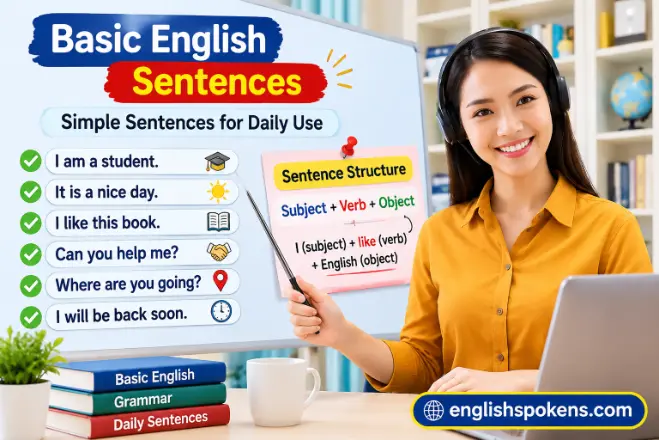
Step 1: Study one pattern
Start with:
Subject + Verb + Object
Example: I drink water.
Identify the subject, verb, and object.
Step 2: Change the words
Use the same structure with different words:
- I read books.
- I eat rice.
- I learn English.
Notice that the structure stays the same.
Step 3: Say your own examples aloud
Think of familiar activities and say a sentence using the pattern.
For example:
- I cook dinner.
- I watch videos.
- I clean my room.
Do not only select the correct answer from a list. Try to produce a sentence yourself.
Step 4: Write and check
Write your sentence in a notebook. Check whether its parts are in the correct order.
If you are unsure, compare it with a reliable grammar explanation, such as the Cambridge Dictionary grammar guide, or ask someone to review it.
Step 5: Repeat with another pattern
Move to a different pattern after you understand the first one. Return to earlier patterns when you make repeated mistakes.
Short, regular practice is a reasonable starting point. The time needed and the pace of improvement will differ between learners.
What If You Understand the Patterns but Still Cannot Use Them?
If you can identify the correct sentence but cannot create one independently, repeat the task in a different way. You can practise building sentences in realistic situations with these beginner English dialogues.

Instead of reading:
“I read books.”
Cover the example and try to create a new sentence using the same pattern.
If you struggle, return to the subject, verb, and object. Choose familiar words and try again.
If you repeatedly make the same error, write down the incorrect version and the corrected version. Practise making a new sentence with the same structure.
A public discussion on Reddit’s English-learning community includes a learner who reported difficulty constructing sentences despite previous grammar practice. The discussion also highlights a possible difference between recognizing correct answers and producing sentences independently. This is an individual report, not proof that all learners need the same method.
The practical lesson is to check your ability to create sentences, not just your ability to recognize them.
Check Your Progress
Try these tasks on basic English sentence patterns for beginners without looking at the examples above.
Task 1: Identify the pattern
- I sleep.
- She is tired.
- He reads books.
- We study at home.
Task 2: Identify the sentence parts
In the sentence “She reads books,” identify:
- The subject
- The verb
- The object
Task 3: Produce your own sentences
Write one original sentence using each of these patterns:
- Subject + Verb
- Subject + Verb + Complement
- Subject + Verb + Object
Then read your sentences aloud during English conversation practice.
Task 4: Identify the two objects
In “She gave me a pen,” identify the indirect object and the direct object.
Task 5: Identify the adverbial and object complement
In “We study at home,” identify the adverbial. In “They made him captain,” identify the object complement.
Answers
Task 1
- Subject + Verb
- Subject + Verb + Complement
- Subject + Verb + Object
- Subject + Verb + Adverbial (Place)
Task 2
- Subject: She
- Verb: reads
- Object: books
Task 3
Answers will differ. Check that each sentence follows the selected pattern and expresses a complete idea.
Task 4
- Indirect object: me
- Direct object: a pen
Task 5
- Adverbial: at home
- Object complement: captain
You are making progress when you can identify the structure, produce a new sentence without copying the example, and explain why the words appear in that order.
Frequently Asked Questions
What are basic English sentence patterns for beginners?
They are common structures that show how the subject, verb, object, complement, and other sentence parts work together. Examples include Subject + Verb and Subject + Verb + Object.
Does every English sentence follow Subject + Verb + Object?
No. “I read books” follows SVO, but “I sleep” does not need an object. Other sentences use complements or additional information.
Why is English sentence order important?
Word order helps show the relationship between the people, actions, and things in a sentence. Incorrect order may make your meaning unclear or produce an unnatural sentence.
Should beginners learn all basic English sentence patterns at once?
No. Begin with the simpler patterns, understand their parts, and practise making original examples. Learn patterns with two objects or object complements later if they are difficult.
Is memorizing sentences enough?
Memorizing useful examples can help, but it does not prove that you can construct new sentences independently. Practise changing the words and producing your own examples.
What to Learn Next
Return to the home page for more beginner lessons, or continue with How to Make Simple English Sentences.
That lesson should focus on the process of constructing sentences independently. This article has focused on recognizing and understanding the basic English sentence patterns for beginners themselves. To see how this topic fits into a broader learning sequence, follow the spoken English learning roadmap.
After that, 100 Easy English Sentences for Daily Speaking can provide a separate collection of everyday examples for practice.