
100 Daily Used English Sentences for Everyday Conversations
Learning English becomes easier when you understand how to use common words and complete sentences in real-life situations. This guide covers 100 daily used English sentences with simple explanations and practical examples for greetings, small talk, home, family, friends, school, office, shopping, restaurants, travel, telephone conversations, health, and social interactions.
You will also learn useful English vocabulary, everyday phrases, common sentence patterns, basic grammar structures, natural responses, and mistakes to avoid while speaking. In addition, this article explains how to improve your pronunciation, listening, speaking fluency, and confidence through daily practice, mirror exercises, shadowing, voice recording, and real-life conversations.
Whether you are a beginner, student, or working professional, these practical lessons will help you understand and use English more naturally in everyday communication.
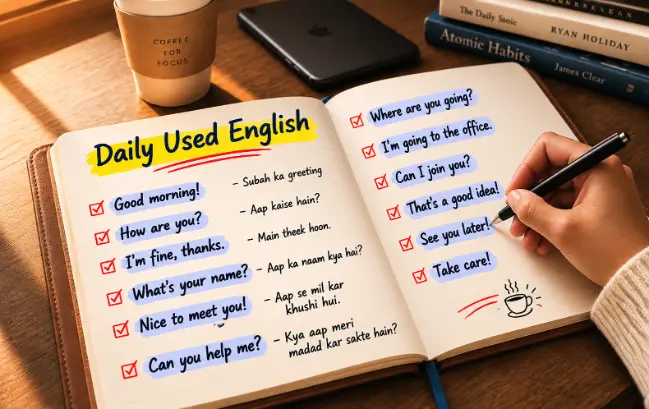
Learning English becomes easier when you know which sentences to use in real-life situations. From greeting someone in the morning to ordering food, asking for directions, talking to friends, and communicating at work, simple English sentences help you express yourself more naturally.
Many learners search for daily used English because they want to speak confidently without translating every word from their native language. The best way to develop this skill is to learn complete sentences, understand their meanings, and practise using them in everyday conversations.
In this guide, you will discover 100 daily used English sentences for different situations, including home, family, school, office, shopping, restaurants, travelling, telephone conversations, and social interactions. You will also learn useful vocabulary, sentence structures, grammar patterns, and speaking practice techniques to improve your communication skills.
Whether you are a beginner, student, professional, or someone preparing to improve their spoken English, these practical examples can help you build confidence and improve your everyday English.
Want more lessons? Explore our English speaking lessons for more daily used English practice.
100 Daily Used English Sentences for Everyday Conversations
The following sentences are organised by everyday situations. Learn them as complete expressions rather than memorising individual words. You can change names, places, times, and other details to make each sentence suitable for your own life.
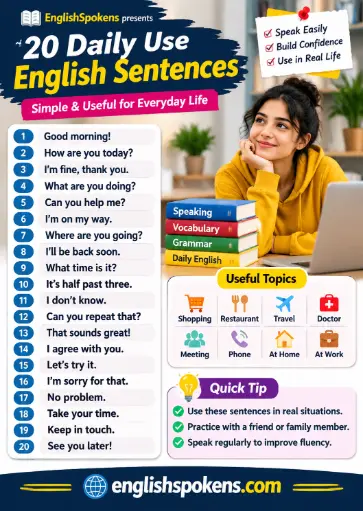
1. English Sentences for Greetings and Introductions
Greetings are conversation starters that help people begin friendly or professional interactions. Use these expressions when meeting someone, introducing yourself, or ending a conversation.
- Good morning! — Use this greeting when meeting someone in the morning.
- Good afternoon! — A polite greeting used after midday.
- Good evening! — Use this expression when greeting someone in the evening.
- Hi, how are you? — A common way to start an everyday conversation.
- How’s it going? — An informal expression used with friends and familiar people.
- I’m doing well, thanks. How about you? — A friendly response when someone asks how you are.
- My name is [your name]. — Use this sentence when introducing yourself.
- It’s nice to meet you. — A polite expression when meeting someone for the first time.
- Where are you from? — Ask this question to learn about someone’s hometown or country.
- It was nice talking to you. — A friendly way to end a conversation.
Remember that greetings depend on the situation and level of formality. “How are you?” is suitable for many situations, while “How’s it going?” is more informal. Also, “Good night” is normally used when saying goodbye or going to sleep, not when greeting someone.
2. Daily Used English Sentences for Small Talk and Weather
Small talk helps people communicate comfortably without discussing complicated subjects. You can talk about the weather, hobbies, entertainment, daily activities, and personal interests.
- How has your day been? — Ask someone about their day.
- What are you up to today? — Find out what someone is doing.
- Did you have a good weekend? — Start a conversation about someone’s weekend.
- The weather is lovely today. — Make a positive comment about the weather.
- It looks like rain. — Use this expression when rain seems likely.
- It’s quite cold outside. — Talk about cold weather.
- What do you usually do after work? — Ask about someone’s daily routine.
- What are your hobbies? — Learn about someone’s interests and pastimes.
- What kind of music do you enjoy? — Start a conversation about music.
- Have you watched any good movies lately? — Discuss films and entertainment.
These daily used English expressions are useful conversation starters because they encourage people to share their experiences, opinions, and interests. You can also discuss sports, photography, gardening, travel, books, or other hobbies.
3. Daily Used English Sentences at Home and in Daily Routine
Home conversations are an important part of everyday English. These sentences help you communicate with family members, discuss household responsibilities, and describe your daily activities.
- I just woke up. — Tell someone that you have recently left your bed.
- I’m getting ready for the day. — Describe your morning routine.
- Breakfast is almost ready. — Tell family members that breakfast will be served soon.
- Could you pass me the tea, please? — Make a polite request at the breakfast or dinner table.
- Where are my keys? — Ask about something you cannot find.
- Please turn off the lights. — Give a simple household instruction.
- I’ll tidy my room later. — Talk about a household task you plan to complete.
- The dog needs a walk. — Discuss taking care of a pet.
- I’m preparing dinner. — Explain what you are doing in the kitchen.
- I’m going to bed now. — Tell someone that you are ready to sleep.
You can practise these daily used English sentences while preparing breakfast, making coffee, drinking milk or tea, cleaning your room, washing dishes, or having dinner with your family.
4. English Sentences for Family, Friends, and Social Life
Communication with friends, parents, neighbours, and other people becomes easier when you know simple expressions for invitations, plans, and everyday social situations.
- How is your family? — Ask someone about their family.
- Please give my regards to your parents. — Send greetings to someone’s parents.
- Are you free this evening? — Ask whether someone has time.
- Would you like to have coffee with me? — Invite someone for coffee.
- Let’s meet after class. — Suggest meeting after a lesson or class.
- I’m on my way. — Tell someone that you are travelling towards them.
- Sorry, I’m running a little late. — Apologise when you cannot arrive on time.
- Thank you for inviting me. — Show appreciation for an invitation.
- That sounds like a great idea. — Respond positively to someone’s suggestion.
- Good night. See you tomorrow. — Say goodbye when ending the day.
These daily used English phrases are useful for building friendships, maintaining relationships, arranging dinner plans, visiting someone’s home, and participating in community activities.
5. Common English Questions, Requests, and Permission
Asking questions and making polite requests are essential communication skills. The following sentences can help you communicate clearly when you need assistance, information, or permission.
- Could you help me with this? — Ask someone for assistance.
- Would you mind opening the window? — Make a polite request.
- Could you say that again, please? — Ask someone to repeat information.
- What does this word mean? — Ask for the meaning of unfamiliar vocabulary.
- How do you spell that? — Ask someone to spell a word or name.
- How do you pronounce this word? — Ask about correct pronunciation.
- May I borrow your pen? — Request permission to use something.
- Is it okay if I sit here? — Ask permission before taking a seat.
- Could you show me the way to the station? — Ask someone for directions.
- Let me know if you need anything. — Offer help to another person.
Notice the difference between “Can you help me?” and “Could you help me?” Both are correct, but “Could you” often sounds more polite. Similarly, “Would you mind” is a useful structure for respectful requests.
6. Daily Used English Sentences for School, Study, and Work
English is important in education and professional environments. Students, teachers, employees, and business professionals use these expressions during classes, assignments, meetings, presentations, and group discussions.
- What time does the class start? — Ask about a class schedule.
- I have an assignment to finish. — Explain your study responsibilities.
- Could you explain this topic? — Ask a teacher or colleague for clarification.
- I didn’t understand the question. — Explain that you need further information.
- I’m taking an English course to improve my speaking. — Discuss your learning goals.
- I have a job interview tomorrow. — Talk about an upcoming interview.
- Could you clarify the main point, please? — Request clarification during professional communication.
- I’ll send the report by email this afternoon. — Discuss an office task.
- Let’s share our ideas during the group discussion. — Encourage teamwork and collaboration.
- I have a presentation this afternoon. — Explain your professional or academic schedule.
These expressions are useful for Business English and Business Communication Skills. They can help you communicate with teachers, students, colleagues, managers, and business partners.
For professional conversations, practise polite questions, clear statements, telephone conversations, email writing, presentation language, and interview preparation. These skills can improve your ability to communicate in the workplace.
7. English Sentences for Shopping, Food, and Restaurants
Shopping and restaurant conversations involve asking about prices, selecting products, making payments, and ordering food. These expressions are useful when visiting shops, supermarkets, cafés, and restaurants.
- How much does this cost? — Ask about the price of a product.
- Do you have this T-shirt in another size? — Ask for a different clothing size.
- Can I try this on? — Ask permission to try on clothing.
- Is there any discount? — Ask whether the shop offers a lower price.
- I’ll take this one. — Tell the shopkeeper that you want to buy something.
- Can I pay by card or cash? — Ask about available payment methods.
- Could I see the menu, please? — Request a restaurant menu.
- I’d like to order a pizza, please. — Place a food order.
- Could I have a glass of milk, please? — Politely request a drink.
- Could I have the bill and receipt, please? — Ask for payment details after a meal or purchase.
Daily used English for shopping is simple. Learning shopping vocabulary, food names, prices, payments, and common restaurant expressions will help you manage everyday transactions more confidently.
8. Daily Used English Sentences for Travel and Directions
Travelling often requires you to ask questions about transportation, locations, tickets, hotel rooms, and reservations. These practical English phrases can help when travelling within a city or visiting another country.
- Where is the nearest bus stop? — Ask about nearby public transportation.
- How do I get to the railway station? — Ask for travel directions.
- Is it far from here? — Find out the distance to a location.
- Which bus goes to the city centre? — Ask about a bus route.
- What time does the train leave? — Ask about a departure time.
- I’d like to book a room for two nights. — Make a hotel reservation.
- Do you have a reservation under [your name]? — Confirm a booking.
- Could you take me to the airport, please? — Request transportation.
- I think I’ve lost my way. — Explain that you are lost.
- How long will it take to get there? — Ask about journey duration.
Practise these daily used English expressions with vocabulary related to airports, flights, railway stations, hotels, tickets, directions, and transportation. They can also help you communicate with reception staff, drivers, and other travellers.
9. English Sentences for Telephone Conversations, Emails, and Plans

Telephone conversations and digital communication are part of modern everyday life. Whether you are calling a friend, contacting a business, or sending a message through WhatsApp, these sentences can help you communicate effectively.
- Hello, this is [your name] speaking. — Introduce yourself during a phone call.
- May I speak to [person’s name], please? — Politely ask to speak with someone.
- Sorry, the line is breaking up. — Explain that the phone connection is unclear.
- Can you hear me clearly? — Check whether someone can hear you.
- I’ll call you back in ten minutes. — Explain when you will return a call.
- I’ll send you the details on WhatsApp. — Tell someone where you will share information.
- Did you get my message? — Check whether someone received your message.
- Please reply when you have a moment. — Politely request a response.
- Can we reschedule our appointment? — Ask to change an agreed time.
- I’ll keep you updated. — Promise to share new information.
You can use this daily used English in personal conversations, office communication, customer support, professional emails, and business calls.
10. English Sentences for Feelings, Opinions, Health, and Apologies
Expressing emotions and opinions is an important part of meaningful communication. These sentences help you discuss your feelings, explain problems, agree or disagree, and respond politely.
- I’m feeling a little tired today. — Describe your physical condition.
- I don’t feel well. — Explain that you are not feeling healthy.
- I have a headache. — Describe a common health problem.
- I need to take my medicine. — Talk about taking prescribed or necessary medicine.
- I agree with your point. — Show agreement during a conversation.
- I’m not sure about that. — Express uncertainty politely.
- In my opinion, we should wait. — Share your personal opinion.
- I’m sorry for the inconvenience. — Apologise for causing a problem.
- Thank you for your patience. — Show appreciation when someone waits.
- Please call emergency services now. — Request urgent help during an emergency.
These daily used English expressions are useful when communicating with friends, family members, healthcare professionals, and other people in different situations.
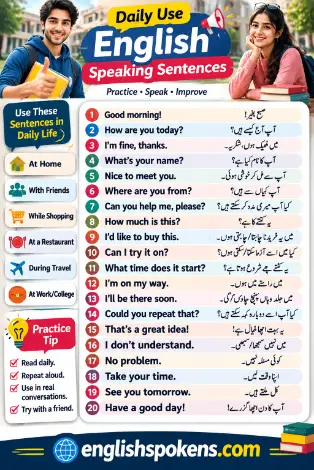
How to Practise Daily Used English Sentences Effectively


Memorising 100 sentences is a useful beginning, but real improvement comes from using them in actual conversations. A consistent English-learning routine can help you develop better vocabulary, grammar, pronunciation, fluency, and confidence. Daily used English becomes natural only when you repeat it in real situations.
1. Learn Five to Ten Sentences Every Day
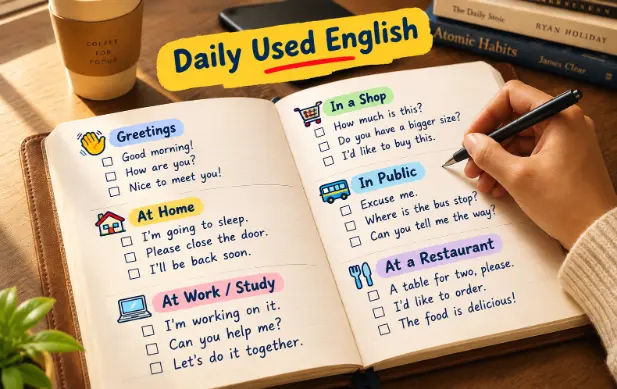
Do not try to memorise all 100 sentences in one sitting. Select five to ten sentences and practise them throughout the day. This is the easiest way to build daily used English habits.
For example:
- Morning: Practise greetings and introductions.
- Afternoon: Practise school, work, and shopping sentences.
- Evening: Practise family conversations and small talk.
- Night: Review the sentences you learned.
This simple routine makes English learning more manageable.
2. Practise Speaking in Front of a Mirror
Mirror practice is a simple way to become more comfortable speaking English.
Stand in front of a mirror and introduce yourself. Talk about your daily routine, family, hobbies, studies, or work.
For example:
“Hello, my name is [name]. I am a student. I enjoy learning English. Every day, I practise speaking and listening to improve my communication skills.”
Pay attention to your pronunciation, facial expressions, sentence structure, and speaking confidence.
3. Use the Shadowing Technique
Shadowing is a speaking exercise in which you listen to an English speaker and repeat the words shortly after hearing them.
Follow these steps:
- Choose a short English conversation.
- Listen carefully to the speaker.
- Repeat each sentence aloud.
- Notice pronunciation, stress, and intonation.
- Repeat the same conversation several times.
This exercise helps you become more familiar with natural English pronunciation and speaking patterns.
4. Improve Your Listening and Reading Skills
Speaking is not the only important language skill. Listening and reading also help you understand how English is used in real situations.
Try these activities:
- Listen to English podcasts and conversations.
- Watch English videos with subtitles.
- Read short English stories and articles.
- Notice new vocabulary and useful phrases.
- Listen to different speakers and accents.
- Repeat expressions that you hear frequently.
Good listening skills make it easier to understand questions and respond appropriately during conversations.
Free listening and speaking lessons are available on British Council LearnEnglish and BBC Learning English.
5. Understand Basic Grammar and Sentence Structures
You do not need complicated grammar to communicate in everyday situations. However, understanding basic grammar structures can help you create correct sentences.
Here are five useful patterns:
| Grammar structure | Example |
|---|---|
| Simple present | I drink tea every morning. |
| Present continuous | I am studying English right now. |
| Simple past | I called my friend yesterday. |
| Simple future | I will call you tomorrow. |
| Modal request | Could you help me, please? |
Also practise questions, statements, negative sentences, imperatives, and common verbs.
Understanding these sentence structures will help you change the examples in this article and create your own English sentences.
6. Record Your Voice and Correct Mistakes
Recording yourself is a useful way to evaluate your speaking progress.
Choose a topic and speak about it for one minute. Record your voice and listen carefully.
Check the following:
- Are you pronouncing words correctly?
- Are your sentences grammatically accurate?
- Are you speaking clearly?
- Are you using appropriate vocabulary?
- Are you pausing too frequently?
- Can you express your ideas confidently?
Ask a teacher or conversation partner for feedback when possible. Correcting repeated mistakes can improve your accuracy over time.
7. Practise Real Conversations
Find opportunities for English conversation practice with friends, classmates, teachers, colleagues, or other learners.
You can practise through:
- Daily conversations at home.
- Group discussions with students.
- English speaking clubs.
- Telephone conversations.
- Online language-learning communities.
- Business English activities.
- Job interview preparation.
- Short presentations.
Remember that communication is a two-way activity. Listen carefully, understand the other person’s message, and respond with relevant sentences.
Common Mistakes to Avoid When Speaking English
Many beginners understand English vocabulary but make mistakes when putting words together. Learning the correct sentence structures can improve communication. Avoiding these errors makes your daily used English clearer and more natural.
| Incorrect sentence | Correct sentence |
|---|---|
| I am agree with you. | I agree with you. |
| I have 20 years. | I am 20 years old. |
| He go to school. | He goes to school. |
| I did not went there. | I did not go there. |
| She don’t know. | She doesn’t know. |
| I am having a headache. | I have a headache. |
| Could you tell me where is the station? | Could you tell me where the station is? |
Pay attention to subject-verb agreement, verb tenses, question formation, articles, and prepositions. Practising correct examples regularly can help you avoid these common errors.
If you are unsure about a word, check its meaning and pronunciation in the Cambridge Dictionary.
Frequently Asked Questions About Daily Used English
1. What are daily used English sentences?
Daily use English sentences are common expressions used in everyday communication. They include greetings, questions, requests, statements, responses, and phrases for situations at home, school, work, shops, restaurants, and while travelling.
2. How can beginners learn daily used English?
Beginners can start by learning five to ten simple English sentences every day. They should understand the meaning, practise pronunciation, listen to English conversations, and use the sentences in real-life situations.
3. How can I improve my English speaking fluency?
Practise speaking regularly, listen to English audio, use mirror practice, try shadowing, record your voice, and communicate with other English learners. Consistent practice helps develop fluency and confidence.
4. Which English sentences are useful at work?
Expressions such as “Could you clarify the main point?”, “I’ll send you the report by email,” and “Let’s discuss this during the meeting” are useful for professional communication and Business English.
5. How many English sentences should I learn daily?
Start with five to ten sentences per day. Review previously learned sentences before moving to new vocabulary and expressions. Focus on understanding and using each sentence rather than memorising large lists.
6. Can daily used English sentences improve communication skills?
Yes. Practising common English expressions can help you ask questions, give answers, share opinions, make requests, and participate more comfortably in everyday conversations.
7. Should I learn grammar before speaking English?
You do not need to master every grammar rule before speaking. Start with basic sentence structures and practise speaking at the same time. Gradually improve your grammar, vocabulary, pronunciation, and listening skills.
Conclusion
Learning English does not require memorising complicated vocabulary or using difficult grammar structures in every conversation. Start with simple, practical expressions that you can use in your everyday life.
These 100 daily used English sentences cover greetings, small talk, home conversations, family, friends, school, work, shopping, restaurants, travel, telephone conversations, feelings, and common requests.
Make English part of your daily routine. Practise speaking, improve your listening, read simple English content, learn useful vocabulary, and ask for feedback when necessary.
Daily used English is a skill that grows with practice, so use it every day. Most importantly, do not be afraid of making mistakes. Every conversation gives you an opportunity to learn something new. With regular practice, patience, and consistency, you can gradually improve your English-speaking confidence and communicate more naturally in everyday situations.
You can also read our English learning guides to improve your speaking confidence step by step.