
Business English: Complete Guide to Professional Communication
Business English helps you communicate clearly in professional situations such as meetings, emails, presentations, interviews, negotiations and client conversations. The practical route is to learn the language you need for your role: build useful vocabulary and grammar, develop listening, speaking, reading and writing, then practise realistic workplace tasks. This guide explains CEFR levels, professional expressions, industry language, corporate communication, learning resources and relevant exams. Use the examples and practice steps to make your workplace messages clearer, more polite and easier to act on.
- Workplace communicationMeetings, emails, calls and presentations
- Four language skillsListening, speaking, reading and writing
- Practical learning pathBuild from basic tasks to advanced discussions
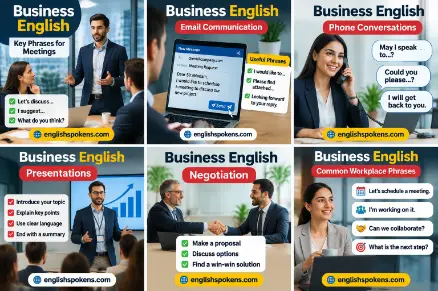
1. What Is Business English?
Business English is the spoken and written English people use to complete professional tasks. It includes everyday workplace communication and more specialised language for sales, finance, management, customer service and international trade. It is not a separate language with its own grammar. It is English adapted to a work purpose, audience and level of formality.
Business English in a real situation
A colleague might say, “Could you send me the revised proposal by Thursday?” The sentence uses ordinary English, but its purpose, vocabulary and polite tone make it suitable for a professional setting.
کیا آپ جمعرات تک ترمیم شدہ تجویز مجھے بھیج سکتے ہیں؟
Business English includes emails, reports, presentations, meetings, phone calls, negotiations, client conversations and online discussions.
Business English vs General English
| Area | General English | Business English |
|---|---|---|
| Purpose | Everyday communication | Workplace and commercial tasks |
| Vocabulary | Home, travel, hobbies and daily life | Deadlines, budgets, clients and projects |
| Tone | Changes with the situation | Often clear, tactful and audience-aware |
| Example | “What are you doing today?” | “What are your priorities for today?” |
Both use the same core grammar. The main differences are context, vocabulary, purpose and tone.
Business language and commercial English The relationship between business and language learning is practical: learners develop the language skills needed to complete specific work tasks, not simply memorise business terminology.
“Business language” is a broad description of words and expressions used in an organisation. “Commercial English” is sometimes used for language connected with trade, buying, selling and business transactions. These labels can overlap; they are not universally fixed proficiency levels. Ask what you need to do at work, then learn the language for that task.
For an academic overview of spoken and written Business English in workplace contexts, see Corpus Analysis of Business English.
Business English, professional English and corporate language
People also search for professional English, corporate English, English for business and business language. These phrases overlap, but their emphasis can differ. Business English usually focuses on practical communication for work: meetings, emails, presentations, negotiation and client contact. Corporate English often describes the shared communication used across a company, while professional English can include career tasks such as interviews, networking and workplace presentations.
When a company adopts English as a corporate language, employees may use it to communicate across offices, countries and departments. This does not mean every employee has the same level. Effective English for corporate communication therefore uses clear wording, shared terminology, respectful turn-taking and written confirmation of important decisions. English for international corporate communication also requires awareness of different accents, communication styles and cultural expectations.
2. Why Is Business English Important?
Professional communication affects how clearly you share information, understand instructions, work with colleagues and serve customers. Business English helps you take part in these tasks with fewer misunderstandings. It is especially useful when your workplace includes international clients, suppliers or teams who use English as a shared language.
Communicate clearly
Explain a task, deadline or problem so another person knows what is needed. Clear wording reduces avoidable confusion.
Work with other people
Ask questions, give updates, share opinions and respond respectfully during meetings and team discussions.
Support customers and clients
Understand enquiries, explain services, handle complaints and confirm next steps professionally.
Develop your career
Use English to describe your experience, contribute to projects and present results. Better communication can support career development, but it does not guarantee a promotion or salary increase.
Match learning to your actual work
A learner who answers customer enquiries needs different practice from an accountant who prepares reports or a manager who leads meetings. List three tasks you perform, or hope to perform, in English. Learn the phrases, vocabulary and writing formats connected to those tasks first.
This approach is consistent with English for Specific Purposes research, which recommends identifying learners’ real communication needs before selecting lessons. A Pakistan-based 2022 study of business students also highlighted the value of field-specific vocabulary. Read the study record.
Business English is useful for more than managers in large companies. It can help university students preparing for internships, graduates applying for international jobs, employees who write emails or join meetings, entrepreneurs pitching ideas, freelancers speaking with overseas clients, and customer-service or hospitality staff. Beginners can start with simple workplace introductions and instructions; experienced speakers can focus on negotiation, leadership and cross-cultural communication.
Choose your learning route: If you are new to English, build everyday speaking and grammar first. If you already speak English, identify the professional tasks that make you hesitate and practise those directly. If you manage a team, consider a corporate English programme based on employees’ roles and communication needs.
Business English for students, BBA learners and working professionals
BBA students and learners of business administration can use Business English to discuss case studies, explain marketing plans, prepare reports, take part in group projects and present research. Students of English for management studies may also need language for leadership, operations, finance, strategy and organisational behaviour.
Working professionals may need to improve professional English for a specific task: an accountant may need to explain financial statements, a sales executive may need to present a proposal, and a manager may need to give feedback or lead a meeting. Entrepreneurs and start-up founders may need English for pitching, persuading, promoting a product and speaking with international partners.
3. Business English Levels (A1 to C1)
Business English does not have one fixed level. A learner can use basic workplace English at A1 or A2 and develop more independent communication at B1, B2 and C1. The Common European Framework of Reference for Languages (CEFR) describes six broad levels: A1, A2, B1, B2, C1 and C2. These levels describe general language ability; a learner’s ability may differ across speaking, listening, reading and writing.
A1 — Beginner
Introduce yourself, name your job, identify simple objects and understand short, familiar instructions when people speak clearly.
Example: “I work in the sales department.”
A2 — Elementary
Handle simple routine exchanges, give basic information about your work and make arrangements.
Example: “The meeting is at 10 a.m. in Room 3.”
B1 — Intermediate
Explain familiar work tasks, describe progress, write straightforward emails and take part in predictable conversations.
Example: “We completed the first stage, but we need two more days to test the update.”
B2 — Upper-intermediate
Contribute to meetings, explain reasons, compare options, give presentations and discuss more complex work issues.
Example: “We should review the implementation cost before making a decision.”
C1 — Advanced
Communicate flexibly in demanding professional situations, adapt tone to the audience and lead complex discussions.
Example: “The proposal is commercially promising; however, the projected return depends on managing the delivery risk.”
C2 — Proficient
C2 is part of the full CEFR scale, although it is outside the A1-to-C1 range named in this guide. It describes very high overall proficiency, not a special Business English certificate.
Cambridge Business English qualification names
You may encounter B1 Business Preliminary (BEC Preliminary), B2 Business Vantage (BEC Vantage) and C1 Business Higher (BEC Higher). These are specific qualifications, not compulsory stages every professional must complete. Cambridge currently states that the BEC exam suite continues in China and has been discontinued in other countries. Check the official Cambridge Business English page before planning an exam.
The Council of Europe CEFR overview explains the six levels and their use in language learning and assessment.
Yes. You do not need an MBA, a business degree or advanced English to begin. At A1–A2, learn greetings, introductions, job titles, departments, numbers, dates, time, simple instructions and polite requests. At B1, practise routine emails, updates and predictable meetings. At B2, work on spontaneous discussion, presentations and negotiation. At C1, refine nuance, diplomacy, leadership language and high-stakes communication.
These are practical learning priorities, not official CEFR job-entry rules. A person may be strong at reading but less confident in speaking, so assess each skill separately.
4. Four Essential Business English Skills
The four core language skills are listening, speaking, reading and writing. They work together. You may read an email before a meeting, listen to colleagues, explain your view and then write a follow-up message.

Speaking
Use clear sentences to introduce yourself, explain a problem, give an update, ask questions and share an opinion.
Practice: Give a 30-second update on one task you are working on.
Listening
Understand the main point, details, decisions, deadlines and the speaker’s attitude. Listen for names, dates and numbers.
Practice: Listen to a short work conversation and note the agreed next step.
Reading
Read emails, instructions, reports, proposals, schedules and workplace notices. Identify the purpose, requested action and deadline.
Practice: Read a short email and identify who must do what, and by when.
Writing
Write messages that are organised, polite and easy to act on. Practise subject lines, short paragraphs, requests and summaries.
Practice: Write a three-sentence email confirming a meeting time and purpose.
Build connected skills
Read a short business notice, listen to a related conversation, explain the information aloud and write a brief summary. This gives you a realistic way to use the four skills together.
5. Essential Business English Grammar
You do not need a different grammar system for work. You need reliable control of common English structures and the ability to choose a suitable tone. Focus on grammar that helps you explain facts, ask for information, make requests, describe progress and discuss possible outcomes.
Sentence structure and subject–verb agreement
Use a clear subject and verb: “The finance team prepares the monthly report.” In some varieties, collective nouns can take plural agreement when the group is viewed as individuals. Follow your organisation’s style consistently.
Verb tenses for work updates
- Routine: “We send invoices every Friday.”
- Current activity: “I am reviewing the contract.”
- Completed action: “We finished the first phase yesterday.”
- Present result: “We have received the client’s approval.”
Modal verbs for polite requests
Can, could, would and may help you make requests. Choose a form that suits the relationship.
“Could you share the updated file?”
کیا آپ تازہ ترین فائل شیئر کر سکتے ہیں؟
“Would you mind reviewing this section?”
کیا آپ اس حصے کا جائزہ لینے کی زحمت کریں گے؟
Questions and clarification
- “When is the deadline?”
- “Who is responsible for the next step?”
- “Could you clarify what you mean by final approval?”
Conditionals for planning
- “If the client approves the design, we will begin production.”
- “If we had more time, we could test another option.”
Passive voice, articles and prepositions
The passive is useful when the action matters more than the person: “The report was approved on Monday.” Learn combinations such as “responsible for,” “interested in,” “depend on” and “agree with.” Check articles in “a proposal,” “the budget” and “an update.”
Basic rules to check before sending a message
- Use a clear subject and verb.
- Keep verb tense consistent with the time you mean.
- Check singular and plural forms.
- Use articles and prepositions carefully.
- Separate long ideas into readable sentences.
- Check spelling, names, dates, figures and punctuation.
Grammar practice should support communication. If a sentence is grammatically correct but too direct for a sensitive request, revise its tone as well.
Basic Business English grammar and practice
Basic business grammar is the same core grammar used in General English, applied to workplace tasks. For more accurate business writing, practise:
Reported speech and updates
“The client said that the delivery date had changed.” Use reported speech to pass on instructions, decisions and feedback accurately.
Comparatives and trends
“Sales were higher in June than in May.” Practise describing increases, decreases, proportions, charts and financial figures.
Countable and uncountable nouns
“We received three requests” but “We need more information.” This helps prevent common errors in emails and reports.
Linking words and punctuation
Use however, therefore, although and in addition to show relationships between ideas. Keep sentences readable and punctuate lists and dates consistently.
Business writing grammar check: before sending a professional email or report, check the subject and verb, tense, articles, prepositions, singular and plural forms, modal verbs, punctuation, names, figures and dates. Grammar should make the message clearer, not make it unnecessarily complicated.
6. Business English Vocabulary and Expressions
Learn business words in context. A word is easier to remember when you know what it means, where it is used and how it appears in a sentence. This practical starter list contains 100 useful terms grouped by workplace situation; it is not a claim that these are the only or statistically most frequent business words.
- colleague — someone you work with
- manager — a person who leads a team
- employee — a person who works for an organisation
- employer — a person or organisation that hires workers
- client — a person or business receiving a professional service
- customer — a person who buys a product or service
- supplier — a business that provides goods or services
- stakeholder — a person or group affected by a project or decision
- team — people working towards a shared goal
- department — a section of an organisation
- agenda — a list of topics for a meeting
- objective — a result you want to achieve
- priority — something that needs attention first
- deadline — the latest time to finish a task
- schedule — a plan of times and activities
- milestone — an important stage in a project
- task — a piece of work to complete
- project — planned work with a specific goal
- strategy — a plan for achieving a larger goal
- target — a result or level you aim to reach
- minutes — the written record of a meeting
- attendee — a person present at a meeting
- chairperson — the person who leads a meeting
- proposal — a suggested plan or idea
- feedback — comments intended to help improve something
- clarification — an explanation that makes something clearer
- consensus — general agreement among a group
- action item — a task agreed during a meeting
- follow-up — a later message or action after a discussion
- decision — a choice made after considering options
- budget — a plan for income and spending
- revenue — money earned from business activity
- profit — money left after costs are deducted
- loss — a situation where costs exceed income
- expense — money spent to run a business
- cost — the amount needed to buy or produce something
- invoice — a document requesting payment
- payment — money given for goods or services
- cash flow — money moving into and out of a business
- forecast — an estimate of future results
- lead — a person or organisation that may become a customer
- prospect — a potential customer being considered
- campaign — planned activities to promote something
- brand — the identity and reputation of a product or organisation
- market — the group of buyers or industry served
- audience — the people a message is intended to reach
- conversion — when a person completes a desired action
- product — an item made or sold
- service — work or support provided to customers
- competitor — a business offering similar products or services
- workflow — the order in which work moves through a process
- process — a series of steps used to complete work
- resource — something needed to do a task
- delivery — the act of providing or transporting an order
- inventory — the goods a business has available
- quality — how well something meets requirements
- efficiency — achieving a result with appropriate use of resources
- capacity — the amount of work a team or system can handle
- approval — official permission to proceed
- procedure — an established way of doing a task
- update — new information about progress
- request — a polite or formal ask for something
- response — an answer or reaction
- enquiry — a question asking for information
- attachment — a file sent with an email
- subject line — the short heading of an email
- reminder — a message that helps someone remember an action
- confirmation — a message showing that something is agreed or received
- announcement — a formal message sharing news
- report — a document explaining facts, progress or results
- recruitment — the process of finding and hiring people
- vacancy — a job position that is available
- candidate — a person applying for a role
- interview — a formal conversation to assess suitability
- onboarding — helping a new employee start
- appraisal — a review of someone’s work performance
- promotion — movement to a more senior role
- salary — regular fixed pay for a job
- benefit — an additional employment advantage
- performance — how well a person or team does its work
- negotiate — to discuss terms to reach an agreement
- agreement — a shared decision or arrangement
- terms — the conditions of an agreement
- offer — a proposal made to another party
- counteroffer — a different offer made in response
- compromise — an agreement where each side adjusts something
- contract — a formal agreement with obligations
- clause — a separate part of a contract
- risk — the possibility of loss or difficulty
- obligation — something a person or organisation must do
- delegate — to give a task or responsibility to another person
- collaborate — to work together
- coordinate — to organise people or activities
- implement — to put a plan into action
- evaluate — to judge the quality or effectiveness of something
- monitor — to check progress over time
- resolve — to find an answer to a problem
- escalate — to refer an issue to someone with more authority
- innovate — to introduce a new idea or method
- outcome — the result of an action or process
Professional phrases for everyday work
Asking for an opinion
- “What’s your view on this?”
- “How do you feel about the proposal?”
- “Could you share your thoughts?”
اس تجویز کے بارے میں آپ کی کیا رائے ہے؟
Giving an opinion carefully
- “From my point of view, we need more time.”
- “I tend to think this option is more practical.”
- “The way I see it, we have two choices.”
میری رائے میں، ہمیں مزید وقت درکار ہے۔
Agreeing and disagreeing respectfully
- “I agree with that approach.”
- “I see your point; however, we should review the cost.”
- “Could we consider another option?”
میں آپ کی بات سمجھتا ہوں، تاہم ہمیں لاگت کا جائزہ لینا چاہیے۔
Clarifying and following up
- “Could you explain that in more detail?”
- “Just to confirm, the deadline is Friday, correct?”
- “I’ll follow up with you tomorrow.”
Common business idioms
Touch base — contact someone briefly. “Let’s touch base on Thursday.”
Hit the ground running — start effectively and quickly. “The new team needs to hit the ground running.”
Get the ball rolling — begin an activity. “Let’s get the ball rolling on the project.”
Bring something to the table — contribute a skill or idea. “What can you bring to the table?”
Low-hanging fruit — an opportunity that is relatively easy to achieve.
Circle back — return to a topic later. “I’ll circle back after the review.”
On the same page — sharing the same understanding.
Burn the midnight oil — work late into the night.
Use idioms carefully
Idioms can make conversation sound natural, but they may confuse international colleagues. Prefer plain language in contracts and important instructions. “Table this” can also mean different things across varieties: in US business usage it often means postpone discussion, while in some British contexts “table a proposal” can mean formally present it. If the meaning matters, say “postpone this topic” or “put this proposal forward.”
7. Business English for Workplace Situations

Professional communication changes with the situation. A friendly chat with a colleague does not need the same tone as a client negotiation. Learn useful expressions for each task, then practise choosing the right level of formality.
Small talk and building rapport
Start with a neutral topic, ask an open question and listen to the answer.
- “How has your week been so far?”
- “How is the new project going?”
- “Have you worked with this team before?”
Presenting ideas
State your goal, explain the steps and support your suggestion with relevant facts.
- “The aim is to reduce response time.”
- “I suggest testing this approach with one team first.”
- “To summarise, this option is easier to measure.”
Asking for clarification
Identify the point you did not understand. A specific question is more useful than simply saying “I don’t understand.”
- “Could you clarify the project timeline?”
- “What should I complete before Friday?”
- “Do you mean the first draft or the final version?”
Agreeing and disagreeing
Acknowledge the other person’s point before explaining your own view.
- “That makes sense to me.”
- “I understand the concern. Another option might be…”
- “I’m not sure that will work within the current budget.”
Managing meetings
- “Shall we get started?”
- “Would anyone like to add something?”
- “Let’s confirm who is doing what before we finish.”
Changing the subject or returning to the agenda
- “That’s worth discussing. Could we return to the deadline for now?”
- “Let’s schedule a separate discussion for that issue.”
Negotiations
- “Would you be open to adjusting the delivery date?”
- “Could we review the payment terms?”
- “Let me summarise what we have agreed.”
Telephone and video calls
- “Hello, this is Ayesha from the support team.”
- “Could you hold for a moment, please?”
- “Your audio is breaking up. Could you repeat the last point?”
More workplace situations to practise
A complete Business English learning plan should prepare you for more than meetings and presentations. Practise the communication tasks that appear in your own role, then adapt the phrases below to your workplace.
Giving feedback and discussing performance
Be specific, describe the work rather than judging the person, and agree on a useful next step.
- “The report is clear. Could you add the latest figures to the final section?”
- “One area we could improve is the response time.”
Practice: Give one positive comment and one practical suggestion about a sample task.
Delegating tasks and giving instructions
Explain the task, expected result, deadline and who is responsible. Invite questions before work begins.
- “Could you prepare the first draft by Thursday afternoon?”
- “Please let me know if anything affects the deadline.”
Practice: Give a colleague three clear steps for completing a small task.
Handling customer concerns and complaints
Listen carefully, acknowledge the issue, clarify the facts and explain what you can do next. Do not promise an outcome you cannot guarantee.
- “I understand why that is frustrating. Let me check the details.”
- “Here is what I can do to help resolve the issue.”
Practice: Respond calmly to a customer who has received an incorrect order.
Apologising and resolving misunderstandings
Use a direct apology when appropriate, explain the correction briefly and confirm the next action.
- “I’m sorry for the confusion. I’ll send the corrected version today.”
- “Let me check that I have understood your request correctly.”
Practice: Correct a misunderstanding about a meeting time or project requirement.
Making sales calls and contacting new clients
Introduce yourself, explain why you are calling, ask whether it is a suitable time and make the purpose of the call clear.
- “Hello, this is Sara from Northstar Solutions. Is now a convenient time?”
- “Would you be available for a short follow-up call next week?”
Practice: Record a 30-second introduction for a potential client.
Describing graphs, charts and business results
State what the chart shows, describe the main trend, compare important figures and avoid claiming that a change caused another result unless the data supports it.
- “Sales increased steadily during the second quarter.”
- “The figures remained broadly stable compared with last month.”
Practice: Describe one trend, one comparison and one important figure from a simple chart.
Remote and hybrid meetings
Online meetings require clear turn-taking and confirmation because audio delays, background noise and different time zones can cause misunderstandings. Use concise phrases to manage the conversation.
- “Can everyone see the slides?”
- “I think we may have lost your audio. Could you repeat that last point?”
- “Before we finish, let’s confirm the actions, owners and deadlines.”
Choose formality to fit the relationship
In a formal meeting with a senior manager, “Could you share your view?” may be appropriate. With a close colleague, “What do you think?” may sound natural. Neither phrase is automatically better; the relationship, purpose and workplace culture guide the choice.
For further practice, the British Council meeting lesson covers participation, interruption and clarification strategies.
Five essential lessons for professional conversations
The following five lesson units develop the core situations in the supplied professional-English video transcript. Learn the purpose of each expression, then practise it in a realistic exchange.
Making small talk and building rapport
Small talk creates a comfortable start before business begins. Choose a neutral subject such as the journey, a conference, a shared project or a general weekend plan. Ask open questions and listen to the answer.
“How has your week been so far?”
“Have you worked with this team before?”
“What did you think of the presentation?”
Practice: Start a 30-second conversation with a new colleague. Ask one open question and one relevant follow-up question.
Presenting ideas and sharing thoughts
Organise your message in a simple order: purpose, evidence, proposed action and expected result. Use signposting so listeners know when you are moving to another point.
“The main objective is to reduce response times.”
“There are two reasons for this recommendation.”
“To summarise, I recommend testing the idea with one team first.”
Practice: Explain one improvement for your workplace in 60 seconds. Include the problem, your suggestion and one reason.
Asking for clarification
Clarification prevents mistakes. Be precise about the word, figure, deadline or instruction you need explained. Confirm your understanding before acting.
“Could you clarify what you mean by the final version?”
“Just to confirm, should I send this to the whole team?”
“Could you walk me through the second step again?”
Practice: Ask three specific questions about a task, including one question about its deadline.
Agreeing and disagreeing respectfully
Show that you have understood the other person before adding your view. If you disagree, explain the reason and, where possible, offer an alternative.
“I agree, and I would add one point.”
“I see your point. My concern is the delivery cost.”
“Could we test both options before deciding?”
Practice: Respond to a colleague’s proposal with one agreement and one polite disagreement, each supported by a reason.
Changing the subject and returning to the topic
Use a transition to connect a new subject to the discussion. If a meeting moves off the agenda, acknowledge the point and guide the group back without dismissing the speaker.
“That connects with a point we discussed earlier.”
“Could we return to the delivery deadline for now?”
“This deserves a separate discussion. Shall we schedule time for it?”
Practice: Role-play a meeting where someone introduces an unrelated issue. Bring the discussion back to the agreed agenda politely.
- Open with one sentence of small talk.
- Present an idea in three clear points.
- Ask a clarification question.
- Agree or disagree and give a reason.
- Summarise the decision and next action.
Record your response. Check whether your message is easy to follow, whether your tone is appropriate and whether you used complete sentences.
Other workplace topics to master
Competitor resources and professional teaching materials also place strong emphasis on meetings, chairing and interrupting politely, professional email tone, phone and video calls, job interviews, CVs and cover letters, reports, proposals, meeting minutes, negotiation, customer complaints, giving and receiving feedback, leadership, remote-team communication and business travel. These are important extensions to the five core conversation lessons.
These five lesson units are based on the supplied transcript from English with Lucy’s video, 5 things you MUST KNOW to master Professional English | Business English. Watch the original YouTube lesson. The video also refers to five additional ebook topics but does not name all of them in the transcript supplied here, so this article does not attribute an invented list to the video.
Business English for meetings: an ESL lesson sequence
A practical business meetings ESL lesson can follow five stages: prepare an agenda, open the meeting, invite opinions, clarify or challenge a point respectfully, and summarise decisions with action owners and deadlines. These steps help learners move from memorised phrases to active participation.
Opening and managing a meeting
- “Thanks for joining. Let’s get started.”
- “The main item on today’s agenda is the launch date.”
- “Could we hear your view before we make a decision?”
- “Let me summarise the actions we have agreed.”
Asking for and giving opinions formally
- “What is your view on the proposed timeline?”
- “I tend to feel that we may need more time.”
- “From my point of view, the current plan is workable.”
- “It seems to me that the deadline is too ambitious.”
Speaking more directly with colleagues
- “What do you think?”
- “The way I see it, we have two options.”
- “Actually, I think we should test the idea first.”
- “Basically, we need to agree on the next step.”
Use careful language when you need to be diplomatic or when you are unsure. More direct language may suit a relaxed discussion with colleagues. Match your wording to the relationship and situation.
Telephoning in business and professional calls
Telephoning in business communication requires clear introductions, message-taking, call transfers, polite interruptions and confirmation of details. Practise saying names, email addresses, phone numbers, dates, times, currencies and reference numbers slowly enough to be understood.
Business telephone conversation
Caller: Good morning. This is Ali Khan from the accounts team. May I speak to Ms Ahmed, please?
Receptionist: Certainly. May I ask what the call is regarding?
Caller: I’m calling to confirm the invoice details for order 4582.
Receptionist: She is in a meeting at the moment. Would you like to leave a message?
Caller: Yes, please ask her to call me back before 3 p.m. I can also send the details by email.
For practice, learners can listen once for the purpose of the call, listen again for the details, then role-play both sides. This is useful for business conversation ESL classes and for professionals who need to handle calls with international customers.
Business English Pod: listening to formal and informal opinions
The supplied Business English Pod lesson uses a workplace meeting to show how a manager asks for opinions and how colleagues express careful or direct views. It then contrasts that formal meeting with an informal conversation between colleagues. The main learning point is not to memorise one phrase, but to recognise how tone changes with audience and context.
Try the original lesson: Business English – Lesson 1: Giving Opinions in English. The companion lesson page is BEP 27 – Meetings: Giving Opinions in English.
Business English for job interviews and career development
Job seekers can use professional English to introduce their experience, explain achievements, describe strengths and ask relevant questions. Prepare examples that show what you did, how you approached a problem and what changed as a result. Avoid memorised answers that do not match the question.
Interview practice
Interviewer: Could you tell me about a challenge you handled at work?
Candidate: In my previous role, we had delays in responding to customer enquiries. I helped organise a shared tracking sheet and clarified who was responsible for each request. The team could then follow up more consistently.
Interviewer: What did you learn from that experience?
Candidate: I learned to communicate responsibilities clearly and check progress before a deadline.
For career preparation, practise describing your responsibilities, explaining a project, discussing results and asking about the role. You can also improve your CV and cover letter by using accurate action verbs and evidence rather than vague claims.
8. Business English Writing Skills
Good workplace writing makes the purpose clear and helps the reader take the right action. Keep emails and reports organised. Use a suitable greeting, state the reason for writing, provide necessary details and make the next step easy to identify.
A simple professional email structure
- Use a specific subject line.
- Choose an appropriate greeting.
- State your purpose early.
- Give only the details the reader needs.
- State the action or deadline clearly.
- Close politely and include your name.
Example: requesting a project update
Subject: Project update for the weekly review
Hello Sara,
Could you please send me the latest project update by 3 p.m. on Wednesday? Please include completed tasks and any issues that may affect the deadline.
Thank you for your help.
Best regards,
Ali
The request is specific: it identifies the information needed and gives a deadline.
Reports and summaries
Organise a report around its purpose. Depending on the task, include an overview, relevant facts, findings, risks and recommended next steps. Label figures clearly and distinguish confirmed results from estimates.
Proposals and business writing practice
Explain the problem, describe the proposed solution, show the resources or costs involved and state the expected result. Use evidence you can support; avoid guarantees when the outcome is uncertain.
Check tone and accuracy before sending
- Replace unclear instructions with a specific request.
- Use polite wording without hiding the action required.
- Check names, dates, amounts, attachments and links.
- Keep one main purpose in each email where possible.
- Read the message from the recipient’s point of view.
The British Council English for Emails lessons include language and exercises for organising, writing and checking workplace emails.
- Meeting minutes: record decisions, action items, owners and due dates.
- Business reports: present background, findings, figures, risks and recommendations.
- Proposals: explain a problem, proposed solution, resources, costs and expected outcome.
- Executive summaries: give decision-makers the key message and recommendation quickly.
- CVs and cover letters: describe relevant experience with accurate action verbs and evidence.
- Complaint and goodwill messages: respond to problems, apologise appropriately, thank people and recognise good work.
- Professional chat and memos: keep short internal messages clear, relevant and respectful.
For an important message, separate confirmed facts from estimates, avoid unexplained abbreviations and make the requested action easy to find.
ESL business writing: grammar, tone and practice
ESL business writing lessons should teach more than email templates. Learners need to recognise purpose, audience, tone and the action the reader is expected to take. A good business writing practice routine includes a model text, a short language focus, a guided rewrite and an independent writing task.
Write a clear email
Subject: Updated project timeline
“Hello Maya, Could you please review the revised timeline attached? Please send any comments by Thursday at 2 p.m. so we can finalise the schedule. Best regards, Ahmed.”
Write a short business report
Use headings for purpose, findings, risks and recommendations. Separate facts from estimates and explain what the figures mean for the decision.
Write a proposal
Describe the problem, proposed solution, resources, cost, expected result and next step. Keep the recommendation easy to locate.
Write meeting minutes
Record the decision, action, responsible person and deadline. Avoid turning minutes into a word-for-word transcript.
Business writing practice: take a direct sentence such as “Send the report today” and revise it for a client, a colleague and a manager. The information stays the same, but the level of formality changes.
9. Business English for Different Industries
Some professional expressions are used across many workplaces, but each industry also has its own terms, documents and communication tasks. Learn the common language first, then build vocabulary for your role. Do not memorise technical words without understanding how they are used in your field.
IT and technology
Learn language for software releases, bugs, user requirements, testing, data security and project updates.
Example: “We found an issue during testing and are preparing a fix.”
Human resources and recruitment
Focus on job descriptions, applications, interviews, onboarding, performance reviews and employee policies.
Example: “The candidate has relevant experience in team management.”
Accounting and finance
Practise invoices, budgets, expenses, revenue, forecasts, financial statements and payment terms.
Example: “The invoice is due for payment next Monday.”
Sales and marketing
Explain products, understand customer needs, discuss leads, describe campaigns and report results.
Example: “The campaign generated more enquiries, but conversions remained steady.”
Hospitality and customer service
Learn polite service language, booking details, complaint handling, recommendations and clear policy explanations.
Example: “I’m sorry for the inconvenience. Let me check what options are available.”
Management and entrepreneurship
Develop language for goals, planning, delegation, risks, decisions, partnerships and business proposals.
Example: “We need to review the costs before approving the next stage.”
Build a role-specific word list
Choose a real document or task from your industry. Highlight unfamiliar terms, check their meanings in a reliable subject dictionary and write one accurate example sentence for each. Ask a colleague or teacher whether the wording sounds natural in your workplace.
Accounting English course: practise invoices, ledgers, accounts payable and receivable, cash flow, balance sheets, audit findings and explaining financial figures. Learn to describe what a number means, not only how to name it.
English for management studies: focus on organisational structure, leadership, strategy, decision-making, delegation, performance reviews, project management and case-study discussions.
English for hospitality industry roles: practise reservations, check-in and check-out, guest requests, service recovery, complaints, food descriptions, safety instructions and polite customer interaction.
English for entrepreneurship: learn to explain a business idea, pitch to investors, describe a target market, discuss pricing, present a business model and negotiate with partners.
Commercial English: concentrate on trade, orders, quotations, delivery terms, payment conditions, contracts, suppliers and customer transactions. Commercial English overlaps with Business English but is often more focused on buying, selling and trade.
Corporate English: develops the shared communication standards an organisation needs across departments, locations and international teams. A corporate English course should be designed around the employees’ actual roles and tasks.
Accounting English course: essential finance vocabulary
An accounting English course should teach learners to describe transactions and explain what financial information means. Start with these terms, then build towards the more detailed vocabulary used in accounting reports and audits.
Core accounting English vocabulary
- Revenue: income generated from normal business activities.
- Expense: a cost incurred while running the business.
- Profit: the amount remaining after relevant costs are deducted from revenue.
- Loss: when expenses exceed revenue for the period.
- Invoice: a document requesting payment for goods or services.
- Accounts payable: amounts the business owes to suppliers.
- Accounts receivable: amounts customers owe to the business.
- Cash flow: money moving into and out of the organisation.
- Balance sheet: a statement of assets, liabilities and equity at a point in time.
- Forecast: an estimate of future financial performance.
English for entrepreneurship, management studies and hospitality
English for entrepreneurship focuses on explaining a business idea, identifying a target market, pitching to investors, discussing a business model, describing revenue streams and negotiating with partners. English for management studies adds language for strategy, leadership, operations, organisational behaviour, project management and case-study presentations. English for the hospitality industry covers reservations, guest requests, service recovery, complaints, food and room descriptions, safety instructions and customer care.
A commercial English course may place greater emphasis on trade, quotations, purchase orders, delivery terms, suppliers, payment conditions and contracts. Choose a specialist pathway only when those tasks match your work or studies.
10. Corporate English and Professional Communication

Corporate English usually refers to English used across an organisation, including communication between teams, managers, employees, clients and international offices. It overlaps with Business English. The exact language depends on the organisation, industry, role and people communicating.
Corporate English is not a separate CEFR level
A company may use English as its shared working language, but employees still have different proficiency levels. A clear communication policy should explain expectations for emails, meetings, reports, customer communication and internal documents.
Use plain language in international teams
Prefer familiar words, explain abbreviations, avoid unexplained idioms and confirm important decisions in writing. Do not assume every colleague understands the same cultural references.
Train for real job tasks
Identify what employees need to do: speak to customers, write reports, present data, manage meetings or negotiate with suppliers. Training can then use realistic tasks and feedback.
Develop professional communication habits
Listen without interrupting, ask focused questions, acknowledge other views, explain disagreement respectfully and confirm responsibilities.
Research on Business English curriculum design supports connecting learning materials with specific workplace needs. A study of a Business English meetings module used needs analysis and combined practical tasks, reflection, language focus and feedback. Read the research summary.
The British Council corporate English pathways describe training for meetings, presentations, negotiations, professional writing and industry-specific communication.
Cross-cultural communication
International colleagues may differ in how directly they disagree, how they use silence, how they address senior staff and how quickly they expect a response. Avoid assuming that one communication style is universal. Check meaning, allow turn-taking and use plain language.
Customer service and complaints
Listen without interrupting, acknowledge the problem, ask for relevant details, explain available options and confirm the next step. Do not promise a refund, delivery date or solution unless you have authority to do so.
Leadership and feedback
Practise delegating tasks, setting expectations, giving constructive feedback, recognising achievements and discussing performance without personal criticism.
Remote and hybrid teams
Use concise meeting updates, clear written action items, explicit turn-taking and reliable follow-up. In a video call, confirm who is speaking and repeat important decisions in the chat or meeting notes.
Business travel and networking
Prepare language for airport and hotel arrangements, event registration, introductions, professional networking, small talk and follow-up after meeting a contact.
Professional pronunciation
Prioritise intelligibility, word stress, sentence stress and accurate pronunciation of names, dates, times, phone numbers, currencies and figures. You do not need to imitate a particular accent to communicate effectively.
- “Discuss about the proposal” → “Discuss the proposal.” The verb discuss does not need about.
- “Explain me the process” → “Explain the process to me.”
- “I will revert back” → “I’ll get back to you.” The shorter phrase is more natural in international business communication.
- “Send me the file” → “Could you send me the file?” Use a suitable level of politeness for the relationship.
- Mixing formal and casual tone → choose a consistent tone for the recipient and purpose.
- Using idioms in important instructions → prefer plain language when clarity or safety matters.
- Not confirming figures → repeat important dates, amounts and numbers to check that both people heard them correctly.
- Waiting until your English is perfect to speak → contribute with short, clear sentences and ask for clarification when needed.
Corporate English courses, classes and speaking programmes
A useful corporate English course starts with a needs analysis rather than a generic list of grammar topics. A provider or corporate English teacher should identify employees’ roles, current proficiency, communication gaps and priority tasks. Corporate English classes may be delivered as group lessons, one-to-one coaching, online sessions or blended learning. Corporate English lessons should use realistic company situations and give learners opportunities to speak, write and receive feedback.
A corporate English speaking course can focus on meetings, presentations, calls, negotiations, customer conversations and cross-cultural teamwork. For measurable progress, organisations can use a starting assessment, attendance records, task-based speaking and writing samples, progress reviews and a final assessment. A corporate English teacher should be able to adapt the material to the learners’ roles without assuming that every employee needs the same vocabulary.
English for international corporate communication
When English is the shared corporate language, colleagues may use different first languages and accents. Effective communication depends on clarity, checking understanding, explaining acronyms, allowing time for questions and confirming decisions in writing. This is more useful than asking employees to imitate a native accent. A native-level conversational style is not a universal requirement; intelligibility, accuracy and professional judgement matter more.
Some learners describe their goal as native-level business conversation or advanced professional English. A more useful target is to communicate fluently enough for your role, understand different accents, express nuance, and adapt your tone. You do not need to sound like a native speaker to be an effective international colleague.
11. Practical Business English Conversations
Conversation practice helps you prepare for situations you may face at work. Read each short dialogue aloud, notice the purpose of each response and then replace the details with your own role, project or workplace. These are original practice examples.
Introducing yourself to a colleague
Maya: Good morning. I’m Maya. I’ve just joined the marketing team.
Omar: Welcome, Maya. I’m Omar from the sales team. How are you finding your first day?
Maya: Everyone has been helpful. I’m looking forward to working with the team.
Omar: Great. Let me know if you need information about the sales process.
Arranging a meeting
Nina: Do you have time to discuss the client proposal?
David: Yes. Would Thursday at 11 a.m. work for you?
Nina: Thursday works. Should I send a calendar invitation?
David: Please do. I’ll review the figures before the meeting.
Sharing an opinion
Manager: What do you think about launching the update in May?
Aisha: From my point of view, May may be too early. We still need to test two features.
Manager: What would you recommend?
Aisha: I suggest reviewing the test results next week before confirming the date.
Asking for clarification
Team lead: Please prepare the figures for the quarterly review.
Employee: Would you like the figures for this quarter only or a comparison with the previous quarter?
Team lead: Please include both.
Employee: Understood. I’ll send the summary by Wednesday afternoon.
Following up with a client by phone
Caller: Good afternoon. This is Sam from Northstar Services. I’m calling to follow up on the proposal we sent yesterday.
Client: Thank you. We are reviewing it now.
Caller: Would it be helpful if I clarified any part of the proposal?
Client: Not at the moment. We’ll contact you if we have questions.
Practise beyond reading
- Read the dialogue once to understand the situation.
- Read it aloud again, focusing on clear pronunciation and natural pauses.
- Cover one speaker’s lines and respond without looking.
- Change the names, times, project and details to make a new conversation.
- Record your response and check whether your meaning is clear.
Politely disagreeing during a meeting
Manager: I think we should launch the campaign next Monday.
Sara: I understand the benefit of launching early. My concern is that the customer-support team has not received the final information yet.
Manager: What would you suggest?
Sara: Could we move the launch to Wednesday and use Monday and Tuesday for the final checks?
Bringing a meeting back to the agenda
Omar: We should also discuss the office renovation.
Chair: That is an important issue. We have a separate facilities meeting tomorrow. Could we finish the client deadline discussion first?
Omar: Certainly. Let’s continue with the deadline.
Answering a job interview question
Interviewer: Could you tell me about a project you are proud of?
Candidate: In my previous role, I helped organise a customer-feedback project. My responsibility was to coordinate the responses and prepare a weekly summary. We identified two recurring issues and shared recommendations with the support team.
Interviewer: What did you learn from that experience?
Candidate: I learned to organise information clearly and communicate findings to people with different responsibilities.
12. Business English Listening and Practice
Listening practice should prepare you to understand real workplace messages, not only recognise individual words. Listen for the main purpose first, then notice details such as dates, names, figures, decisions and responsibilities.
Listen for the main idea
On the first listen, identify the situation: arranging a meeting, reporting a problem, giving an opinion or asking for an update. Do not stop for every unfamiliar word.
Listen for key details
On the second listen, write down the deadline, people involved, numbers, decision and next action. Replay the part you missed.
Use transcripts carefully
Read a transcript after listening. Check which words you missed, notice useful phrases and listen again without reading.
Try short dictation
Play one short sentence, pause and write what you heard. Compare it with the transcript. Focus on word endings, contractions and numbers.
A 10-minute listening routine
Useful listening topics include meetings, client calls, workplace introductions, project updates, presentations and professional discussions. Choose audio close to your level, then gradually increase its speed and complexity.
Professional listening can be difficult because colleagues may speak quickly, use different international accents, refer to figures without repeating them or join calls with poor audio. Practise listening for names, dates, times, currencies, percentages, spelling and action owners. When a number matters, repeat it back: “Just to confirm, that is fifteen, one-five?”
Use a mix of short meetings, presentations, phone calls, workplace podcasts and business news. First understand the message; then study vocabulary and pronunciation. A transcript is a checking tool, not a substitute for listening.
Business English listening: podcasts, videos and workplace audio
Listening practice for business should include meetings, interviews, presentations, telephone calls, negotiations and informal conversations. Business English Pod publishes lessons built around realistic dialogues, vocabulary explanations and practice. Its topics include meetings, presentations, telephoning, negotiation, socialising, travel and professional conversations. Some study notes, transcripts and online practice activities may require membership.
Explore the Business English Pod learning resources or browse its functional English lessons. For a second listening model, use the English with Lucy lesson on five professional-English topics. Listen first without the transcript, identify the main message, then replay and note useful expressions.
Business English exercises for independent practice
Use a mix of short activities so you practise more than vocabulary recall. These formats work for self-study and for business ESL lessons:
Business English vocabulary exercises
Match a word to its meaning, choose the right word for a sentence and write one example connected to your job.
Business English reading exercises
Read an email, short report or workplace notice. Identify the purpose, key facts, requested action and deadline.
Listening questions and dictation
Listen to a meeting or telephone call, answer comprehension questions and write down names, dates, prices, phone numbers and action points.
Graphs and charts practice
Describe a trend, compare two figures, explain a percentage change and summarise what the data may mean for a business decision.
Grammar worksheets and tests
Practise tenses, conditionals, modals, prepositions, reported speech, articles and sentence structure in work-related examples.
Pronunciation and spelling practice
Read job titles, company names, product terms and figures aloud. Check word stress, spelling and clear pronunciation of letters and numbers.
13. How to Learn Business English Step by Step
Start with the work situations you need most. Set a small, measurable goal, practise useful language and apply it in a realistic task. You do not need to learn every business term before you begin speaking.
A practical 20-minute daily routine
- 5 minutes — Vocabulary: review five to eight terms in example sentences.
- 5 minutes — Listening: listen to a short workplace conversation.
- 5 minutes — Speaking: summarise the audio or role-play a work situation.
- 5 minutes — Writing: write a short email, update or meeting note.
Can you master Business English in 30 days or three months?
In 30 days, you can build a useful routine and learn expressions for a limited set of familiar tasks. In three months, regular focused practice may help you handle more workplace situations with greater confidence. Neither period guarantees mastery or fluency. Progress depends on your starting level, practice time, feedback, exposure and the complexity of the communication you need.
Check progress by recording a short introduction, writing an email, summarising a meeting and answering common work questions. Compare later attempts for clearer meaning, more accurate language and fewer pauses—not just the number of words memorised.
- Build basic English: learn sentence order, common verbs, pronouns, questions, simple present and past forms, numbers, dates and everyday vocabulary.
- Learn to introduce yourself: practise your name, role, department, company, responsibilities and reason for contacting someone.
- Learn workplace essentials: greetings, requests, instructions, schedules, job titles, meeting words and simple email phrases.
- Develop the four skills: listen to short dialogues, read simple work messages, speak in role-plays and write short emails.
- Move to professional tasks: practise meetings, presentations, reports, negotiations and industry-specific language as your foundation improves.
Your first Business English lesson can be a simple self-introduction: “Hello, my name is ____. I work in the ____ department. My main responsibility is ____. I am learning Business English because I want to ____.”
- Days 1–7: greetings, self-introduction, job titles, departments, numbers, dates and basic sentence patterns.
- Days 8–14: workplace vocabulary, simple requests, instructions, short listening tasks and basic emails.
- Days 15–21: small talk, clarification, opinions, agreement and disagreement, plus short role-plays.
- Days 22–30: a mock meeting, a short presentation, a follow-up email and a review of mistakes.
This plan builds a foundation; it does not promise fluency in 30 days. Continue with a 60- or 90-day plan that adds more complex meetings, reports, interviews, presentations and negotiations.
Choose a realistic scenario and speak both sides of a short dialogue. Record a one-minute update about a project you know. Read a sample email aloud and then rewrite it with your own details. Use a language partner, tutor or structured role-play when possible. If you have no partner, use shadowing, self-recording, timed speaking prompts and transcript-based listening. Ask for human feedback on important professional writing before sending it.
Business English for beginners: from basic English to workplace communication
If you are learning Business English for beginners, do not start by memorising advanced business jargon. First become comfortable with basic sentence patterns, everyday vocabulary, simple questions and short conversations. Then replace general examples with workplace situations: “I go to work” becomes “I work in the finance department”; “I need help” becomes “Could you help me with this report?” This is how you can change basic English into practical Business English without learning a new grammar system.
14. Business English Courses, Apps and Learning Resources
Choose a learning resource according to the task you need to improve. A general English course may build your foundation, while a business-focused course can provide practice with workplace emails, meetings, presentations and professional discussions.

Live classes and a teacher
Choose live lessons if you need speaking time, immediate correction and guided role-play. Check the teacher’s experience, class size, level and opportunities to speak.
Self-study courses and apps
Self-study can help with vocabulary, listening and grammar. Check whether the resource includes business situations, useful feedback and tasks that match your level. No single app is best for every learner.
Books and grammar practice
Cambridge titles such as Business Vocabulary in Use and Grammar for Business provide structured vocabulary or grammar practice. Paul Emmerson’s Business Grammar Builder is another title learners may encounter. Check the level, edition, answer key and availability before choosing.
Free lessons and PDF materials
Use resources with a clear learning goal and practice tasks. The British Council offers free Business English learning resources, including English for Emails. Some teaching resources include worksheets; check usage terms before reusing or sharing them.
How to choose a resource
- Does it match your current level?
- Does it teach a task you actually need?
- Does it include examples and meaningful practice?
- Can you receive feedback on speaking or writing?
- Are price, subscription terms and cancellation rules clear?
- Is the material suitable for your industry?
International universities offering Business English or closely related professional-English courses
These are examples of university-backed courses and online specializations, not a ranking and not all full university degrees. Course access, fees, eligibility and schedules can change, so check the official programme page before applying.
University of Washington — Business English Communication Skills
An online programme covering networking, meetings, planning and negotiating, presentations and a capstone project. The university lists it as intermediate level, flexible and seven months long. It is offered with Coursera; the university page states that it is not eligible for an F-1 visa.
Arizona State University — Business English
ASU Global Launch describes live group-learning and self-paced options. Its Business English course covers meetings, proposals and contract negotiation; the self-paced option is listed for high-intermediate B2 learners. The page notes eligibility conditions for ASU degree-seeking students, so check access before planning to enrol.
The Hong Kong University of Science and Technology — Business English for Non-Native Speakers
This five-course specialization includes Business English: Basics, Cross-cultural Communication, Effective Business Writing, Effective Business Speaking and Business Case Analysis. HKUST also lists English for Doing Business in Asia courses in speaking and writing.
Georgia Institute of Technology — Speak English Professionally
This professional-speaking course covers face-to-face communication, online meetings, phone conversations, interviews and presentations. It is designed for non-native English speakers at low-to-intermediate speaking levels. The current course page showed no upcoming sessions at the time checked.
University of Pennsylvania — English for Career Development
This is not a dedicated Business English qualification, but it is relevant to learners preparing for international careers. It covers the US job-search process, resumes, cover letters, networking and interviews for non-native English speakers.
How to choose between university courses
Choose University of Washington if you want a structured sequence of professional communication tasks; HKUST if you want a broad foundation that includes cross-cultural communication and business cases; ASU if its eligibility and B2 requirement fit you; Georgia Tech if your main need is professional speaking; and Penn if your priority is English for job applications and interviews. These are course-fit suggestions based on the published course descriptions, not a claim that one university is universally best.
University course versus university degree
A short online course, specialization or certificate is not the same as earning a bachelor’s or master’s degree in business. If you want to study a BBA, MBA or management degree taught in English, that is a separate university-admissions search and may require academic entry qualifications and an English proficiency test.
- Engoo Business: corporate one-to-one English lessons, business-focused materials and practice for workplace scenarios. Best evaluated as a tutor-led/corporate learning option. Engoo for Business.
- Cambly Business English: professional-development lessons for workplace communication, business numbers, leadership, software developers and job interviews. Check the level and lesson count of the specific course. Cambly professional-development courses.
- Linguahouse Business English: ESL/EFL lesson plans, worksheets, articles and other classroom or self-study resources; some materials are free while others may be restricted. Linguahouse Business English resources.
- OneStopEnglish Business: teacher-oriented business ESL lesson plans and materials, including topics such as reports, negotiations, emails, relationships and presentations. Check current access and availability before relying on a specific resource. Example business lesson material.
- British Council Business English: free activities for emails, interviews, business topics and professional listening, alongside paid live, tutor-led and self-study options. British Council Business English.
- Cambridge English: business vocabulary and professional-English learning products, including Business Vocabulary in Use at different levels. Cambridge business and professional English resources.
Books and grammar references: learners may also compare Grammar for Business (Cambridge), Business Vocabulary in Use (Bill Mascull), Business Grammar Builder (Paul Emmerson) and Communicating in Business (Simon Sweeney). Match the edition and level to your needs; a grammar book does not replace speaking practice.
- EF English Live Business English: a teacher-supported online option with private and group classes, business-specific units and industry-specific material. Its published course description includes meetings, presentations, interviews, persuasive emails and networking. EF English Live Business English.
- Pearson Business Partner: an eight-level business-English course aligned to the Global Scale of English and CEFR, designed for learners with or without work experience. It combines professional communication, grammar, writing and pronunciation. Pearson Business Partner.
- Intelligent Business Elementary: a coursebook option for elementary learners who need a structured introduction to business contexts. Check the edition and current availability before buying. Pearson sample material.
- Business Grammar Builder / Essential Business Grammar Builder: Paul Emmerson’s books focus on grammar practice for business learners, including intermediate-to-upper-intermediate and pre-intermediate-to-intermediate needs. Macmillan Business Grammar and Vocabulary series.
- Communicating in Business: Simon Sweeney’s Cambridge coursebook practises socialising, telephoning, presentations, meetings and negotiations, with a focus on spoken communication and related writing tasks. Cambridge Business English catalogue.
- Success with Business: exam-preparation materials have been published for Preliminary, Vantage and Higher levels. Check that the preparation book matches the current exam availability and format in your country. National Geographic Learning course information.
A coursebook series such as The Business, Business Partner or Intelligent Business can provide a syllabus, but learners should still practise speaking, listening and writing in realistic situations. A book alone cannot give feedback on a live conversation.
- The Business 2.0 — Upper Intermediate (B2): a structured coursebook for university students and working learners, combining business concepts, vocabulary, grammar, speaking, writing and case studies. Macmillan Education series information.
- Business English Handbook: a reference and practice book for upper-intermediate and advanced learners, with business topics, communication and listening practice. Macmillan course information.
- Business Grammar and Practice: Michael Duckworth’s Oxford Business English reference for grammar practice in professional contexts. Check the edition and current availability because some editions are older. Bibliographic record.
Check book titles carefully: “Business Grammar in Use” is often used as a broad search phrase, but it should not be treated as the exact title of every grammar resource. Compare the actual title, author, publisher, level and edition before buying.
Business English classes, online courses, teachers and tutors
If you are comparing a Business English course online, live class or private tutor, check whether the programme matches your level and professional goal. A useful course should offer a placement assessment, clear learning outcomes, real workplace tasks, speaking time, writing feedback and progress checks. Ask whether the teacher has experience with adult learners and professional English. A business English teacher or tutor should be able to explain why a phrase is suitable for a client email but too formal for a quick team chat.
One-to-one online lessons
Useful when you need individual feedback, flexible scheduling or practice for a specific interview, presentation or client meeting. Check the tutor’s experience and the lesson plan before purchasing a package.
Group Business English classes
Useful for role-play, discussion, teamwork and listening to different accents. Check class size and how much speaking time each learner receives.
Self-paced Business English courses
Useful for grammar, vocabulary and listening at your own pace. Check whether you can receive feedback on writing and speaking, not just automatic quiz scores.
Corporate English training
Useful when a company wants role-specific learning and progress reporting for a team. Training should begin with a needs analysis and use tasks employees actually perform.
Business ESL lessons for learners and teachers
ESL for business professionals should be practical and task-based. A business ESL lesson can start with a workplace problem, introduce the vocabulary and functional phrases, use a short listening or reading model, and finish with a role-play or writing task. For example, a business meetings ESL lesson might ask learners to chair a meeting, invite opinions and record actions. An ESL business writing lesson might ask learners to improve an email, write a short report or prepare a proposal. An ESL conversation business activity should give each learner a reason to ask questions, clarify details and respond to another person’s point.
For teachers, a simple lesson sequence is: needs analysis → target language → model dialogue or text → controlled practice → realistic role-play or writing → feedback and reflection. This structure works for business ESL lessons at beginner, intermediate and advanced levels when the task and language are adjusted appropriately.
Business English platforms and teaching resources
Engoo Business
Engoo’s corporate English service offers one-to-one lessons and workplace-focused materials. Its Business Plus package describes industry-tailored lessons, role-play and tutors with business experience. Check the current package, tutor availability and company requirements.
Engoo for Business
Cambly Business English
Cambly’s professional-development catalogue includes Business English, business communication, leadership and management, business numbers, and job-interview practice. Course levels and lesson counts vary by programme.
Cambly professional-development courses
EF English Live
EF offers business-focused online learning with private and group classes, self-study materials and modules for meetings, presentations, interviews and industry-specific language. Check the current plan and pricing for your region.
EF English Live Business English
British Council Business English
Use its free learning resources for emails and workplace topics, or explore corporate English pathways and assessment options for organisations.
Free Business English resources · Corporate English courses
Linguahouse Business English
Provides ESL lesson plans and materials for business English classes. Resources may include worksheets, audio or video; free access varies by lesson.
Linguahouse Business English lesson plans
OneStopEnglish Business
Offers teacher-oriented business English lesson plans and worksheets, including first lessons and workplace communication topics. Some materials require registration or a subscription.
Business first lessons: a lesson plan
Business English Pod
Offers podcast and video lessons built around workplace dialogues, language explanations and practice. It is useful for business English listening and conversation practice.
Business English Pod
Pearson Business Partner
An eight-level course for adult learners from A1 to C1. It is designed for learners with or without work experience and includes functional language, grammar, writing, pronunciation and workplace tasks.
Pearson Business Partner
Business English books, grammar builders and coursebooks
Books can give your learning a sequence, but choose the title by level and purpose rather than by a keyword alone:
- Business Partner (Pearson): eight levels from A1 to C1, designed for learners with or without previous work experience.
- Intelligent Business Elementary: a coursebook for learners who need a structured elementary introduction to business topics.
- The Business Upper Intermediate: a higher-level coursebook with professional communication tasks such as report writing and expressing views in meetings.
- Business Grammar Builder: Intermediate to Upper-intermediate — Paul Emmerson: a grammar and vocabulary reference for professional adults who want structured business grammar practice.
- Business Grammar Builder: Intermediate to Upper-intermediate — Paul Emmerson: a grammar and vocabulary reference for professional adults who want structured business grammar practice.
- Grammar for Business — Cambridge: a reference and practice book for spoken and written grammar in professional contexts.
- Business Grammar & Practice — Michael Duckworth: contextualised grammar reference and exercises for professional learners.
- Communicating in Business — Simon Sweeney: communication practice for socialising, telephoning, presentations, meetings and negotiation.
- Cambridge English Business 5 Vantage Student’s Book with Answers: an older B2 BEC Vantage practice book with four past papers. Check current exam availability and book edition before relying on it.
- Success with Business BEC Vantage: B2 exam-preparation material; confirm the current test format and availability in your country.
Searches such as “business grammar in use” may refer to different grammar references. Check the exact book title and author: Grammar for Business, Business Grammar Builder and Business Grammar & Practice are distinct resources. Likewise, “Business Vantage 5” commonly points to the older Cambridge English Business 5 Vantage exam-practice book, not a current general course level.
Finding a Business English tutor online
A Business English tutor online can help you prepare for a real work task, such as a presentation, job interview, meeting or client call. Before booking, ask whether the tutor can assess your level, tailor the lesson to your industry, give feedback on writing and speaking, and provide a short learning plan. A native speaker is not automatically a qualified teacher; teaching skill, relevant experience and useful feedback matter.
If you prefer an in-person course, compare local business English classes by teacher qualifications, class size, course length, speaking time, assessment and total cost. For an online class, also check the time zone, platform, cancellation rules and whether lessons are live or self-paced.
Open English Business
Open English also offers a corporate English service for companies. Its business programme describes live group and private classes, business-focused lessons, flexible access and progress reporting for organisations. It is primarily a company training option, so individual learners should check whether the corporate service accepts personal enrolments.
Open English for Business · Corporate language training information
To learn corporate English, choose a programme that links general language development with the communication tasks used in your organisation. A structured corporate conversation in English activity might ask employees to explain a process, clarify a misunderstanding, give feedback or agree on a deadline. For advanced professional English, add complex presentations, negotiation, leadership communication and cross-cultural problem-solving.
15. Business English Exams and Certifications
An exam can provide evidence of language ability for a specific purpose, but it is not the same as a complete learning programme. Choose a test after checking what it measures, whether an employer or institution accepts it and whether it is available in your location.
TOEIC
TOEIC assessments are designed around English used in international workplace settings. Depending on the test, tasks may include listening to conversations, reading workplace materials, responding to questions, expressing opinions and writing emails. See ETS’s comparison of TOEIC and TOEFL.
TOEFL
TOEFL is primarily designed to assess English communication for academic settings, such as study in English-medium institutions. It can demonstrate general English proficiency, but it is not a dedicated Business English qualification.
Cambridge B1 Business Preliminary
This qualification is associated with B1-level business communication. Its tasks are based on everyday work and business contexts.
Cambridge B2 Business Vantage and C1 Business Higher
These qualifications correspond to B2 and C1. Cambridge currently says the BEC suite continues in China and has been discontinued elsewhere. Check the official page before planning to register.
Exam preparation checklist
- Confirm the exact test name and current format.
- Check whether the organisation requesting a score accepts it.
- Review the official test specification and sample tasks.
- Practise each assessed skill under realistic conditions.
- Check local registration, dates, fees and test-centre availability.
ETS explains that TOEIC measures workplace-related English, while TOEFL focuses on academic communication. Read ETS’s explanation. For Cambridge BEC status and levels, use Cambridge English’s official information.
TOEIC is designed to measure English used in workplace and international communication. Depending on the test, it can assess listening, reading, speaking and writing through workplace-related material. TOEFL is designed primarily to assess academic English communication for study contexts. TOEFL may be required by universities, but it is not a dedicated Business English exam.
Do not choose an exam simply because its name is familiar. Ask the employer, university or institution which exact test and version it accepts, then check the official test format and score requirements.
ETS: Why TOEIC? · ETS: TOEIC and TOEFL differences
Cambridge Business English exam names
The traditional Cambridge Business English Certificates are associated with B1 Business Preliminary, B2 Business Vantage and C1 Business Higher. These are exam names and levels, not general labels for every Business English course. Cambridge currently says this BEC suite continues in China and has been discontinued elsewhere; check the official Cambridge page for the latest availability and alternatives before you book.
telc offers dedicated Business English examinations, including telc English B1 Business, B1–B2 Business and B2 Business. These tests assess reading, listening, writing and speaking through work-related tasks. The dual-level B1–B2 examination reports the level achieved. Check the exact test format, local examination centre and whether the organisation requesting proof accepts the certificate. telc English B2 Business and other vocational English options.
telc English B1 Business · telc English B1–B2 Business · All telc English certificates
Cambridge B1 Business Preliminary, B2 Business Vantage and C1 Business Higher preparation
The Cambridge BEC names are often used in searches for Business English exams and preparation books. B1 Business Preliminary, B2 Business Vantage and C1 Business Higher refer to the three traditional BEC levels. Cambridge’s current information says the BEC suite remains available in China and has been discontinued in other countries. If you are outside China, do not assume a local exam centre still offers it. If you are in China, check the current annual exam dates and registration instructions on the official Cambridge page.
For B2 Business Vantage preparation, compare current practice materials with older titles such as Cambridge English Business 5 Vantage and Success with Business BEC Vantage. For C1 Business Higher preparation, verify the current exam availability before buying a book or joining a preparation class.
TOEIC Business, TOEFL and telc: choose the right test
TOEIC is more closely connected with workplace English, while TOEFL is primarily used for academic English proficiency. telc also offers dedicated Business English exams, including B1, B1–B2 and B2 options; its catalogue includes other vocational English examinations as well. Check the exact certificate, format, local availability and acceptance rules with the employer or institution that needs your result. Some searchers use the phrase “TOEIC Business” for this workplace focus, while “TOEFL Business” is not the name of a separate TOEFL exam; TOEFL remains an academic English test.
16. Frequently Asked Questions
These answers address common learner questions about professional communication, learning plans, vocabulary and workplace practice.
What is the meaning of Business English?
Business English is the English used for professional tasks such as meetings, emails, presentations, negotiations, customer communication and workplace discussions. It uses standard English grammar with vocabulary and tone suited to work.
What is the difference between Business English and normal English?
General English supports everyday communication. Business English focuses on workplace and commercial situations. The grammar system is not separate; the vocabulary, purpose, tone and tasks are different.
What level is Business English?
Business English can be taught at different CEFR levels. Learners may start with simple workplace phrases at A1 or A2 and develop more independent communication at B1, B2 and C1. The right level depends on what the learner can do in each skill.
How do I learn English for business?
Choose the workplace tasks you need, learn relevant vocabulary and sentence patterns, listen to realistic conversations, practise speaking or writing those tasks and get feedback. Start with familiar situations and increase the difficulty gradually.
What is a Business English class?
It is a lesson or course that develops English for professional situations. Depending on the level, it may cover meetings, emails, presentations, negotiations, workplace vocabulary, listening and speaking.
How can I practise Business English?
Role-play a meeting, write a short work email, summarise a report, practise a client call or listen to a workplace conversation. Use situations that match your job or career goal, then review clarity, grammar and tone.
What are 100 important words in Business English?
The 100-word list in this guide covers people and roles, planning, meetings, finance, sales, operations, communication, human resources, negotiations and leadership. Learn the words in example sentences rather than memorising them without context.
What are the four skills in English?
The four core skills are listening, speaking, reading and writing. Business communication often combines them—for example, reading an agenda, listening in a meeting, sharing an idea and writing a follow-up email.
How can I change basic English into Business English?
Keep the meaning but make the wording clearer and more suitable for the situation. For example, change “Send me the report” to “Could you please send me the report by Thursday?” The second version is more specific and polite.
What are common topics in Business English?
Common topics include workplace introductions, small talk, meetings, presentations, emails, reports, interviews, negotiations, telephone calls, video conferences, customer service and professional networking.
How can I improve my English speaking skills?
Practise short, realistic conversations regularly. Listen to a model, repeat useful expressions, answer questions aloud, record a short response and review whether your message is clear. Feedback helps you identify what to improve next.
What are five ways to improve speaking skills?
Speak regularly, listen actively, learn complete phrases, practise role-play and record yourself for review. Choose one skill to improve in each session instead of trying to correct everything at once.
How can I practise English daily?
Use a short routine: review vocabulary, listen to a workplace conversation, speak for a few minutes about a work topic and write a short message. A consistent routine is more useful than memorising a large list once and not using it.
Can I master English in three months?
Three months can be enough to make noticeable progress on specific workplace tasks if you practise consistently and receive feedback. It is not a reliable promise of complete mastery; your starting level, time and learning environment matter.
Can I learn English in 30 days?
You can learn useful phrases and build a basic practice habit in 30 days. Becoming fluent or mastering professional communication usually requires longer, continued practice.
What is the best app to learn English?
There is no single best app for everyone. Choose a resource that matches your level and goal, provides accurate examples, offers enough listening and speaking practice and gives useful feedback. For workplace goals, check that it includes professional situations.
How can I learn English with PDF materials?
Choose a worksheet or PDF with a clear learning goal, read the explanation, complete the exercises and use the new language in your own sentences or dialogue. Check the answer key where available and use materials from sources that permit your intended use.
What are the basic rules of English?
Begin with sentence order, subject–verb agreement, verb tenses, questions, articles, prepositions and punctuation. For workplace communication, also learn how to make polite requests and organise information clearly.
How do I improve an English dialogue?
Make the purpose of the conversation clear, use natural responses, ask relevant follow-up questions and keep each speaker’s turn connected to what was said before. Practise the dialogue aloud and then change the details.
Is English hard to learn?
Some parts of English, such as spelling, pronunciation and verb patterns, can take time. Learning becomes more manageable when you study in small steps, practise language you need and review mistakes without expecting instant perfection.
What is Basic English speaking?
Basic English speaking means using simple, familiar language for greetings, introductions, everyday questions, short answers and basic descriptions. For workplace beginners, start with your name, job, department, daily tasks, numbers, dates and simple polite requests.
How do I start learning English?
Begin with common words and short sentences, then practise greetings, self-introductions, basic questions, listening and simple grammar. Set a small daily goal. If your long-term aim is Business English, add job titles, workplace objects, schedules and simple email phrases once you can form basic sentences.
What is the fastest way to learn English?
The fastest practical approach is focused, frequent practice with feedback. Work on the exact tasks you need, listen and speak every day, review useful phrases in context and correct recurring mistakes. There is no shortcut that guarantees fluency in a fixed number of days.
What should my first English lesson be?
A useful first lesson for a complete beginner covers greetings, saying your name, asking someone’s name, spelling, numbers and simple sentences with “I am” and “I work.” For a Business English learner, add a short introduction to your role and department.
How can I learn English very well?
Build a foundation in grammar and vocabulary, practise listening and speaking regularly, read material at your level, write short texts and get feedback. Use English for real purposes instead of only memorising word lists. Review progress every few weeks and gradually increase the difficulty.
What are 20 useful starter words for Business English?
A practical starter set is: meeting, agenda, colleague, manager, client, customer, project, task, deadline, schedule, update, report, proposal, budget, cost, invoice, feedback, approval, request and follow-up. These are useful workplace words, not a statistically ranked frequency list.
What are 100 useful words in English for work?
The 100-word Business English vocabulary list in this guide is grouped into people and roles, planning, meetings, finance, sales, operations, communication, human resources, negotiation and leadership. Learn each word with a definition and an example sentence so you can use it accurately.
What are the 20 most used words in Business English?
There is no single universally accepted ranking of the 20 most frequent Business English words across all industries and corpora. For practical beginner study, start with common workplace terms such as team, work, meeting, client, project, task, time, plan, update, report, cost, budget, deadline, request, issue, result, decision, support, schedule and target.
What is 850 Basic English?
Basic English is a controlled form of English associated with C. K. Ogden and an 850-word core vocabulary. It was designed as a simplified system for basic communication. It is not a Business English level, exam or substitute for the wider vocabulary needed in professional work.
What are 50 new words in English to learn?
Rather than choosing random words, learn 50 terms connected to a goal. For Business English, select words from the 100-word list in this guide, divide them into five groups of ten and write one work-related sentence for every word. Review the groups over several days.
What are the 200 most common words in English?
Frequency lists vary depending on whether they are based on spoken conversation, books, news or online writing. A general 200-word list is useful for building basic fluency, but it will not cover every professional task. Combine high-frequency general English with vocabulary from your own industry.
What are 10 unique or advanced words useful at work?
Ten useful professional verbs are: clarify, coordinate, implement, evaluate, negotiate, delegate, monitor, resolve, escalate and facilitate. They are not rare words; they are practical verbs that help you describe workplace actions precisely.
What are the 500 words in English?
There is no one official set of 500 English words that every learner must know. A useful list depends on your level and purpose. Build it from high-frequency everyday English first, then add workplace vocabulary for your role, such as accounting, sales, hospitality, management or technology.
How do I start a dialogue in English?
Start with a greeting and a simple question connected to the situation. At work, you could say, “Good morning. How is your project going?” or “Hello, I’m Sara from the finance team. Have we met before?” Listen to the response and ask a relevant follow-up question.
How can I improve my English dialogue?
Practise complete conversations rather than isolated sentences. Give each speaker a clear purpose, use natural follow-up questions, respond to what was just said and include a polite way to end the exchange. Read the dialogue aloud, then change the names, details and outcome without looking at the model.
How can I improve my English in 80–100 words?
Practise English every day by combining listening, speaking, reading and writing. Learn a few useful words in complete sentences instead of memorising long lists. Listen to short conversations and repeat natural phrases. Speak aloud about familiar topics, record yourself and notice one mistake to improve. Read simple articles or workplace messages and write a short summary. Ask a teacher or language partner for feedback when possible. Set realistic weekly goals and review your progress regularly. Consistent practice is more effective than expecting fluency in a few days.
What are the seven different types of English?
There is no official universal list of exactly seven types. In language learning, people often mean different purposes: General English, Business English, Academic English, Technical English, Medical English, Legal English and English for Hospitality or Travel. These are learning contexts, not separate grammar systems. British English, American English and other world varieties are different kinds of English usage.
Is every online English company a Business English provider?
No. Some companies offer general conversation lessons, while others publish dedicated workplace courses, business tutors or corporate training. Before enrolling, check whether the programme actually teaches meetings, emails, presentations, negotiation and industry vocabulary. For example, compare the specific Business English syllabus rather than judging a provider only by its brand name.
What is the difference between Business English and corporate English?
Business English usually focuses on communication for professional tasks such as meetings, emails, presentations and negotiations. Corporate English often refers to communication used across an organisation, including shared language practices, internal communication and cross-border teamwork. The terms overlap, and neither is a separate grammar system.
Can I learn Business English if I am a complete beginner?
Yes. Start with basic English sentence patterns, greetings, introductions, job titles, numbers, dates and polite requests. Then practise simple workplace emails and short conversations before moving to meetings, presentations and negotiation.
What should I look for in a Business English teacher or tutor?
Look for a teacher who can assess your current level, understand your professional goal, plan realistic role-plays, correct your speaking and writing, and explain differences in tone. Ask for a sample lesson and a clear progress plan before buying a long package.
Are online Business English classes effective?
They can be effective when they include active speaking time, realistic workplace tasks, feedback and a structured learning plan. A video call alone is not enough; check class size, teacher feedback, lesson materials and how progress is measured.
What are business ESL lessons?
Business ESL lessons teach English to learners who need it for work. They often use meeting simulations, email writing, telephone calls, presentations, negotiation role-plays and industry-specific vocabulary. A good lesson connects language practice to a realistic workplace task.
Which Business English coursebook should I choose?
Choose by level and learning goal. Business Partner covers A1 to C1; Intelligent Business Elementary suits an elementary starting point; The Business Upper Intermediate suits learners with a stronger foundation; grammar references such as Grammar for Business or Business Grammar Builder can support accuracy. Check the edition and current availability before buying.
Do I need native-level English to work internationally?
No. You need clear, accurate and appropriate communication for your role. Focus on intelligibility, listening, professional vocabulary, tone and the ability to clarify information. A particular native accent is not a universal workplace requirement.
What is BBA English?
The phrase usually refers to the English language skills used by Bachelor of Business Administration students, such as discussing management, accounting, marketing, business cases, reports and presentations. It is not a separate official English language system.
How can I improve Business English listening?
Listen to short workplace podcasts, meetings, interviews and phone calls. First identify the situation and main message, then listen again for names, dates, figures, decisions and next actions. Use the transcript after listening to check what you missed.
What is the best way to practise business telephone calls?
Practise opening a call, stating your name and purpose, asking for a person, leaving a message, clarifying details and closing politely. Record role-plays and check whether you said names, numbers, dates and times clearly.
What does BBA English mean?
BBA English usually means the English needed for Bachelor of Business Administration study: reading business cases, discussing management, marketing and accounting, writing reports and delivering presentations. It is not a separate grammar system or a single standardised course.
Is there a separate TOEFL Business exam?
TOEFL is an academic English proficiency test, not a dedicated Business English examination. If you need a workplace-focused English test, compare TOEIC and business-specific telc examinations, then confirm which test your employer or institution accepts.
Can I learn Business English online for free?
Yes. You can begin with free lessons, podcasts, sample worksheets and self-study activities from providers such as the British Council, Business English Pod and some ESL resource sites. Free resources may not include personal feedback, so consider a tutor or language partner when you need corrections.
What is the difference between a Business English course and a corporate English course?
A Business English course may be designed for an individual learner or a class of professionals. A corporate English course is usually commissioned by an organisation and adapted to its employees, roles, communication needs and reporting requirements. Both may teach meetings, emails, presentations and negotiation.
Course catalogues, prices, examination formats and local availability can change. Confirm current details with the official provider or examination body before enrolling or paying.